



Photo: Collected
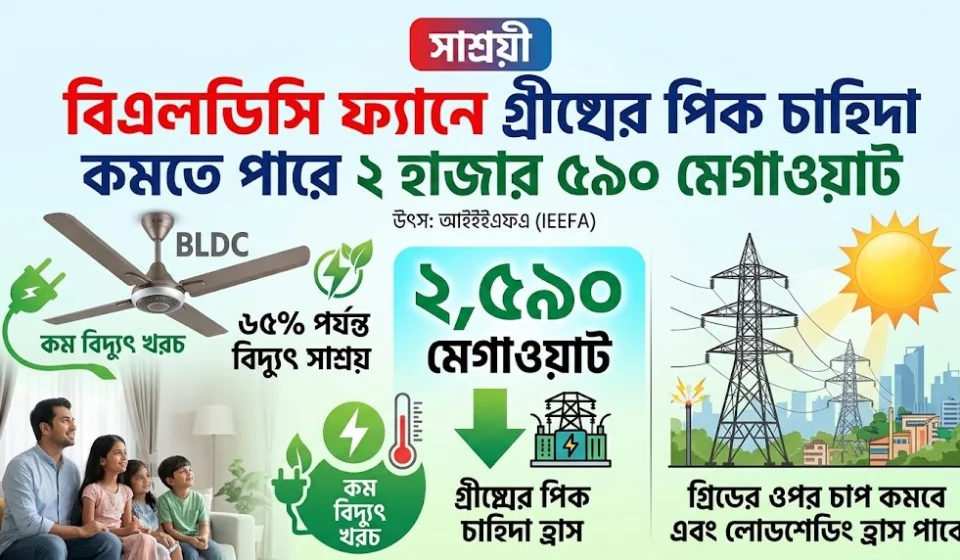
If energy-efficient ‘BLDC’ (brushless direct current) fans can be used instead of conventional fans, electricity demand at the summer peak could be reduced by as much as about 2,590 megawatts. In summer, running fans in the country’s households alone pushes up electricity demand by more than 5,000 megawatts.
This information has emerged from a research report by the US-based international research organisation ‘Institute for Energy Economics and Financial Analysis’ (IEEFA).
The report, titled ‘Household Space Cooling in Bangladesh: Role of Energy-Efficient Fans’ and published today (Monday), says the use of efficient fans would reduce pressure on the power sector and also avoid the need for about $4 billion in investment in new coal-fired power plants.
BLDC fans are a modern type of electric fan that run on a brushless DC motor instead of a conventional AC induction motor. They have no carbon brushes; the fan rotates with the help of permanent magnets and an electronic circuit board.
By IEEFA’s estimate, running fans to keep homes cool on summer nights — particularly at 9pm — creates an additional electricity demand of 5,212 megawatts in the country. The country’s highest (peak) electricity demand of 19,027 megawatts was recorded at 9pm on 27 August 2026.
Based on a survey of 435 households across 26 districts, the report shows that while ordinary fans consume 70 watts or more, BLDC fans need only 35 watts. Yet only 1.4 percent of all fans currently in use in the country use BLDC technology.
The report’s author and IEEFA lead energy analyst Shafiqul Alam said, ‘Various crises in global energy supply have made it difficult for the Bangladesh Power Development Board (PDB) to meet demand. Widespread use of BLDC fans will reduce electricity demand and ease the pressure on the PDB.’
The research says that if all ordinary fans could be replaced with BLDC fans, 6,913 gigawatt-hours of electricity could be saved annually, worth about Tk 89.87 billion (Tk 8,987 crore).
Although households are keen to cut their electricity bills, 75 percent of families do not even know such fans are available on the market. After being made aware, 96 percent of consumers showed interest in using BLDC fans, but their high price has become the main barrier.
While an ordinary fan now costs about Tk 2,000, a BLDC fan costs between Tk 5,000 and Tk 6,300.
The report says that about 40 percent of the country’s low-income households, with a monthly income below Tk 25,000, pay an average electricity bill of Tk 663 a month in summer. Without government support, it would take them 7.7 to 9.6 years to recover the extra cost of a BLDC fan (payback period).
To overcome this price problem, IEEFA has called on the government and relevant agencies to take seven specific steps:
1. National programme: Create a national programme to ensure efficient fans and form a ‘Super ESCO’ (Super ESCO) to implement it.
2. Public awareness: Encourage people by publicising information on electricity and cost savings.
3. Standards and labelling: Finalise fan standards and star labelling through the standards regulator SREDA (SREDA).
4. Bulk procurement and carbon revenue: Reduce production costs by procuring a large quantity (bulk) of fans at once through the government, and lower prices for low-income people by using international carbon revenue funds.
5. Easy financing: Introduce the option of paying the price in instalments with the electricity bill (on-bill financing).
6. Effective implementation: Roll out the programme quickly under the Super ESCO.
7. Quality assurance: Build strong mechanisms to monitor and control the quality of products entering the market.
Shafiqul Alam believes that if the price of BLDC fans can be brought down by drawing on international experience and through bulk procurement, the payback period for low-income households’ extra cost will fall to 4.8 years.
The report recommends prioritising rapid demand-reduction methods over long-term projects to tackle the ongoing crisis in the country’s energy sector.
Background
According to a forecast by the Power Grid Company of Bangladesh (PGCB), generation could be 14,317 megawatts against demand of 17,140 megawatts at 11pm on 28 August. This could push load-shedding to 2,695 megawatts — the Daily Observer reported this on that day. The newspaper also reported that daily load-shedding repeatedly exceeded 2,000 to 3,000 megawatts throughout August.
By the numbers
According to a 28 April 2025 report by Ittefaq’s English edition, the country’s installed generation capacity, including imported electricity, is about 26,900 megawatts. The same report said the national generation record at the time was 16,477 megawatts, set on 30 April 2024.
At a glance
The International Energy Agency (IEA) policy database says that under the Sustainable and Renewable Energy Development Authority’s (SREDA) ‘Standard and Labelling Regulation-2018’, there are provisions for introducing minimum energy efficiency standards and star labelling for ceiling fans, LED lights, ACs and refrigerators. When a standard for an appliance is declared mandatory, it is enforced by BSTI so that substandard appliances are not sold.
Sources
Original report: Ajker Patrika
Background sources: Daily Observer, 28 August 2026; Ittefaq (English), 28 April 2025; International Energy Agency (IEA), date not stated