



Photo: Collected
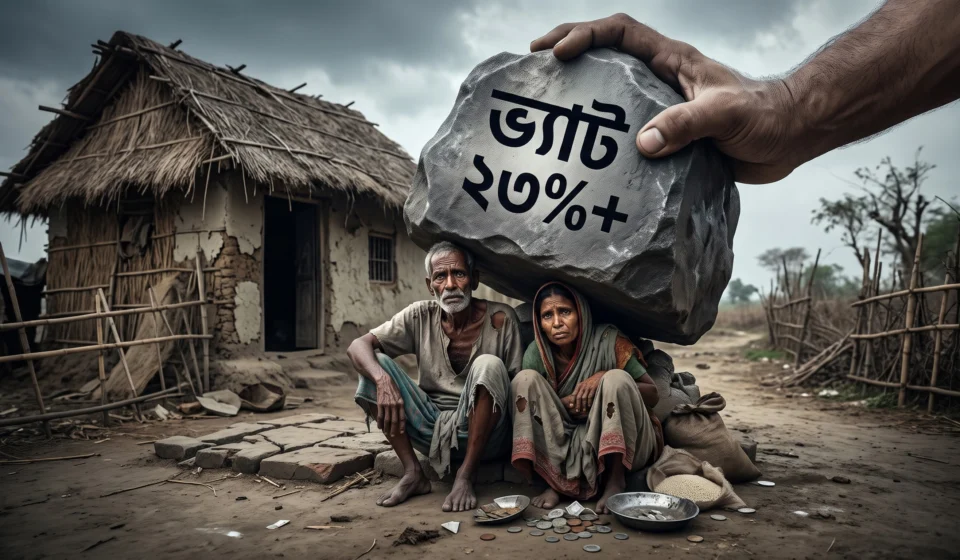
Measured against income, the poorest 10 percent of households in the country pay 20.37 percent to the state treasury as VAT. For the richest 10 percent, the rate is only 2.80 percent. That means the indirect tax, or VAT, burden on low-income people is seven times heavier than on the wealthy under the current tax structure. The picture comes from a study by the private research organisation RAPID.
The study, carried out with support from Friedrich-Ebert-Stiftung (FES) Bangladesh, is titled “Missing Revenue in Bangladesh: Tax Potential, Gaps and Distributional Consequences”. It was led by RAPID Chairman M A Razzaque. The findings were presented on Saturday at a discussion and publication event at a hotel. Finance Secretary Md Khairuzzaman Mozumder, NBR Member Syed Mushfiqur Rahman, PRI Chairman Zaidi Sattar, Dhaka University Professor Sayema Haque Bidisha and ERF President Doulot Akter attended the event.
The VAT pressure shows even more clearly when rural and urban areas are counted separately. Extreme-poor families in villages pay more than 23 percent of their income in VAT, while poor urban families pay 16.5 percent. Income tax works the other way round. Because they fall below the taxable income threshold, the poorest 70 percent of households pay almost no personal income tax. The richest 10 percent of households pay 11.03 percent of their income as personal income tax.
According to the study, the country’s top 10 percent of households by income hold more than 40 percent of total household income. At prevailing tax rates, more than 93 percent of potential personal income tax should come from this group.
The researchers also found a large shortfall in direct tax collection. Only 3.57 percent of the total labour force is registered as active income taxpayers. Among TIN holders, the return filing rate is 43.1 percent at the individual and other levels and 23.6 percent at the company level. Wealth distribution is also highly unequal. The wealthiest 1 percent of households own 47.4 percent of total net personal wealth, and the top 10 percent own 76.4 percent. The bottom half of households, by contrast, hold just 3.4 percent.
The study analysed data from fiscal year 2021-22. It found that uncollected personal income tax and domestic VAT that year amounted to 5.89 percent of GDP. Personal income tax had a potential of 4.85 percent of GDP, but only 0.98 percent was collected. Domestic VAT had a potential of 3.82 percent, while 1.80 percent was collected. According to RAPID, gaps in business registration, concealment of sales information and failure to deposit collected VAT into the state treasury are costing the government a large amount of revenue.
By RAPID’s estimate, the tax-to-GDP ratio could be raised from 7.3 percent to around 13.5 percent without imposing new taxes or raising tax rates. That would require proper enforcement of existing laws, wider tax coverage and an end to tax evasion. The researchers proposed broadening the income tax base with a focus on high earners, improving the VAT collection system, reviewing corporate tax exemptions and considering an inheritance tax. They also stressed modernising tax administration, removing harassment and corruption, and improving the quality of public spending.
RAPID Chairman M A Razzaque said, “Judging the success of revenue mobilisation solely by how much money has been collected is not enough.” In his view, how fair and transparent the tax system is, whether taxpayers can pay without harassment and whether people receive quality public services in return for their taxes matter just as much.
Background
Earlier studies have also found that VAT weighs more heavily on the poor. A joint survey by SUPRO and Oxfam Bangladesh found that 12.1 percent of the poor’s income goes to VAT, compared with 5.9 percent for the rich. The Financial Express reported the findings of that report, which was prepared on 18 June 2019. In an earlier study supported by the International Growth Centre (IGC), RAPID itself found that every 1 percentage point rise in the indirect tax burden increases poverty by 0.42 percent, The Daily Star reported.
The numbers
According to NBR Chairman Md Abdur Rahman Khan, the tax-to-GDP ratio was 7.4 percent in FY2023-24 and fell to 6.6 percent in FY2024-25. The calculation was made by the IMF and was not yet final at the time, The Business Standard reported on 26 August 2025. Independent Television reported on 14 July 2026 that the FY2025-26 target was 9.5 percent, but the actual ratio came to around 8 percent. An 11-member national task force led by Zaidi Sattar set a target of raising the ratio to 12 percent by 2030 and to 15-20 percent by 2035, though its report put the current ratio at around 10 percent, TBS reported. The figures differ between sources because the years and calculation methods differ.
At a glance
The NBR describes VAT, or value added tax, as an indirect tax that consumers pay through a registered person. At each stage, the tax applies only to the value added. The NBR’s own worked example uses a 15 percent rate. RAPID stands for Research and Policy Integration for Development. The Daily Star named Md Deen Islam, associate professor of economics at Dhaka University, as its research director.
Sources
Background sources: The Financial Express — https://thefinancialexpress.com.bd/print/bangladeshi-poor-bear-over-12pc-burden-of-vat-study-1625711611; The Daily Star — https://www.thedailystar.net/node/3557356; The Business Standard, 26 August 2025 — https://www.tbsnews.net/bangla/Economy/news-details-381926; Independent Television, 14 July 2026 — https://www.itvbd.com/economy/271064; TBS — https://www.tbsnews.net/bangla/node/445161; National Board of Revenue — https://nbr.gov.bd/faq/vat-faq/eng