


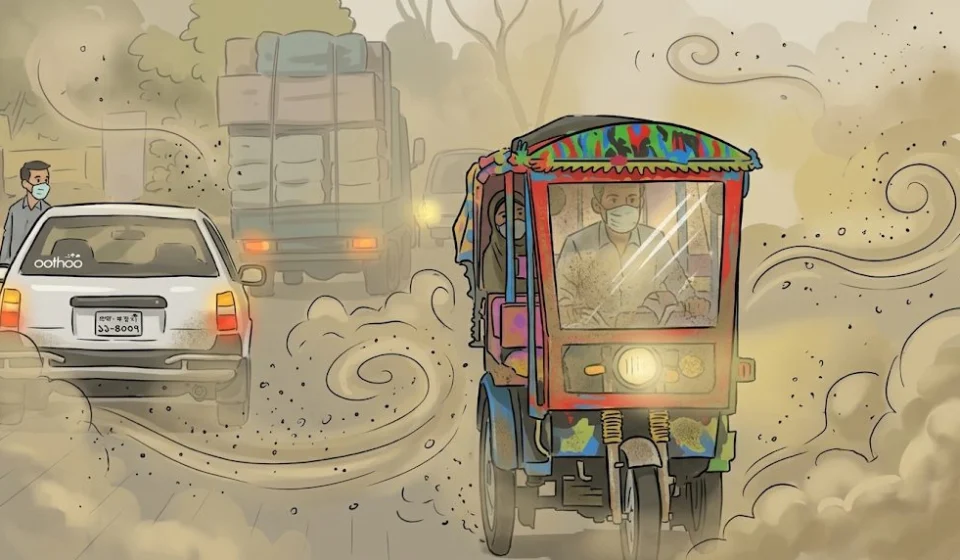
Dhaka second on IQAir list with score of 216; pollution at hazardous level in BIDS area

Photo: Collected
With the onset of winter, Dhaka’s air is in a dire state and pollution has risen sharply. In winter humidity in the air usually drops and pollution rises, making the air unhealthy.
The website of Switzerland-based air quality monitor IQAir showed on Wednesday (18 November) morning that Dhaka ranked second in the list of the world’s polluted cities.
In the organisation’s record for 8am to 9am, Dhaka’s Air Quality Index score was 216.
The real-time AQI station ranking shows pollution in some parts of Dhaka between ‘unhealthy for sensitive groups’ and ‘unhealthy’. The worst is the Bangladesh Institute of Development Studies (BIDS) area, with an IQAir score of 483, indicating hazardous air.
Other areas on the list are Gulshan’s BASE Edgewater Outdoor, Progoti Sarani, Bashundhara Residential Area, Becharam Dewri in Old Dhaka, Grace International School, Baridhara Park Road, Gulshan Lake Park, Eastern Housing and Baridhara Lakeside.
The main cause of Dhaka’s poor air is PM2.5, or fine particulate matter. These tiny particles, less than 2.5 micrometres in diameter, can penetrate deep into the lungs and enter the bloodstream. This significantly raises the risk of serious respiratory and cardiovascular illnesses such as worsening asthma, bronchitis and heart disease.
Winter weather patterns, uncontrolled emissions from vehicles and industry, dust from ongoing construction and nearby brick kilns are blamed for this pollution crisis.
The other cities in IQAir’s top five were Lahore in Pakistan (296, very unhealthy), Kolkata in India (199, unhealthy for all), Delhi in India (181, unhealthy for all) and Kathmandu in Nepal (179, unhealthy for all).
By global standards, air with an index below 50 is considered clean, and 51 to 100 moderate. Between 101 and 150 it is a caution level or unhealthy for sensitive people (children and the elderly), and 151 to 200 is unhealthy for all. An index of 201 to 300 is called very unhealthy, and above 300 the air is hazardous.
Many people die every year from health problems caused by air pollution. A study published in the British Medical Journal (BMJ) in November 2023 said air pollution from fossil fuels kills 52 lakh people worldwide every year.
According to the World Health Organization, the combined effects of household and ambient air pollution kill 67 lakh people a year.
As Dhaka’s air has been excessively polluted for a long time, the Ministry of Environment, Forest and Climate Change has advised everyone to wear masks when going out. Sensitive people have also been asked not to go out unless absolutely necessary.
Brick kiln and factory owners and the public have been asked to stop burning solid waste. They have also been asked to put up sheds and fencing at construction sites, keep construction materials covered, cover trucks or lorries while transporting materials, spray water around construction sites at least twice a day and keep old, smoke-emitting vehicles off the roads.
Highly sensitive groups: children, the elderly and patients with heart disease or breathing problems should best avoid all outdoor activity.
Ordinary healthy people: should limit time spent outdoors and avoid strenuous physical work.
If you must go out, be sure to use an effective mask against pollution.
Use an air purifier to keep indoor air clean, and keep windows and doors closed to stop polluted air coming in.
By the numbers
According to a Bangla Tribune report of 11 November, Dhaka ranked 25th on IQAir’s list that day with a score of 78, and the air was ‘moderate’.
By Khobor Sangjog’s count, exactly a year earlier, at 8am on 18 November 2025, Dhaka’s score was 101 and it ranked fifth among polluted cities.
Sources
Background sources: Bangla Tribune, 11 November 2026; Khobor Sangjog, 18 November 2025