

Second Padma bridge, elevated expressway, chord line: minister hopes for big change in communications in five years

Photo: Collected
Implementing important projects such as the second Padma bridge, the Dhaka-Chattogram elevated expressway and the Dhaka-Cumilla chord line over the next five years would bring a radical change to the country’s communication and infrastructure sector, Road, Railway and Shipping Minister Sheikh Rabiul Alam hopes. The government has taken steps to implement these communication projects.
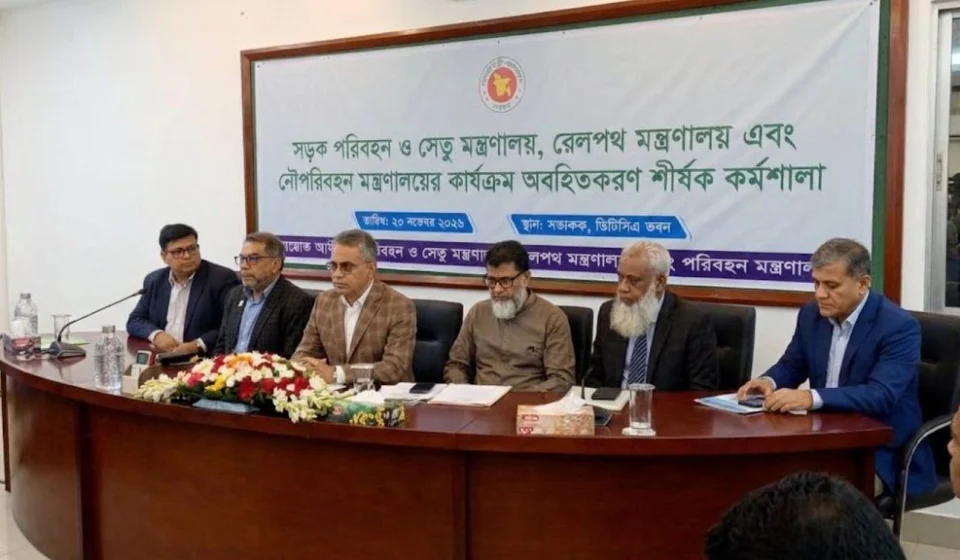
A workshop titled ‘Briefing on the activities of the Ministries of Road Transport and Bridges, Railways and Shipping’ was held at the conference room of the Dhaka Transport Coordination Authority (DTCA) today, Friday. Members of Reporters for Rail and Road (RRR) took part.
The minister said some of these important public projects are in preparation for implementation, some are undergoing feasibility studies and for some the development project proposal (DPP) is being prepared. A feasibility study on the second Padma bridge has begun, and work on its detailed design is also progressing.
The minister said three options have been worked on for the Dhaka-Chattogram elevated expressway. In his view, the second option — a partly elevated road instead of an elevated road along the entire route — seems cost-effective. A proposal will go to the prime minister; if this option is approved, work could begin within a year.
The road minister said there are plans to build the Dhaka-Cumilla chord line, worth about Tk 83,000 crore, entirely as an elevated route. This would require less land acquisition, reduce complications and allow faster implementation.
Sheikh Rabiul Alam explained that several institutional steps must be completed before a project is taken up and implemented. As a result, it takes one to one and a half years just to start work after a project is taken up, and another three to four years for implementation.
Noting that rail, waterway and road communication and bridge sector projects have been taken up in view of the government’s election manifesto and public importance, the minister said implementing them over the next five years would bring big changes to the communication sector.
He also urged journalists to publish news after verifying full information instead of fragmented information or speculation-based reports. According to the minister, the government’s faults, mistakes and deviations must certainly be highlighted; but alongside making an institution controversial, journalists should also play a role in correcting and developing it.
Minister of State for Road and Railways Habibur Rashid said responsible journalism is not confined to highlighting the government’s development activities. Journalists also have a role in ensuring the government’s transparency and accountability, exposing irregularities and improving the quality of services through constructive criticism. He said it is essential to refrain from publishing news without verification and spreading misinformation.
In the state minister’s words, a government elected by people’s votes is accountable to the people. The government is working to ensure sustainable development under the prime minister’s directions.
The day-long workshop had six sessions. Discussions covered the Public Procurement Act and Rules; Bangladesh’s integrated communication and transport system; progress, challenges and tasks in the road, bridge, rail and waterway sectors; and the government’s initiatives, achievements and future plans for building a modern communication system. Alongside an open discussion, a special ‘Ministers’ Session’ was held with the ministers. Officials, experts and participants gave their views at the various sessions.
RRR president Anwar Hossain, general secretary Tawhidul Islam and other members of the organisation attended the workshop. Also present were Railways Secretary Md Fahimul Islam, Bridges Division Secretary Mohammad Abdur Rouf, Road Transport and Highways Division Secretary Dr Mohammad Ziaul Haque and Shipping Secretary Md Ataur Rahman Khan.
Bangladesh Railway Director General Md Afzal Hossain, Roads and Highways Department Chief Engineer Md Moniruzzaman, Bangladesh Inland Water Transport Authority (BIWTA) Chairman Md Muhidul Islam and Bangladesh Bridge Authority Chief Engineer Md Abul Hossain were also there.
Also present were Roads and Highways Department Additional Chief Engineer and Road Safety Project Director Mohammad Sabbir Hasan Khan, Superintending Engineer Md Ahsan Habib and Professor Dr Md Asif Raihan of BUET’s Accident Research Institute.
Background
According to a bdnews24.com report on 3 November, Prime Minister Tarique Rahman has directed that feasibility studies for building one more bridge each over the Padma and Jamuna rivers be completed by next September and the related plans finalised; a Y-shaped second Padma bridge plan was discussed at the meeting.
Ittefaq reported on 11 May that Bridges Minister Sheikh Rabiul Alam said that day that the feasibility study for the second Padma bridge had been completed. Later, in an interview with Jugantor on 9 August, he said the study was being rechecked and no final decision had yet been taken on the bridge’s location.
By the numbers
Finance Minister Amir Khasru Mahmud Chowdhury told parliament on 24 June that Tk 4.5 crore had been allocated in the FY2026-27 budget for a feasibility study on the Paturia-Daulatdia second Padma bridge — BSS reported that day.
Sources
Original report: Ajker Patrika
Background sources: bdnews24.com, 3 November 2026; Ittefaq, 11 May 2026; Jugantor, 9 August 2026; BSS, 24 June 2026