
Photo: Collected
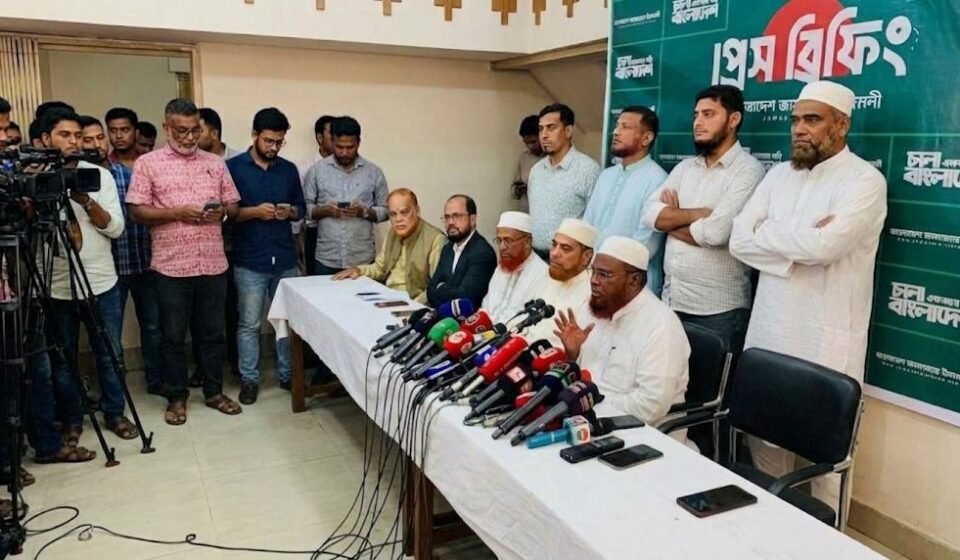
At a press conference held on Tuesday at the party’s central office in Maghbazar in the capital, Jamaat-e-Islami secretary general Mia Golam Parwar alleged that the government is not implementing the verdict of the referendum because it does not embrace July.
He described the BNP’s allegation that Jamaat does not embrace July as ‘laughable’. Golam Parwar said, ‘It is Jamaat-e-Islami that embraces July. Because the government does not embrace July, they are not implementing the verdict of the referendum.’
He alleged, ‘Because the government does not embrace July, they are installing party men in all constitutional institutions. Instead of implementing the July charter, they are installing men of Chhatra Dal and Jubo Dal in constitutional posts and in government, semi-government and autonomous institutions.’
The Jamaat leader also raised allegations about the public service commission. Noting that the government has recently laid hands on the commission, going outside the spirit of July, he said, ‘There they are inviting the PSC chairman and other members for tea and telling them to resign. Yet students of Dhaka University and various other educational institutions came out in the 2024 movement against this very politicisation.’
On the note of dissent, Golam Parwar said, ‘By standing firm on their note of dissent, the BNP has taken a position against reform of the state, which is fascist. Instead of reforming the constitution by forming a special committee of their own, they are going down the path of amendment. They could not accept dissent, they did not sacrifice.’
Noting that Jamaat itself had submitted five notes of dissent but had not stood firm on them, he said, ‘The BNP is sticking to its note of dissent in order to keep the structure of the state in a fascist mould. The way it is being kept without reforming the constitution, whoever becomes prime minister will be a fascist.’
Responding to the Prime Minister’s remarks about the opposition leader not attending the programme at Osmani Udyan, the Jamaat secretary general said, ‘Not mentioning his name in the invitation card for that programme was disrespectful. Yet the names of state ministers were mentioned on the card. According to the rules of precedence, he holds the rank of a full minister. But because he was not given due respect in the invitation, he did not attend the programme.’
He also alleged that when the opposition speaks out against injustice, the government labels it anti-July and tries to shift all blame onto the opposition in order to cover up its own ‘politicisation and failure’. Raising the question of why the opposition’s cooperation is needed to amend the constitution, Golam Parwar said, ‘The people have given the verdict for constitutional reform by casting nearly 70 percent of the vote in the referendum. Without carrying out reform, they want to amend the constitution by bypassing the people. At the same time, the government is misleading the people with untrue information on the question of constitutional reform.’ He strongly condemned this.
On fascism he said, ‘The people of Bangladesh learnt fascism by watching the Awami League. But Rizvi Saheb has forgotten it in just seven months. To recognise a fascist, one must go back to the people. Extortion, plunder and installing party men in government posts are the path of fascism. Ignoring the people’s verdict is the path of fascism. Not accepting the verdict of the referendum is the path of fascism.’
On past alliances, the senior Jamaat leader said, ‘We did not form any alliance with the Awami League. The way the four-party and twenty-party alliances were formed with the BNP. We carried out a movement with the Jatiya Party, the left parties and many others demanding implementation of the caretaker government formula prepared by Jamaat.’ He added that the BNP could not come to power in 1996 ‘because of its anti-people position’. It was because of the BNP that the Awami League came to power in 1996. At that time the people carried out a movement demanding a transparent election. The BNP held a Magura-style election. On coming to power it drove Chhatra Shibir out of the campuses. We did not walk with the Awami League. We carried out a movement together to win the people’s demands.’
Golam Parwar also alleged that opposition MPs are being deprived of the government’s allocations worth crores of taka. He said, ‘Unelected women MPs have been installed to act as policemen over elected MPs. This is the path of fascism. We strongly condemn and protest this incoherent conduct.’
Those present at the press conference included the party’s assistant secretaries general Rafiqul Islam Khan, Abdul Halim and Ehsanul Mahbub Zubair, central executive council members Md Abdur Rab and Matiur Rahman Akond, and many other central leaders.
Background
The referendum was held on the same day as the thirteenth parliamentary election. According to a BBC Bangla report, in that vote held on 12 February 2026, about 7 crore 77 lakh of the 12 crore 77 lakh registered voters cast their ballots — The Business Standard published this information on 16 February 2026.
The President had issued the July National Charter (Constitutional Reform) Implementation Order on 13 November 2025; implementation has three stages — the legal order, the referendum and then reform — The Business Standard reported this information, according to BBC Bangla.
The matter of the note of dissent is not new either. The same report said that the BNP and several other parties had submitted notes of dissent on a number of constitution-related proposals, and that analysts believe those proposals will not be implemented.
The numbers
By BBC Bangla’s count, about 4 crore 81 lakh ‘yes’ votes and about 2 crore 26 lakh ‘no’ votes were cast in the referendum; the report put the share of ‘yes’ votes at more than 60 percent — The Business Standard reported this on 16 February 2026. Barta Bazar’s report of 13 February 2026, on the other hand, put the share of ‘yes’ votes at 68.06 percent and turnout at 60.26 percent. The figures differ from source to source.
The July charter contains a total of 84 reform proposals, of which 47 relate to the constitution — this information appears in the BBC Bangla report published in The Business Standard.
At a glance
To implement the July charter, the newly elected members of parliament will simultaneously serve as members of the constitutional reform council, and the constitutional changes must be passed within 180 working days of the start of the new parliament’s first session — The Business Standard reported this on 16 February 2026. The proposals include reducing the prime minister’s powers, a limit of a maximum of 10 years for one person as prime minister, separating the posts of prime minister and party chief, and forming a bicameral parliament.
Sources
Background sources: The Business Standard (BBC Bangla), 16 February 2026; Barta Bazar, 13 February 2026, Ajker Patrika