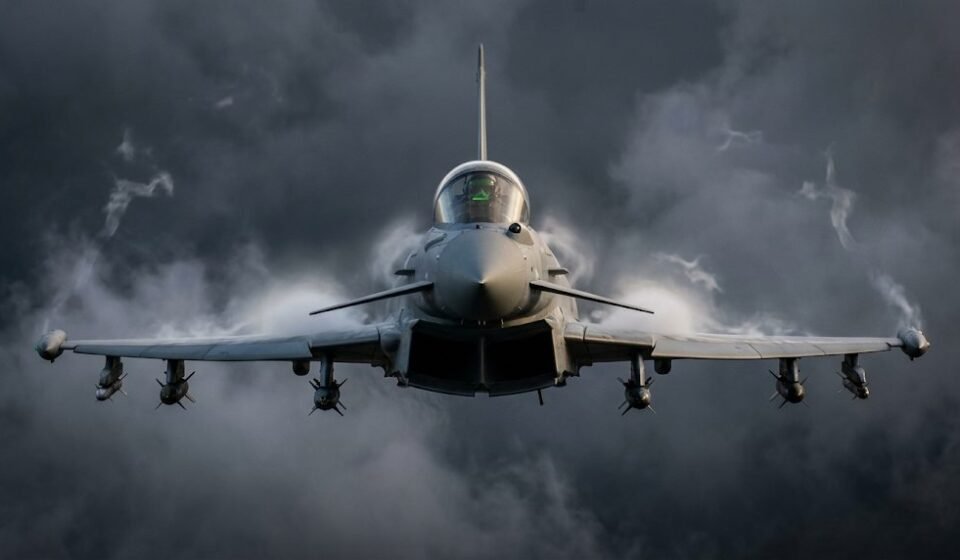
British Typhoons to guard Saudi skies, with transport aircraft and military advisers

Photo: Collected
The United Kingdom is to deploy Royal Air Force (RAF) Typhoon fighter jets to protect Saudi Arabia’s cities and important infrastructure from air attacks by Yemen’s Iran-backed Houthi rebels.
A government statement released on Tuesday (20 October) said British forces would carry out defensive air operations with Typhoon fighter jets to protect Saudi Arabia’s cities and critical national infrastructure.
The statement made clear that the fighter jets’ role would be purely defensive; no offensive strikes would be carried out against the Houthis.
The UK will also provide an Atlas A400M transport aircraft, capable of carrying heavy loads, to move military equipment within Saudi Arabia. In addition, British military advisers will work on the ground with Saudi military officials.
Britain had also announced additional defensive military support for Saudi Arabia last September after renewed Houthi attacks; that support included an RAF air-to-air refuelling aircraft. At that time, however, there was no mention of sending fighter jets.
Earlier still, last March, the British prime minister’s office announced that four fighter jets would be sent to the Middle East to protect regional allies from Iranian missile attacks. The new aircraft were to join four Typhoon fighter jets already deployed in Qatar, with the aim of further strengthening the defences of regional allies facing Iranian attacks.
Houthi attacks on Saudi Arabia have intensified in recent weeks. Yemeni authorities claim that 58 people were killed in an attack on a training camp of the government security forces on Monday.
This month more than a dozen people were killed in an attack on Riyadh airport and flight operations were disrupted. Amid the conflict, the Dhahran headquarters of the Saudi oil producer Saudi Aramco and an oil pipeline running from one end of the country to the other have also been attacked. Air raid warning sirens sounded in the capital Riyadh last night, an indication that the country’s security risk persists.
The UK Ministry of Defence said the Houthis’ attempts to create regional instability and undermine the security and stability of the Middle East are unacceptable; their conduct is deepening Yemen’s already dire humanitarian crisis.
The British Ministry of Defence also said that countering these Houthi activities is important to the United Kingdom’s national economic and security interests.
The ministry further said that if violence increases in the Gulf region it could have serious effects on the United Kingdom too — the cost of living could rise, fuel supplies could be disrupted and the costs of British businesses could go up. At the same time, Yemen’s civilian population is also suffering extensive losses because of the conflict.
Background
According to the British Ministry of Defence, the Typhoons will be in a defensive role and the support also includes extending air-to-air refuelling for Saudi air operations — Al Jazeera reported this on 20 October 2026. In the same report, British Defence Secretary Wes Streeting described the Houthi attacks as ‘utterly abhorrent’ and said the Typhoons would carry out defensive operations to protect Saudi airspace from drones and missiles.
On the attack on Aramco’s Dhahran facility, the news agency SPA, citing an official of the Saudi energy ministry, said the Houthis had targeted an administrative building there and that the authorities worked to bring the resulting fire under control; no one was killed or injured in the incident — Al Jazeera reported this on 13 October 2026.
The numbers
A detailed account of the casualties in the Riyadh airport attack is available in Al Jazeera’s report of 13 October 2026: at least 13 people were killed and more than three hundred injured in Saturday’s attack, and the following day, Sunday, one person was killed and 11 injured by a missile strike.
According to United Nations figures, at least 46 civilians have been killed and more than 130 injured in Yemen since last August — Al Jazeera reported this on 13 October 2026.
At a glance
The conflict is being waged from both sides. According to Al Jazeera’s report of 13 October 2026, explosions were reported at the central station of the Yemen Petroleum Company in the Al-Sabah area of Sanaa after the Saudi-led coalition ordered it to be vacated; coalition spokesman Turki al-Maliki alleged that the Houthis had been using the facility and its underground fuel depot to store missiles and drones.
Sources
Background sources: Al Jazeera, 20 October 2026; Al Jazeera, 13 October 2026, Ajker Patrika