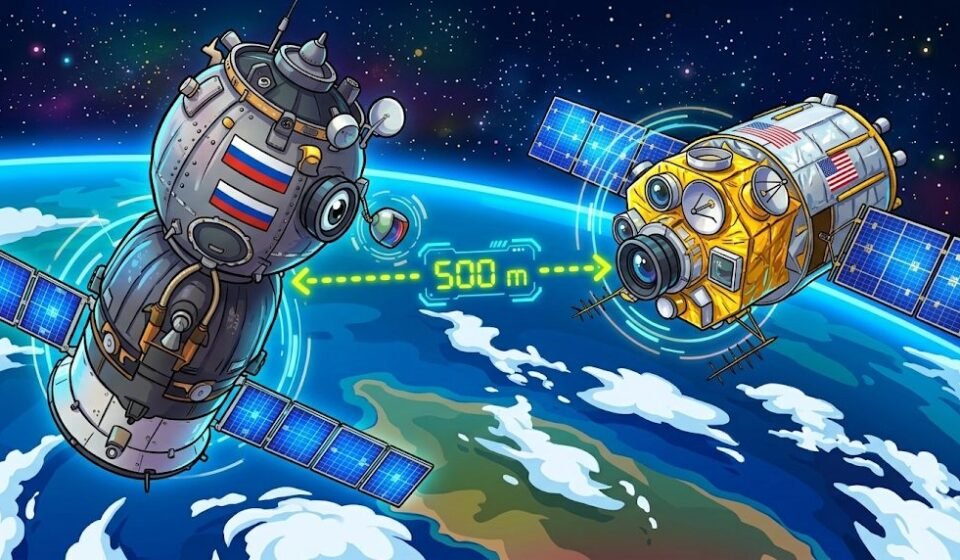
Russian satellite within 500 metres, US craft supplying information to Ukraine under surveillance

Photo: Collected
A military satellite built by Russia has come dangerously close to a commercial artificial satellite in space. The Russian spacecraft came within just 500 metres (a distance of less than a mile) of an observation satellite that provides military information support to Ukraine.
According to LeoLabs, the international space monitoring organisation, this rare and unwanted ‘manoeuvre’ by the Russian satellite has given rise to new concern over international space safety.
Astronomer and space researcher Jonathan McDowell has said on social media that although encounters between two craft in space, or their docking together, are normal, this is probably the first instance of another craft coming so close to another country’s satellite without prior permission.
No clear explanation has been obtained as to why the Russian satellite named ‘Cosmos 2612’ came so close to another commercial craft. Experts believe, however, that it could be part of surveillance over another satellite in space or of a ‘rendezvous and proximity operation’.
The satellite the Russian craft approached, ‘ICEYE-X36’, is operated by a multinational technology company named ‘ICEYE’. This particular satellite carries ‘synthetic aperture radar’ (SAR) technology, which is capable of taking extremely clear pictures of the earth in any weather, by day or by night.
Under an agreement between ICEYE and the Ukrainian government last January, this satellite fleet has been assisting the Ukrainian military with strategic information and surveillance.
The orbit monitoring organisation LeoLabs said in a statement released yesterday, Monday, that on 15 October the Russian ‘Cosmos 2612’ satellite began advancing towards ICEYE-X36 at very high speed. By the early hours of 16 October the gap had narrowed from a distance of 350 kilometres to less than five kilometres.
Over the weekend the Russian satellite checked its speed and maintained a very close position. It was later seen that it had come within just 500 metres (about 1,600 feet) of the ICEYE satellite.
LeoLabs has confirmed, however, that since yesterday the Russian satellite has begun moving away from ICEYE again.
According to a report by the United Kingdom-based research institution the Royal United Services Institute (RUSI), since last May four Russian military satellites had begun matching their own trajectories with ICEYE’s orbit.
LeoLabs said in its analysis that through manoeuvres of this kind it is possible to carry out surveillance over a hostile country’s satellite, to collect intelligence, to disrupt the sending of signals (jamming) or to prepare for some space attack in the future.
In the organisation’s view, although no directly hostile intent is proved by this incident, it does reveal a Russian capability that could be put to use in future strategic space operations.
RUSI believes this could be a tactic of intimidation or an attempt to disable the ICEYE satellite’s communication system by spreading radio frequency.
Confirming the incident, ICEYE said in a statement yesterday, ‘We are aware of the situation that has arisen and are monitoring it closely. Our network, or constellation infrastructure, has been built in such a way that services remain uninterrupted even in any adverse situation.’
For the sake of security, however, the company’s spokesperson was not willing to comment beyond this.
On the other hand, no statement or comment was immediately available from Russia’s defence ministry or the country’s space research agency ‘Roscosmos’ about carrying out this dangerous manoeuvre.
Background
Cosmos 2612 went into orbit in April this year as part of a group of six Russian satellites; according to COMSPOC’s analysis, several satellites of this group had gone close to ICEYE’s satellites as early as last May — Via Satellite provided this information on 19 October 2026.
ICEYE is essentially a Finland-based satellite operating company which also has operations in the United States, and the company operates a fleet of synthetic aperture radar (SAR) satellites — Via Satellite provided this information on 19 October 2026.
The numbers
The stages of the narrowing distance appear somewhat differently in Via Satellite’s report of 19 October 2026: on 15 October the gap came down from about 400 kilometres to about 210 kilometres, and on 16 October it reached 2 to 3 kilometres; over the next two days the craft changed position in front of and behind ICEYE-X36 and at times came within 500 metres. LeoLabs itself has said that these calculations may not be exact. There is a difference in the information between sources.
According to the same report, on 18 and 19 October the Russian craft began moving away and LeoLabs confirmed that the proximity activity had ended.
Sources
Main report: Ajker Patrika
Background source: Via Satellite, 19 October 2026