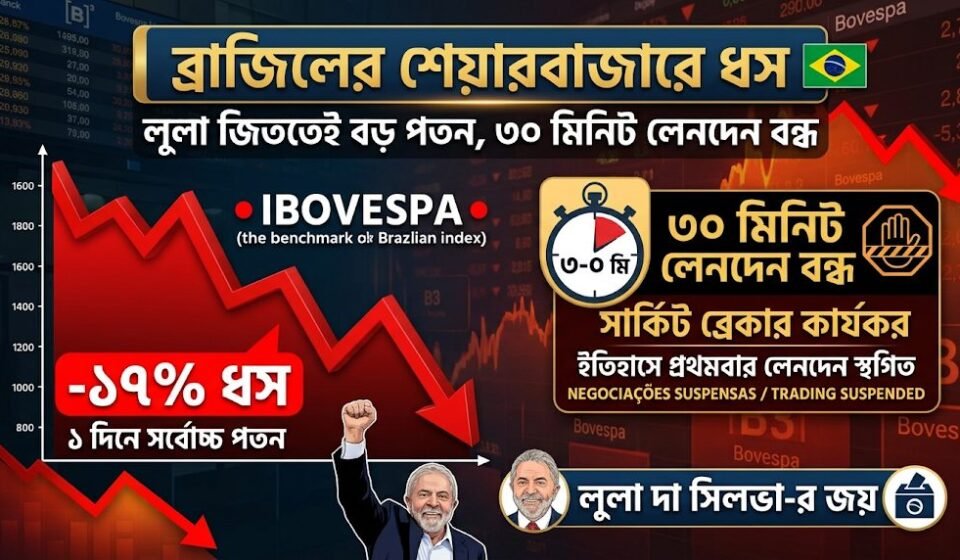
Brazil’s stock market plunges 17 percent after Lula win, trading halted for 30 minutes

Photo: Collected
Brazil’s stock market fell by nearly 17 percent at the start of trading on Monday after President Luiz Inacio Lula da Silva was re-elected.
Leftist leader Lula won 51.8 percent of the vote in the election, while his right-wing rival Flavio Bolsonaro took 48.2 percent. Flavio is the son of jailed former president Jair Bolsonaro.
News agency AFP reported this from Brasilia.
The steep fall in the Ibovespa index forced a 30-minute halt in trading. A statement said trading was suspended after a ‘circuit breaker’, kept for use during sharp market falls, was triggered. Meanwhile, the US dollar rose 12 percent against Brazil’s currency, the real.
The stock market had surged to a record high after Bolsonaro won the first round of the election earlier this month. Monday’s fall pushed share prices below even their pre-election levels.
Circuit breakers were previously activated to stem major market falls during the US subprime mortgage crisis in 2008 and the coronavirus pandemic in 2020.
Lula is now in the final stretch of his third term. During this period, employment in the country has hit a record and inflation is under control. However, public spending has risen and the debt burden is growing.
Brazilians are complaining about falling purchasing power, while the authorities are concerned about rising household debt.
To tackle rising prices, Brazil still has one of the highest policy interest rates in the world.
Background
In the first round of Brazil’s election on 4 October, Flavio Bolsonaro received 47.03 percent of the vote and Lula 45.16 percent, according to results from Brazil’s electoral court (TSE), The Rio Times reported on 5 October.
According to a Trading Economics report on 5 October, share prices rose after Bolsonaro outperformed most polls in the first round and the market saw him as more fiscally restrained.
By the numbers
According to a report in The Rio Times on 5 October, the Ibovespa rose 7.70 percent that day to close at a record 206,911.89 points, the first time the index ended a session above 200,000 points.
Brazil’s central bank cut its policy interest rate (Selic) from 14.5 percent to 14.25 percent on 17 June, Radio Itatiaia reported that day.
At a glance
Selic is the Brazilian central bank’s key policy interest rate, set by the bank’s monetary policy committee, Copom, according to a 17 June report by Radio Itatiaia.
Sources
Original report: BSS
Background sources: The Rio Times, 5 October 2026; Trading Economics, 5 October 2026; Radio Itatiaia, 17 June 2026