

Third languages including Japanese in schools, 150 beds at upazila hospitals, 1 lakh health workers — PM shares plans with expatriates

Photo: Collected
Prime Minister Tarique Rahman has called on everyone, whether at home or abroad, to work together from their own positions for the country’s development and the welfare of its people. In his view, if Bangladesh can be turned into a developed country, all Bangladeshis at home and abroad will benefit.
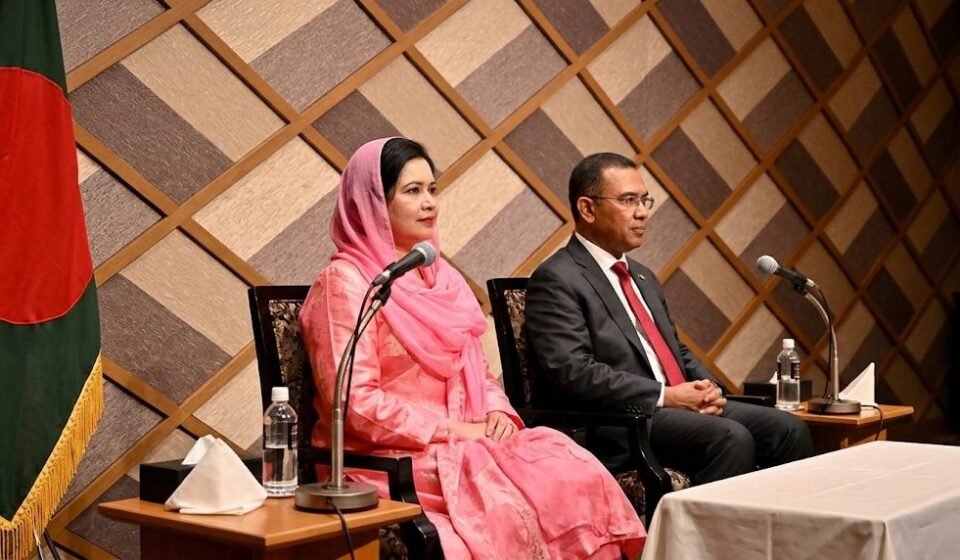
Speaking at a views-exchange meeting with members of the Bangladeshi expatriate community in Japan at the New Otani Hotel in Tokyo this evening, he said, ‘Our first plan is to do something good for the country. Whether we live at home or abroad, wherever we are, if any work of ours can do good for the country and its people, we must try to do it.’ The expatriates asked questions about various problems they face; in reply, the prime minister outlined plans on education, healthcare, building a skilled workforce and increasing Bangladeshis’ participation in Japan’s labour market. His wife, Dr Zubaida Rahman, was with him.
A third language in schools
The prime minister said the government is focusing on the foundation of primary education to strengthen the education system. He said, ‘In addition, to expand students’ employment and higher education opportunities, there is a plan to introduce the opportunity to learn a third language alongside English.’ In his words, ‘There will be opportunities to learn several foreign languages, including Japanese, German, French and others. Students will be able to choose one language according to their preference.’ Saying work on drawing up the plan has begun, he said, ‘We expect to start teaching several foreign languages, including Japanese, in schools from next year.’
The government wants to give students opportunities for sports, arts and cultural activities rather than keeping them confined to textbooks; technical and vocational education will also be emphasised. In the prime minister’s view, if they are skilled in sports and culture as well as foreign languages, they will have an added advantage in higher education and jobs at home and abroad.
150 beds at upazilas, 1 lakh health workers
Replying to a question on Japanese cooperation in health and technology, he said improving the quality of healthcare is a major priority of the government, especially for ordinary people in villages, women and children. Upazila hospitals now have 50 beds each; there is a plan to raise this to 150 over the next five years. Steps will also be taken to introduce dialysis at upazilas and expand specialised services for women and children, so that village people do not have to rush to district or divisional towns for advanced treatment. In his view, strengthening services at the grassroots will ease crowding at large hospitals and also make treatment of critically ill patients easier.
The prime minister spoke of a plan to recruit 1 lakh health workers at village level to emphasise prevention as well as cure. He said, ‘It has been planned that at least 80 per cent of the proposed health workers will be women. They will go door to door to make people aware of healthy living, nutrition, and prevention of diabetes, heart disease and high blood pressure.’ He believes that if people get used to healthy living, illness will decline and pressure on the health system will also ease.
Japan’s labour market
Asked about the language skills and job prospects of Bangladeshi workers in Japan, the prime minister said a skilled workforce is needed to consolidate Bangladesh’s position in the labour market there. ‘Efforts will be made to send workers with proper training, Japanese language education and an understanding of the country’s culture. This will make it possible to maintain the acceptability of Bangladeshi workers in Japan’s labour market in the long term.’
On putting Japanese-speaking expatriates to work in the country, he said they too must be interested. Even though a notice was issued to recruit Japanese language teachers, fewer applications came in than expected. His advice: ‘If expatriates skilled in Japanese contact the education ministry or the Ministry of Expatriates’ Welfare and Overseas Employment, ways of taking possible initiatives on this could be explored.’
In closing, he said, ‘Even though they live abroad, everyone is a citizen of Bangladesh and each has the opportunity to play a role in the country’s development.’ He remarked that collective efforts are needed to boost the economy, education, health and workforce skills. Party leaders and activists were present at the meeting, presided over by Japan BNP president Mir Rezaul Karim Reza.
Sources
Original report: BSS