


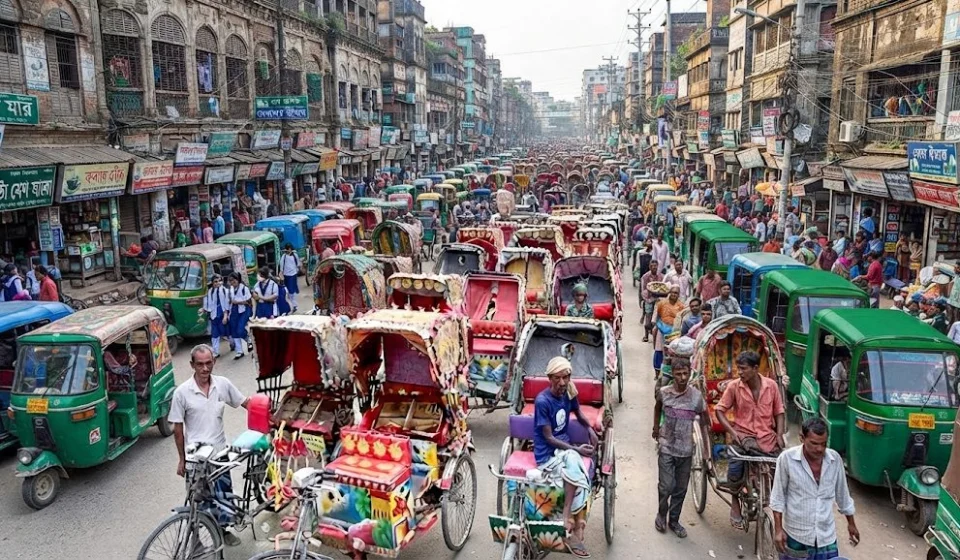
Registration fee Tk 8,000-10,000, speed 25km per hour: new rules for auto-rickshaws in city areas

Photo: Collected
The government has made new rules to regulate battery-run three-wheeler auto-rickshaws in city corporation areas. Various aspects of the rules were presented at a press conference at the Ministry of Local Government on Sunday (1 November).
The press conference was told that the rules were made under the powers given by section 120 of the Local Government (City Corporation) Act, 2009. Their aim is to restore order on the roads, ensure passenger safety and stop illegal charging and auto-rickshaws running anywhere and everywhere.
Under the ‘Three-Wheeler Low-Speed Battery-Run Auto-Rickshaw Operation Rules, 2026 for City Corporation Areas’, no auto-rickshaw will run on the roads from now on without registration and renewal. The rules set registration and renewal fees, a speed limit and specific restrictions on movement. Provision has also been made to register a maximum of five auto-rickshaws against one national identity card.
The one-time registration fee for a two-passenger e-rickshaw has been set at Tk 8,000, with an annual renewal fee of Tk 4,000. For a four-passenger e-rickshaw, the registration fee is Tk 10,000 and the annual renewal fee Tk 5,000.
In addition, Tk 1,000 must be paid for the fitness certificate of each auto-rickshaw. No auto-rickshaw will be able to run on the roads without registration or renewal.
A person will be able to register a maximum of five auto-rickshaws with his or her own national identity card. Each registered auto-rickshaw must have a separate number plate with a QR code. The plate must be fixed in a visible place so that it can be easily identified.
The rules set the economic lifetime of an auto-rickshaw at 12 years. Once this period is over, the registration of the auto-rickshaw concerned will be cancelled automatically.
With passenger safety in mind, the maximum speed has been fixed at 25 kilometres per hour. In areas near schools, hospitals, places of worship and crowded areas, this limit must be further reduced to a maximum of 15 kilometres per hour.
Where auto-rickshaws cannot run has also been made clear. These vehicles are completely banned on national highways, expressways, elevated expressways, main bus routes and footpaths. Nor will they be able to run on roads that the administration declares off-limits to auto-rickshaws.
An auto-rickshaw registered in one city corporation cannot be run for commercial purposes in another city corporation area. That means it must follow the restrictions of the city corporation area where it is registered if it is to be run commercially.
Background
According to an Ittefaq report on 13 August, the Local Government Division issued the ‘Three-Wheeler Low-Speed Battery-Run Rickshaw (E-Rickshaw) Operation Rules, 2025 for City Corporation Areas’ on 14 December 2025 to regulate e-rickshaws in city corporation areas, and they were published in the gazette on 17 December. Later, the relevant sections and schedule of the ‘Local Government (City Corporation) (Amendment) Act, 2026’ were amended to create scope for registration and issuing driving licences.
Desh Rupantor reported on 30 August that preparations were then under way to send the draft rules on e-rickshaw management to the Ministry of Law for final legal vetting.
Sources
Original report: Ajker Patrika
Background sources: Ittefaq, 13 August 2026; Desh Rupantor, 30 August 2026