



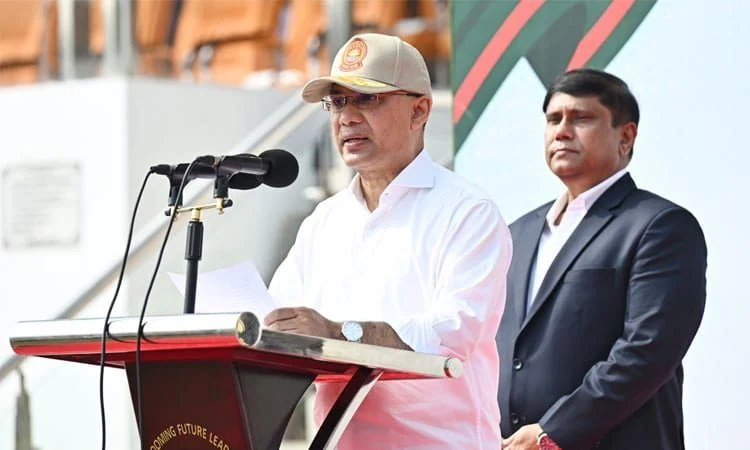

Photo: Collected
Prime Minister Tarique Rahman has set out as this year’s main pledge of 7 November that no one in future should be able to turn Bangladesh into a client state by taking away the country’s independence and sovereignty and the people’s rights.
He spoke of the need for national unity to implement this pledge. In the prime minister’s words, ‘To strengthen national unity in Bangladesh’s socio-economic, geographical and political reality, the spirit of the sepoy-people revolution must be embraced wholeheartedly.’
He made the remarks as chief guest at a programme held at the Army Stadium in Banani in the capital today, Saturday, marking the historic 7 November National Revolution and Solidarity Day.
The prime minister said the 1971 Liberation War, the sepoy-people revolution of 7 November 1975, the anti-autocracy movement of 1990 and the anti-fascist mass uprising of 2024 – each historic event has proved that the people of this country have never compromised on national interest, independence and sovereignty; for them, Bangladesh is above everything.
He described 7 November as a day of deep significance and pride for patriotic, freedom-loving and democracy-loving people. According to him, on this day in 1975 patriotic sepoys and people united to foil the conspiracy against Bangladesh’s independence and sovereignty.
The prime minister said, ‘In the first week of November 1975, conspiracies and plots against Bangladesh reached an extreme. As a continuation of this, on the night of 3 November the then army chief Lieutenant General Ziaur Rahman was placed under house arrest with his family.’ The sepoys and people together resisted the conspiracy against the country’s interests that began with the declarer of independence held captive.
Those who wanted to turn Bangladesh into a client state, impose one-party rule by taking away people’s democratic and political rights and trample the glory and dignity of the armed forces were defeated through the historic revolution of 7 November 1975, the prime minister remarked.
But the conspiracy of the defeated evil forces did not stop, he noted. According to the prime minister, they later organised in various ways and turned the country into a client state again. The glory and dignity of the armed forces were undermined through the planned killing of army officers at Pilkhana, and fascist rule was established in the country by taking away people’s democratic and political rights.
With the sacrifice of thousands of people, those evil forces were defeated in the bloody student-people mass uprising of 2024 and the country became free of fascism, he said. The prime minister paid deep respect to the contributions of all those killed and injured in the long anti-fascist movement and those martyred and injured in the 2024 mass uprising.
He said, ‘The 1971 war was a war to achieve independence, and 2024 was a fight to protect the independence of the country and the people.’ In his view, just as people from all walks of life took to the streets on 5 August 2024, sepoys and people likewise united on 7 November 1975 to foil the conspiracy against independence and sovereignty.
Remarking that time has proved that 7 November 1975 was the day that set Bangladesh’s future course, the prime minister said that every time the country drifted from the spirit of 7 November, independence and the people’s sovereignty came under threat.
Tarique Rahman said, ‘Regardless of party, religion or colour – Muslim, Hindu, Buddhist, Christian or small ethnic group – all citizens of this country have one proud identity: we are Bangladeshi.’ Noting that this identity has united the nation, he said the historic 7 November strengthened the foundation of Bangladeshi nationalism; as long as Bangladesh exists, the importance and significance of the united sepoy-people revolution will remain relevant.
Paying deep respect to martyred President Ziaur Rahman, the prime minister said that just as he stood for the country’s independence and sovereignty on 7 November 1975, he had likewise declared independence in 1971 and fought face to face on the battlefield.
Addressing the young generation, he said, ‘A nation’s history is not merely a recollection of the past; true history inspires a nation’s identity, self-respect and the building of a shared future.’ As a special feature of today’s event, he noted that thousands of teenagers and young people had presented Bangladesh’s historical background centred on 7 November.
If the new generation stays united, inspired by 7 November, Bangladesh will not lose its way again, the prime minister remarked. In his view, the unity of a country’s people cannot be firm if its young generation is not inspired by nationalism.
Describing the achievement of independence as a historic glory, he said it is every generation’s duty to keep the flag of that glory flying high and make independence meaningful. The duty of the young in particular is to embrace the core spirit of independence and devote themselves to building a safe, prosperous, humane and dignified Bangladesh.
Stressing the need, as guardians, to ensure an environment in which all the potential of the young can flourish, the prime minister said, ‘The present government is committed to building a prosperous future.’
Calling on the people of the country, he said that on this historic day of the sepoy-people revolution, the cry of patriotic and democracy-loving people should be – ‘Not Delhi, not Pindi, not anyone else, Bangladesh first’.
The prime minister thanked and congratulated the National Revolution and Solidarity Day-2026 celebration committee, the Ministry of Defence, the Armed Forces Division, the Bangladesh Army, the Bangladesh National Cadet Corps (BNCC), Bangladesh Scouts and, above all, the people of the country for the event.
A historical documentary was screened at the start of the event to mark the day. BNP Chairman and Prime Minister Tarique Rahman watched a special display organised for the day.
The display, organised under the direction of the Ministry of Defence and the supervision of the armed forces, featured 3,000 cadets of the Bangladesh National Cadet Corps (BNCC) and 500 members of Bangladesh Scouts.
Present at the event were the prime minister’s wife Dr Zubaida Rahman, advisers, members of parliament, representatives of various diplomatic missions, the chiefs of the three services, military and civil officials, students representing present and future generations, young people, BNCC and Scouts members and invited guests.
Background
On 5 October, a cabinet meeting chaired by Prime Minister Tarique Rahman approved a general holiday every year on 7 November, ‘National Revolution and Solidarity Day’; it also decided that day to list the day as a ‘Ka’ category day in the Cabinet Division’s circular, bdnews24.com reported on 5 October. The Ministry of Public Administration issued a gazette notification on this on 7 October, according to a Dhaka Times report that day.
Sources
Original report: BSS
Background sources: bdnews24.com, 5 October 2026; Dhaka Times, 7 October 2026