



11 parties form ‘constitution reform implementation council’ to step up pressure over July Charter

Photo: Collected
• A decision in principle has been taken to form a constitution reform implementation council.
• The council will include parties that signed the July Charter, eminent citizens and professionals.
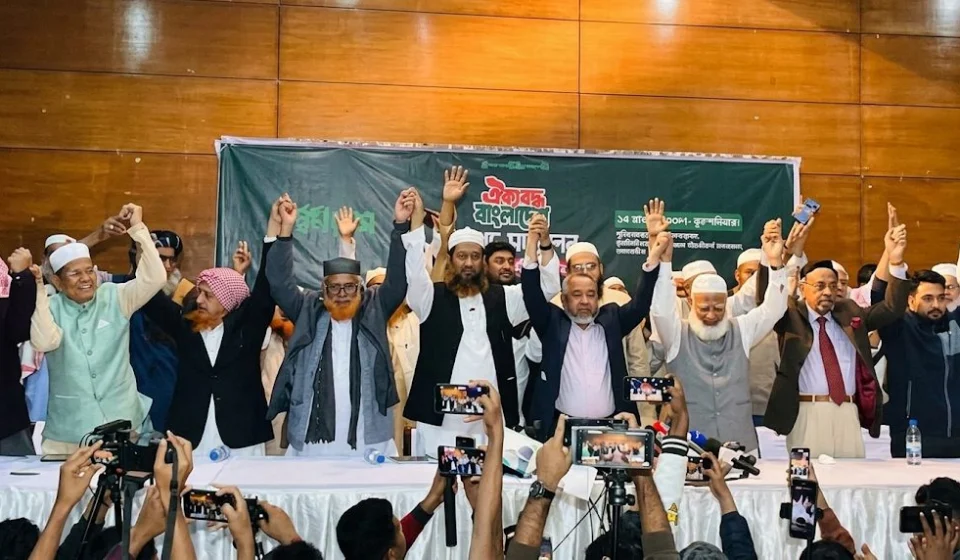
Despite holding seminars, demonstrations and long marches over the past few months, the 11-party alliance led by the parliamentary opposition Jamaat-e-Islami has seen no visible move by the government to meet its demands. The alliance, which has been campaigning for implementation of the July National Charter and enforcement of the referendum verdict among other demands, is therefore set to change tactics to broaden its movement. It wants to build a wider unity beyond its own political circle, bringing in parties that signed the July Charter, eminent citizens and professionals. To that end, an initiative has been taken to form a special committee named the ‘Constitution Reform Implementation Council’, and preparations are also under way for a grand rally in Dhaka in future.
Senior alliance leaders argue that there is no alternative to a broader political and civic movement to increase pressure on the government. Only by building a big movement can pressure be increased. And if professionals and eminent citizens join, there will also be an opportunity to build public opinion in favour of reform.
Several alliance sources said the council is being formed to build public opinion across the wider political and civic sphere for implementing constitutional reform and the referendum verdict. The number of members has not yet been finalised; initially there is talk of 10 to 15. Of these, there are plans to include three or four from Jamaat-e-Islami and one representative from each of the alliance’s other partners. Political leaders outside parliament as well as MPs may get places on the committee. However, no final decision has yet been taken on these matters.
Jamaat-e-Islami Assistant Secretary General Ehsanul Mahbub Zubair told Ajker Patrika that a decision in principle has been taken on behalf of the 11 parties to form the council and determine its tasks and overall approach. The liaison committee is due to meet within a day or two; a proposal will be prepared there and submitted to the top leaders.
In his words, ‘This initiative has been taken on behalf of the 11 parties. One section of political parties is with the government, and some parties are in a middle position. We will talk to those in the middle on this issue too. There will also be discussions with other stakeholders. Since the government is not moving towards implementation, 180 days are passing, the session is on the 9th. So we will discuss with everyone what the alternative could be.’
Senior alliance leaders said that, as a first step, the names of committee members and its terms of reference are being determined. After the decision in principle at the top leaders’ meeting, the liaison committee was tasked with preparing the proposal. The top leaders will review it and give final approval, after which the committee and its action plan will be announced at a press conference. There have been preliminary discussions about holding the press conference at the National Press Club in the capital.
Mostafizur Rahman Iran, chairman of the Bangladesh Labour Party, one of the alliance partners, said, ‘It was decided at the top leaders’ meeting that we would form such a committee. We were asked to make recommendations or decisions on the committee’s activities, what programmes can be taken and what needs to be done. In that light, a draft of names, the number of members and a list of who could be included are being prepared. This will be presented to the Jamaat ameer for his observations.’
The 11-party alliance does not want to confine the work to the main council alone. Alliance sources said there are also plans to form several sub-committees of professionals and experts. The sub-committees will gather expert opinions and recommendations on various aspects of constitutional reform and bring them to the main council. There will also be discussions with July Charter signatory parties outside the 11-party alliance. There are also plans to bring in parties and leaders who took part in the National Consensus Commission’s discussions. However, it has not yet been decided whether they will be on the main committee or join as stakeholders in the discussions.
Meanwhile, the fourth session of the 13th Jatiya Sangsad begins today (Monday). Jamaat-e-Islami is preparing to propose discussion of various issues in this session, including implementation of the July Charter. The party will also seek an update on what steps the government has taken to implement the referendum verdict.
Jamaat’s parliamentary party spokesperson Najibur Rahman told journalists yesterday (Sunday), ‘We want the government to give an update in this session on what it is doing about implementing the July Charter. But it seems there is nothing like that on their agenda. From what I hear, it will be a session just to fulfil the formality.’
At a recent event, Jamaat-e-Islami ameer Shafiqur Rahman said the people have voted in the referendum in favour of constitutional reform; attempting to go a different way in the name of amending the constitution without properly carrying out that reform is unacceptable. He called for implementation of the July Charter and the referendum verdict, keeping the pledge made to the people.
The government, however, wants to resolve all issues, including implementation of the July Charter, through discussion in parliament. Calling on the opposition to come to parliament for discussion, Chief Whip Nurul Islam Moni told journalists yesterday, ‘The prime minister has said we want to solve all the problems of this country on the basis of consensus and are bringing all problems to parliament to solve them.’
Background
According to a bdnews24.com report on 13 February, a referendum on implementing the July Charter was held on 12 February, the same day as the 13th Jatiya Sangsad election; turnout in the referendum was 60.26 per cent.
By the numbers
According to the Election Commission’s revised gazette, 4,72,25,980 ‘yes’ votes and 2,19,60,231 ‘no’ votes were cast in that referendum — BSS reported this on 26 February.
Sources
Original report: Ajker Patrika
Background sources: bdnews24.com, 13 February 2026; BSS, 26 February 2026