


Duchess of Edinburgh Sophie visits Rohingya camp factory that makes 15,000 bars of soap a day

Photo: Collected
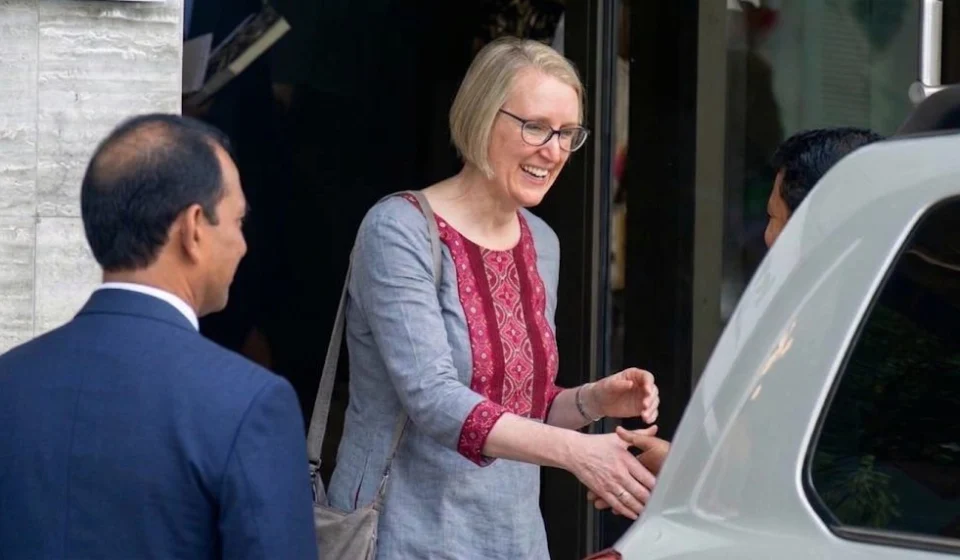
Sophie Helen Rhys-Jones, the Duchess of Edinburgh and a member of the British royal family, has visited Rohingya camps in Ukhiya, Cox’s Bazar. From Tuesday morning to the afternoon, she saw various programmes on protection, education, employment and humanitarian assistance for Rohingya women, children and people with disabilities. Sophie also spoke with representatives of organisations working to improve the lives of the Rohingya.
Sophie, wife of Prince Edward, the younger brother of King Charles III of the United Kingdom, first went in the morning to a CODEC school funded by UNICEF in Camp 18 in Ukhiya. She later inspected various activities in Camps 20, 4 and 5.
Around 12 noon, she and her entourage reached Block A-5 of Camp 20. The PHALS soap factory runs there, funded by the International Organization for Migration and run on the initiative of PULSE.
Sophie looked round the factory’s safety arrangements, the soap-making stages and the production process. The factory makes laundry and bathing soap for use by Rohingya refugees. She was briefed on the automated process from mixing raw materials to making, cutting and finishing the soap for use. She also heard about the employment, technical skills and opportunities for self-reliance of the Rohingya and local men and women working at the factory.
Sophie was also shown how chemical testers check the soap to maintain its quality. The factory produces about 15,000 bars of soap every day, which are supplied through the International Organization for Migration for free distribution among Rohingya refugees.
Officials of the Cox’s Bazar Refugee Relief and Repatriation Commissioner’s office said Sophie and her delegation left for Camp 4 at around 12:30pm. The itinerary included visits to a protection centre for women and children, a multipurpose service centre for women and support programmes for women and children with disabilities. Through these, Sophie got an idea of initiatives for refugees’ education, health, protection and improvement of living standards.
Mohammad Siraj Amin, commander of 14 Armed Police Battalion and additional deputy inspector general of police, said security had been tightened in and around the Rohingya camps for the visit.
Cox’s Bazar Refugee Relief and Repatriation Commissioner Mohammad Mizanur Rahman said, ‘Various local and foreign organisations are working on protection, education and humanitarian assistance for women, children and persons with disabilities in the Rohingya camps. During the visit, the Duchess saw these activities first-hand. In particular, she inspected the initiatives for the protection of women and children and for improving their living standards.’
On a three-day visit, Sophie and her entourage flew from Dhaka to Cox’s Bazar on Monday evening. After staying there overnight and touring the camps throughout Tuesday, they returned to Dhaka in the afternoon.
Sophie came to Bangladesh at the request of the UK’s Foreign, Commonwealth and Development Office. She had also visited Bangladesh in 2017.
By the numbers
According to the UN refugee agency UNHCR, the number of Rohingya refugees in Cox’s Bazar stood at 1,184,864 as of 28 February 2026, up from 1,006,107 at the same time a year earlier, Myanmar-based outlet BNI published in March.
District angle
According to UNHCR UK, most Rohingya in Cox’s Bazar live in 33 camps spread over 23.6 square kilometres, with a population density of about 46,000 people per square kilometre.
Sources
Original report: Ajker Patrika
Background sources: BNI Online, March 2026; UNHCR UK, 2026