



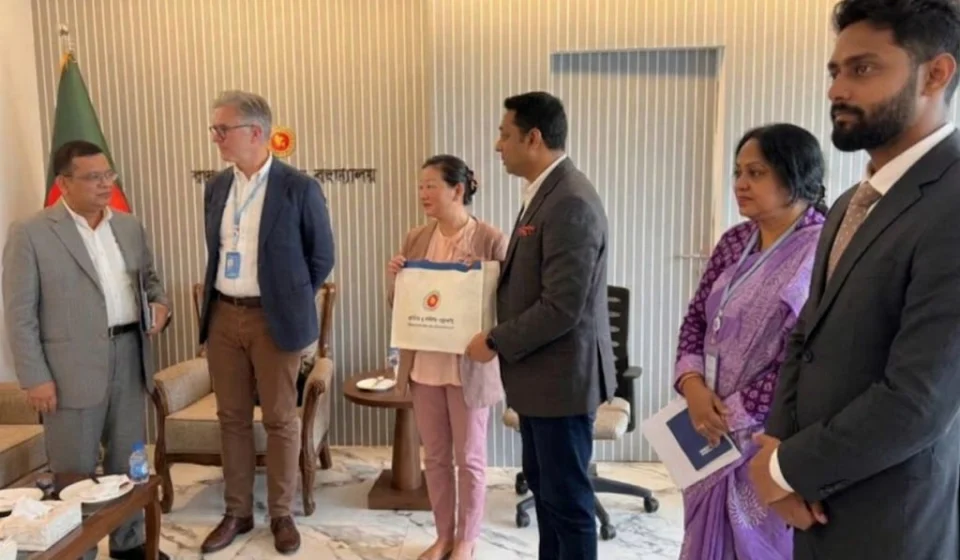

Photo: Collected
The school feeding programme in government primary schools will not be halted. The government is keeping it running while exploring more effective alternative methods of supplying food in future. The aim of the programme is to ensure students’ nutrition and increase their participation in school, said State Minister for Primary and Mass Education Bobby Hajjaj.
He said this when a delegation of the World Food Programme (WFP) paid a courtesy call on the state minister at his office in the Secretariat on Thursday. The delegation was led by Coco Ushiyama, WFP Bangladesh Resident Representative and Country Director.
In his words, ‘At present, around 30 lakh students are being given food every day under school feeding. The government’s priority is to ensure the nutritional value, safety, quality and accountability of the food without causing any disruption to this large programme.’
The state minister said the government is also working on models beyond the existing system, such as coupon-based food supply and serving cooked meals. However, before introducing any new method, a feasibility study, pilot implementation and evaluation of its effectiveness are essential. Preparing such an initiative fully could take anywhere from six months to a year. He therefore believes it would not be practical to suspend the ongoing programme while alternatives are being assessed. In his view, future plans must move forward by making necessary improvements to the current method while maintaining continuity.
Bobby Hajjaj said eight of the programme’s 26 procurement packages have expired. The government is looking into whether the existing tenders for these can be extended, and steps are also being taken to invite fresh tenders later. Emphasis is also being placed on further strengthening food safety, quality, nutritional value, transport and storage, and monitoring and accountability in the current supply system.
The state minister remarked that international experience and successful models from different countries need to be reviewed to make the programme more effective and sustainable. For providing cooked meals, the potential of central kitchens, community-based management and local partnerships could be examined. However, he said, whichever model is adopted must fit Bangladesh’s realities, local capacity, food safety and accountability.
At the meeting, the WFP delegation proposed a rapid review of the ongoing school feeding programme. According to them, the review will give special importance to three issues: food and nutritional value, food safety and quality, and the capacity to run the programme at the field level. The delegation also assured necessary technical assistance and expert advice.
WFP representatives said they are keen to help analyse successful initiatives, challenges and good practices at regional and international levels, including the experiences of Sri Lanka, Pakistan and India, in the context of Bangladesh.
They noted that running school feeding by involving local farmers would ensure students’ nutrition while also supporting local agriculture and the economy.
Present at the meeting were WFP Head of Programme Jesse Wood, Senior Partnerships Adviser (Government Engagement) Md Mohsin, Programme Policy Officer (School Feeding) Sneha Lata and relevant officials of the Ministry of Primary and Mass Education.
Background
According to a Risingbd report of 8 September, the state minister had then said that more than 30 lakh students in 151 upazilas were receiving nutritious food under the school feeding programme. He had also said the remaining government primary schools would be brought under a similar programme, ‘Mid Day Meal’, from next year.
According to the Ministry of Primary and Mass Education, complaints had been coming in from schools in various upazilas about the distribution of rotten buns, rotten eggs and small, rotten bananas; the ministry said strict action would be taken if negligence or irregularities were found, BSS reported on 16 May.
By the numbers
According to a Jugantor report of 5 November, State Minister Bobby Hajjaj had spoken of a plan to bring 1 crore 10 lakh students under school feeding in 2027.
Sources
Background sources: Risingbd, 8 September 2026; BSS, 16 May 2026; Jugantor, 5 November 2026