







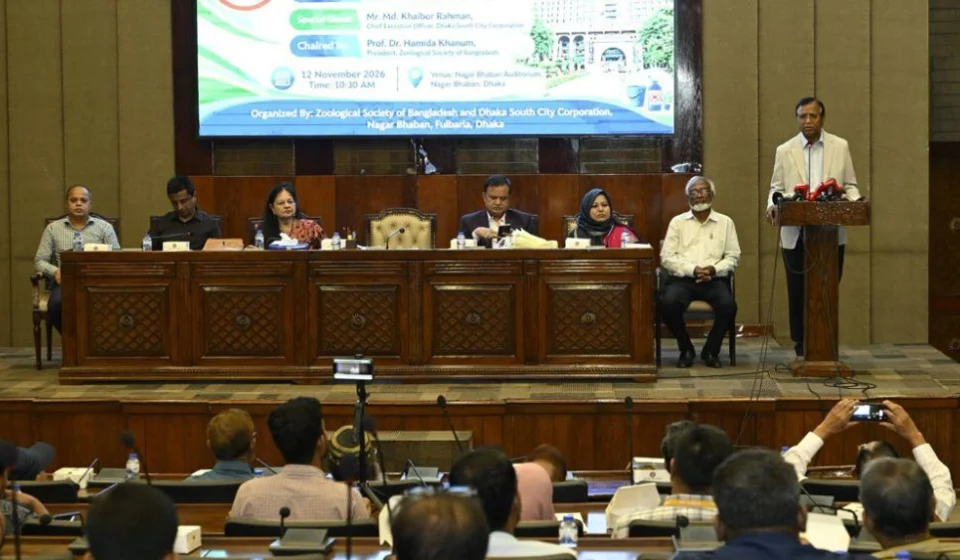
Two days of rain may push up dengue, Kabirul Bashar fears ‘worse’ situation in December

Photo: Collected
Professor Dr Kabirul Bashar of Jahangirnagar University’s zoology department fears the country’s dengue situation could be ‘even worse’ this December than in other years. Dengue could rise in the coming days because of rain, while the spread of Culex mosquitoes will increase in winter. He advised stepping up destruction of mosquito breeding sites, larvicide application and cleanliness drives right away.
He said this at a scientific seminar at the Nagar Bhaban auditorium in the capital on Thursday morning (12 November). The seminar was jointly organised by Dhaka South City Corporation (DSCC) and the Zoological Society of Bangladesh. It discussed recent trends in dengue in the country, effective preventive initiatives, control of mosquito breeding sites, and modern, science-based mosquito control strategies to protect public health.
Professor Kabirul Bashar said dengue could increase following the past two days of rain. There is a fear that the dengue situation this December will be worse than in other years. Culex mosquitoes will also increase in winter, so their breeding sites must be cleaned and larvicide applied right away.
He also questioned how useful the conventional method of fogging to kill mosquitoes is. In his view, it is not an effective method; it should be stopped and larvicide application and cleanliness activities increased. It is also urgent to test how effective the insecticides used for mosquito control are, and those that do not work must be discontinued.
Raising the question of why dengue is not declining despite the city corporation’s various crash programmes and drives, Kabirul Bashar said the outbreak is not declining because Aedes mosquitoes are not being controlled in the right places with the right methods. Drives alone will not do; breeding sites must be identified and effective measures taken.
Speaking as chief guest, DSCC Administrator freedom fighter Md Abdus Salam said citizens bear as much responsibility as the city corporation for controlling dengue. Fifty per cent of the responsibility lies with the city corporation and the remaining 50 per cent with citizens. He believes dengue can be controlled if everyone does their part.
The administrator said that after he took charge, a survey was conducted last March to assess dengue risk. Following special activities in the wards identified as risky, the October survey showed an improvement in the situation. However, risk has emerged in some new wards.
He urged everyone to keep their homes and surroundings clean rather than relying solely on the city corporation’s campaigns.
DSCC Chief Executive Officer Md Khayber Rahman was the special guest at the seminar. Zoological Society of Bangladesh President Professor Dr Hamida Khanam presided. icddr,b senior scientist Dr Shafiul Alam and Directorate General of Health Services senior entomologist (PRL) Md Rezaul Karim Khan took part in the discussion.
DSCC Secretary Md Moshiur Rahman Khan, Chief Waste Management Officer Air Commodore Mahbubur Rahman Talukder and Chief Health Officer Dr Jahane Ferdous Binte Rahman, among other officials concerned, were present.
By the numbers
Figures on dengue deaths in November 2025 differ by source: Jugantor reported on 3 December 2025 that 104 people died that month, the highest that year; Ittefaq put the figure at 99 on 8 December 2025. Both reports said 80 people died in October and 76 in September.
According to a BSS report of 30 December 2025, a total of 413 people had died of dengue in 2025 up to that point; 575 had died in 2024.
Sources
Original report: Ajker Patrika
Background sources: Jugantor, 3 December 2025; Ittefaq, 8 December 2025; BSS, 30 December 2025