





Photo: Collected
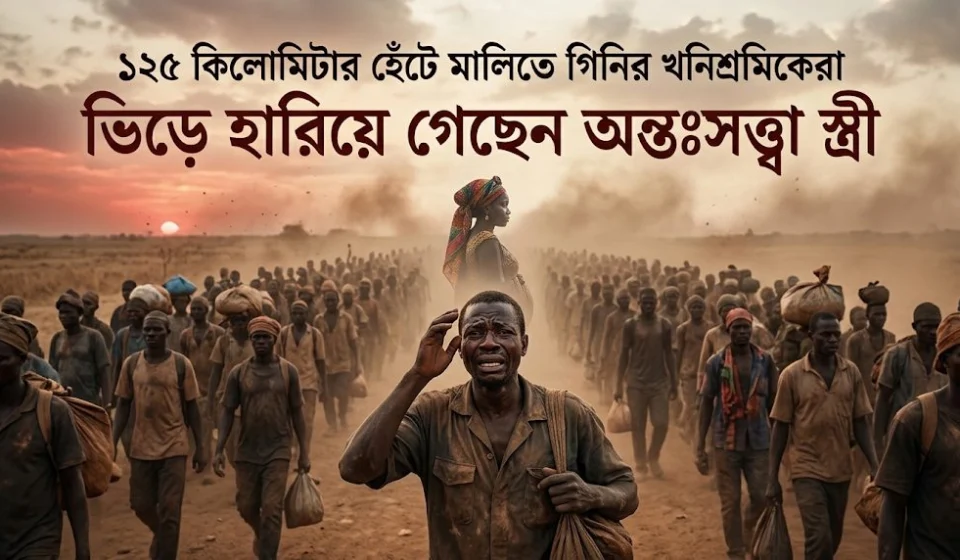
In the rush to flee, 41-year-old Moussa Konate from Côte d’Ivoire lost his wife. Since Guinea’s security forces launched an operation to shut down illegal gold mines, thousands of workers like him and their families have been leaving the country and taking refuge in Mali.
Moussa’s wife, seven months pregnant, went missing in the crowd as they left Guinea a few days ago. There has been no trace of her since.
News agency AFP reported this.
‘There was pushing, screaming and smoke everywhere. When the security forces told us to leave, everything happened very fast,’ Moussa said, looking worried.
‘For the past few days I have been asking newcomers whether anyone has seen my wife. But no one has been able to give me any news,’ he added.
The Malian government has designated two shelters for the displaced in Ouelessebougou. Moussa spoke to AFP while sitting in one of them.
Early this month, the Guinean government deployed security forces to stop illegal gold mining in the north-east. Since then, thousands of miners and their family members have been crossing the border into Mali.
The government of mineral-rich Guinea says informal gold mining is causing widespread environmental damage. The operation is aimed particularly at preventing land degradation and water pollution.
But as a result of the operation, thousands of people have had to cross the border and take refuge in Mali. Many are exhausted, have no money and have been separated from their family members.
Malian authorities said that since the operation began, about one lakh people have arrived in the capital Bamako alone. At least 10 deaths have been reported so far.
According to the country’s health ministry, most of those expelled from Guinea are citizens of Burkina Faso. Citizens of Côte d’Ivoire, Senegal, Togo and Benin are also among them.
Thousands of exhausted workers and their family members were seen lying on the ground at the Ouelessebougou shelter. They had walked about 125km from Kouremale to get there.
To escape the sun, they are barely getting by, huddled against the walls of nearby houses or under makeshift shelters of tarpaulins and tents.
Alassane Kabore, 21, from Burkina Faso, could barely walk.
Describing his bitter experience, he said: ‘We have been through things I would not wish on anyone.’
Kabore said many families were broken up in the chaos as they fled.
Hospital sources in Mali said at least six women have given birth since the displaced people began arriving.
‘Some people were beaten. Many others lost their relatives while fleeing through the bushes in fear for their lives,’ Kabore said.
Standing nearby, leaning against a wall, was Sedou Traore, a 30-year-old miner from Burkina Faso.
‘We really worked hard there. But one day everything suddenly changed. We were told to leave immediately. We weren’t even given time to gather our equipment or the money we had saved,’ he said calmly.
Fears of a humanitarian crisis grow
Mali’s health ministry has estimated that about 228 million CFA francs, or $388,000, will be needed to deal with the crisis.
For now, food and shelter for those arriving from Guinea are being provided by the country’s government authorities, various humanitarian aid agencies and local residents.
However, the arrival of so many people at once has put extra pressure on Mali.
According to the United Nations, more than 50 lakh people in the country were already dependent on humanitarian aid.
Officials also voiced another concern: these displaced and vulnerable people could become recruitment targets for jihadist groups active in the Sahel region.
‘These people are in a very vulnerable situation. We are looking at various ways to ensure that terrorist networks cannot get close to them,’ an official of Mali’s security ministry told AFP.
‘Some countries have pledged to take back their citizens. Côte d’Ivoire is among them,’ he added.
The Burkina Faso government said on Wednesday that 37,136 people have so far been brought home under a repatriation programme run in coordination with Mali. Of them, 7,988 are children and 1,049 are citizens of other countries.
Meanwhile, more than 1,200 suspects have so far been arrested in north-eastern Guinea on charges of illegal gold mining.
Background
According to a Mining Focus Africa report of 22 June 2026, the Guinean government announced a ban on exporting gold produced in the country without processing and certification, with the aim of keeping gold refining revenue in the country.
Earlier, on 12 June, the government suspended the prefect of Siguiri prefecture, the sub-prefects and about 100 environmental officials. It cited their failure to enforce a ban on certain equipment that is especially harmful to the environment, according to a government explanation of 16 June 2026 published on Ground News.
By the numbers
Citing news agency AFP, Macau Business reported that the order banning unregulated and clandestine mining in the Siguiri region took effect on 2 November. According to a joint statement by Guinea’s defence and security ministries, 1,263 people were subsequently detained, including citizens of Guinea, Burkina Faso, Mali, Togo, Niger, Côte d’Ivoire and Ghana.
According to Mali’s announcement, the country has sheltered about 1,60,000 people expelled from Guinea since the operation began, Le360 Afrique reported on 8 November 2026. The figure of about one lakh people mentioned in the original report refers only to Bamako.
Sources
Background sources: Macau Business (AFP), November 2026 — https://macaubusiness.com/guinea-arrests-more-than-1200-over-illegal-gold-mining/; Le360 Afrique, 8 November 2026 — https://afrique.le360.ma/societe/operations-anti-orpaillage-en-guinee-160000-personnes-refoulees-vers-le-mali_VGQ2KKFLJ5HRDC37FTPHDZ7S6Y/; Mining Focus Africa, 22 June 2026 — https://miningfocusafrica.com/2026/06/22/guinea-bans-raw-gold-exports-to-boost-local-refining-and-value-addition/; Ground News, June 2026 — https://groundnews.lakegeneva.lib.wi.us/article/guinea-government-justifies-suspensions-of-civil-servants-in-connection-with-gold-mining