







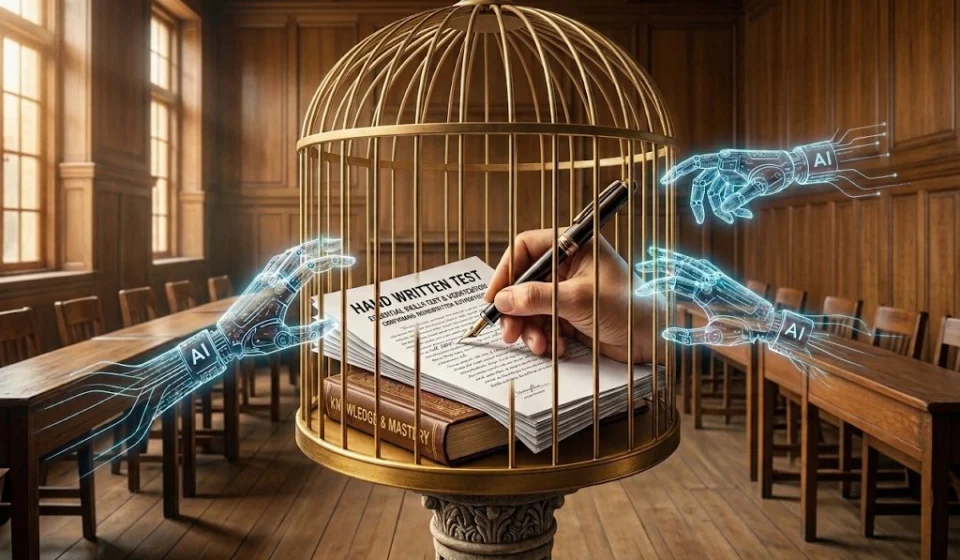
Stanford bans laptops and phones in class, returns to handwritten exams to curb AI cheating

Photo: Collected
Stanford University, the world-renowned US institution, is returning to traditional ‘pen-and-paper’ exams while banning laptops and smartphones from classrooms. The decision has been taken with two aims: to prevent cheating in exams using artificial intelligence (AI), and to assess students’ genuine ability.
The university’s ‘Civic, Liberal and Global Education’ programme said first-year (freshman) students will now have to take quizzes in the classroom and submit essays handwritten. Interestingly, it was the students themselves who proposed this method of testing knowledge, amid concerns over the misuse of AI.
Stanford’s guidelines state that digital devices such as laptops, smartphones and smart glasses interfere with students’ immediate attention and their long-term learning process. Students have therefore been advised to keep all internet-connected devices switched off in their bags during class.
There will, however, be special exemptions for those who find it difficult to take handwritten notes because of a physical disability. And in classes where a complete device ban is not possible, tablets may be used, following the teacher’s instructions, by sitting in the front rows and keeping them flat like a notebook.
According to a report in the university’s student newspaper ‘The Stanford Daily’, in-class timed writing, annotation on paper and journalling have been introduced in the compulsory first-year courses ‘College 101’ and the ‘Program in Writing and Rhetoric’.
Stanford computer science professor Chris Gregg has praised the university’s move. With class attendance falling after the rise of AI, he has himself formed small groups of three students each, called ‘tutorials’.
Professor Gregg said, ‘Catching cheating is extremely uncomfortable for teachers. We are more interested in creating an environment for assessing students’ genuine ability than in catching cheats. Because of this new assessment method, the tendency to cheat at the university has declined in recent years.’
A different note was struck by English professor emeritus Mark Bauerlein. He described artificial intelligence as ‘contrary to humane education’. In his view, since the arrival of AI, the first assumption teachers make is that everyone will cheat if given the chance.
Jared Gould, managing editor of ‘Minding the Campus’, a publication of the ‘National Association of Scholars’, considers Stanford’s decision correct. But he warns that unless universities break away from the culture of unreasonably high marks (grade inflation), simply bringing back handwritten exams will not solve every problem.
Gould said, ‘Students are now leaving the work of thinking to AI (cognitive offloading). But unless you strain your brain a little or make it work, you can never gain real knowledge and become an educated person.’
He fears that many universities may go down the path of simply selling certificates or degrees without testing students’ real reading and writing skills. Against this backdrop, analysts believe Stanford’s decision to return to pen and paper will stand as an important example in protecting the quality of higher education.
Background
According to a report in The Stanford Daily on 19 October 2026, quizzes on course readings have been added to the ‘College 101’ course, and in the winter ‘College 102’ course students will have to write their answers to questions set in class there and then.
The same report said that in the previous year, ‘College 101’ students had to sit an in-class ‘blue book’ exam instead of writing a final essay at home.
Sources
Background sources: The Stanford Daily, 19 October 2026 — https://stanforddaily.com/2026/10/19/ai-policies/