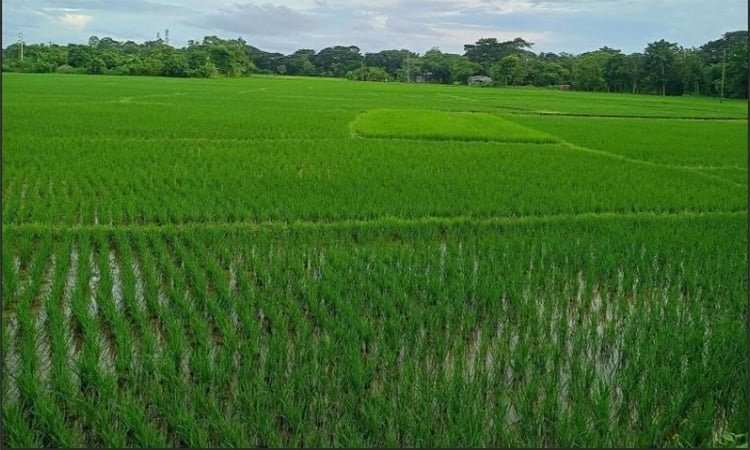

Photo: Collected
The blow of the flood, water standing on the land, damaged seedbeds: leaving all fears behind, farmers in Chattogram have almost completed Aman cultivation. Aman seedlings have already been transplanted on nearly 100 per cent of the targeted land in all districts of the Chattogram region. The transplanted seedlings are turning fresh in the light rain of Bhadra, and green has spread across the fields.
According to Department of Agricultural Extension sources, the target this time was to cultivate Aman on 179,980 hectares of land in Chattogram. Against this, 179,660 hectares have already been cultivated, which is nearly 100 per cent of the target. As a result, Aman cultivation has come close to the target ahead of the scheduled time.
Transplantation of Aman seedlings has been completed at Gumai Beel in Rangunia, the largest agricultural field in Chattogram. There the Aman clumps are now gradually maturing, and green leaves are swaying in the wind across the entire beel. The vast fields of Karnaphuli, Patiya, Anwara, Banshkhali, Chandanaish, Satkania and Lohagara upazilas of south Chattogram have been covered in green. On a visit to Patiya a few days ago, farmers were seen applying the first round of fertiliser to the land after transplanting paddy, while weeding was going on in some places.
Syed Nur, a farmer from the Hailadhar area of Patiya, said, ‘Every year I cultivate paddy on 5 kani (two acres) of land, and I have done the same this time too. The monsoon is going very well this time, a full borsha (this term is used in the local dialect to mean favourable conditions for farming when there is neither drought nor excessive rain in a year). There is no water crisis; it rains again before the land can even dry. As the weather is good, the transplanted Aman has taken hold (matured). I hope the yield will be good this time.’
Agriculturist Mohammad Ali Jinnah, additional director of the Department of Agricultural Extension, Chattogram region, told BSS, ‘Aman cultivation has progressed quickly this time because of favourable weather, timely transplantation of seedlings, supply of the necessary fertiliser and seeds, and government assistance to flood-affected farmers. Even after the flood, farmers did not have to face a major crisis over seedlings. As rehabilitation assistance was provided quickly by the government, the affected farmers were able to return to the fields on time.’
According to data from the Chattogram regional office of the Department of Agricultural Extension, Aman cultivation is very close to the target in Cox’s Bazar as well. The target was to cultivate Aman on a total of 18,885 hectares of land in the district. Of this, seedlings have been transplanted on 18,422 hectares, combining hybrid, high-yielding and local varieties, meaning the progress is 99 per cent.
Aman cultivation is further ahead in Noakhali; cultivation in the district has exceeded the target this time. In Feni, the Aman target this time was about 66,894 hectares, and about 66,837 hectares have already been cultivated. Among the five districts, Lakshmipur is the furthest ahead compared with the target. Progress there against the target is 117 per cent, meaning Aman has been cultivated on more land than the set target.
Agriculture officials say Aman has been cultivated on many plots beyond the plan because of the expectation of a good price for Aman, favourable weather and farmers’ interest.
According to agriculture department officials, there is a risk of cultivation falling behind if a seedling crisis occurs in the Aman season. But this time there was no major crisis because of seedling production and distribution at government initiative and the seedbeds prepared by the farmers themselves. In different upazilas of Chattogram, farmers took seedlings from their own seedbeds and also received support from local nurseries and the agriculture department. As a result, it was possible to transplant seedlings as soon as the land was ready.
Agriculturist Apru Marma, deputy director of the Department of Agricultural Extension, Chattogram district, told BSS, ‘Some apprehension was created at the start of the Aman season this time because of the flood. But after the water receded, farmers prepared the land quickly. As the supply of the necessary fertiliser, seeds and seedlings was assured, there was no major disruption in transplantation. As the weather too has so far been favourable to Aman, it has been possible to achieve the target quickly.’
A sub-assistant agriculture officer in Satkania said, ‘The most positive aspect this time is that farmers’ interest in Aman cultivation has not declined. Government assistance has been given to flood-affected farmers, and seedlings and seeds have been supplied in many places. As a result, there was no seedling crisis. With regular advice at the field level and the necessary inputs including fertiliser assured, cultivation has reached the target ahead of the scheduled time.’