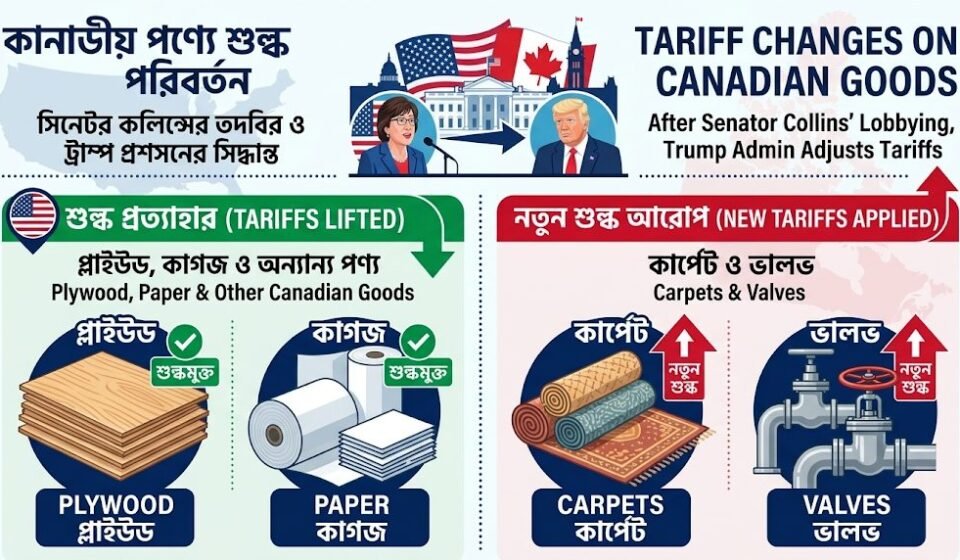
Trump administration lifts tariffs on some Canadian goods including plywood and paper after Senator Collins’ lobbying, new tariffs on carpets and valves

Photo: Collected
President Donald Trump’s administration has withdrawn tariffs on several products imported from Canada after a vulnerable Republican candidate said she had lobbied for the change. The decision came on Friday, two weeks before the US midterm elections.
News agency AFP reported this.
According to a White House statement, the products granted tariff relief include plywood sheets, some paper products, certain machinery and refrigeration equipment.
The decision may benefit Republican Senator Susan Collins. She is facing a strong Democratic challenger in Maine, a state on the US-Canada border. The state has suffered heavily from Trump’s trade war.
Collins wrote on social media that she had secured tariff relief on various products important to Maine’s agriculture industry. The list includes inputs used in producing blueberries, potatoes, apples and seaweed.
Democrats want to wrest control of Congress from the Republicans in the 3 November midterm elections. To that end, they are giving special importance to Collins’ Senate seat.
The economies of the United States and Canada are deeply interdependent. About 70 per cent of everything Canada exports goes to the United States.
Tension between the two neighbours has risen since trade talks between them collapsed last August, and Trump has imposed one new tariff after another as a result.
The White House said that although Friday’s decision lifted tariffs on some products, tariffs were imposed on several new products, including carpets, certain types of valves and waste products. The new measures will take effect from 30 October.
Canada’s minister in charge of Canada-US trade, Dominic LeBlanc, said in a statement sent to AFP that Canada is aware of the recent US tariff measures.
He said, ‘Canada is ready to review these measures and to work constructively and sincerely with the United States.’
According to Senator Collins, many farmers in her state depend on specialised machinery, packaging materials and other products imported from Canada. Some of these products are not available from US suppliers, and using alternatives significantly increases costs.
Trump’s earlier tariffs on cars, steel, aluminium and lumber have dealt a heavy blow to Canada’s economy, reducing employment and hampering growth.
Canada has entered a technical recession after its economy contracted for two consecutive quarters this year.
The tariffs Trump imposed after the collapse of trade talks have affected about $20 billion worth of goods exported from Canada to the United States, or 5.5 per cent of Canada’s total exports to the US. The products range from hockey sticks to cement.
Since taking office for a second term, Trump has brought major changes to the global trading system by imposing steep tariffs on countries, friends and rivals alike.
He claims other countries have been taking advantage of the United States for many years.
By the numbers
According to a 29 May report by BNN Bloomberg, supplied by The Canadian Press, Statistics Canada’s preliminary estimates showed the country’s real GDP fell 1 per cent in the last quarter of 2025 and declined at an annualised rate of 0.1 per cent in the first quarter of 2026; however, economists were divided over whether the two consecutive contractions amounted to a technical recession.
Later, according to a 30 August report by the New Straits Times, supplied by Xinhua, Statistics Canada’s revised figures showed the economy grew 0.3 per cent in the first quarter and expanded at an annualised rate of 3.3 per cent in the second quarter, meaning the country avoided a technical recession. Sources differ with the main report on this point.
Sources
Background sources: BNN Bloomberg (The Canadian Press), 29 May 2026; New Straits Times (Bernama-Xinhua), 30 August 2026