
Photo: Collected
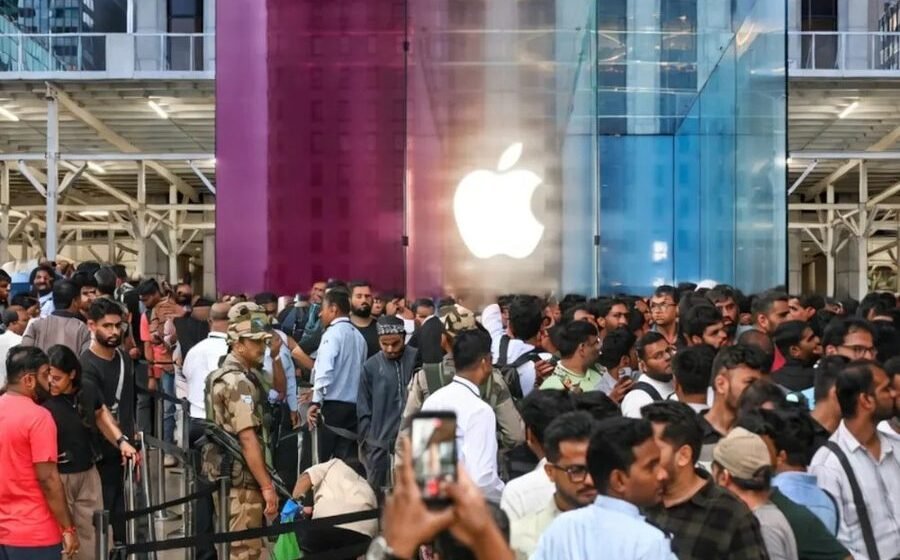
One can order a new iPhone from Apple’s website in just 90 seconds and wait without worry sitting on the sofa. Quick-commerce platforms like BigBasket or Blinkit are even promising to deliver an iPhone to the door in 10 minutes. Yet even in this age of digital convenience, a completely different scene was seen on the streets of India’s big cities early this morning. Hundreds of people spent the whole night on the footpath outside the Apple stores at Delhi’s Connaught Place, Mumbai’s Bandra Kurla Complex or Bengaluru’s Brigade Road – some bare-bodied, some wrapped in sheets. Although the question arises as to why so much hardship just to get a new phone in hand, to the fans it is not suffering but rather part of the celebration.
When a young man named Rahul was talking to journalists while standing on a footpath in Bengaluru at 5am today, there was no sign of tiredness on his face. Standing amid the eager crowd that had come from Haryana, Delhi and Mumbai, he said in a plain voice that this wait is not ordinary shopping to him but rather an annual festival. Every year on the day of the iPhone launch he turns up before dawn like this. Almost the same picture was seen in Mumbai, several hundred kilometres away. Another buyer has been standing in line since 10pm after arriving by night train from Nashik. Even knowing that getting the phone in the scheduled slot in the morning is almost certain, he stayed up all night just to secure a place in the front row. This iPhone lover, who used the 17 Pro Max last year, will return home with the iPhone 18 Pro Max this time.
Scalpers’ dominance in Shanghai
This frenzy is not limited to India’s metropolises alone. On this particular day in September, the picture in international markets is almost the same. Queues form in the same way in big cities of China, Australia, Europe and America. However, the scene in China’s Shanghai is somewhat different and far more commercial. There, pre-sale begins on JD.com, Taobao and Apple’s own website a week before Apple’s flagship store opens, and all stock runs out in just one minute. Apple’s server also crashes under the pressure of traffic. As a result, those who stood in line in front of the outlet on the release day could not buy the phone directly; they had come to book an advance appointment to get the phone in hand in future. There, the whole matter is controlled by a powerful network of black marketeers or scalpers. They book a huge number of phones at once using automated scripts or bots and collect an extra fee of 299 to 599 yuan from ordinary buyers just for a booking slot. As a result, the resale price of the especially attractive ‘Burgundy Pro Max’ model rises by 16 to 27 percent above the actual market price.
Planned scarcity
From outside, the whole thing may seem to be mere inconsistency or foolishness on the part of consumers. But deeper analysis says it is not at all accidental; a large part of it is created artificially and in a well-planned way. This time Apple has more or less put the main ‘iPhone 18’ model on hold and drawn all the attention of customers towards the premium ‘Pro’ series. At the same time, the initial supply of popular new colours and higher-storage models has been deliberately kept limited. Market analysts say adequate supply usually arrives 3 to 4 weeks after a new phone comes to the market. That is, today’s outcry and chaos is not any production shortage but rather a strategically created environment. On one hand, Apple creates artificial scarcity and intense curiosity by controlling the release timing; on the other, scalpers block the supply with the help of technology. As a result, ordinary buyers are forced to pay extra money merely out of the urge to touch the phone before everyone else.
Economists call this strategy the display of quality through queues. According to them, the social publicity created by a long queue of thousands of people outside a shop is not possible even by putting up large billboards at a cost of crores of taka. Research on the psychology of waiting has shown that the more people are made to wait to get something, the more the psychological value of the thing rises in their eyes. That is, the long queue itself proves that the thing inside is truly valuable enough to obtain. The whole arrangement is staged like a perfect drama – the long queue creates buzz, the countdown brings excitement, the roar of applause as the store doors open gives satisfaction, and finally the unboxing videos spreading on social media draw the desired ending.
A question of status and identity
But this long queue is not just a matter of supply or market strategy; deeply entwined with it is the question of human psychology and identity. In 1899, renowned sociologist and economist Thorstein Veblen said in his ‘leisure class’ theory that there is a group of people in society who do not buy products out of need; rather, they buy things on which a great deal of money and time can be spent needlessly and which help display their high status in society. In economics such products are called ‘Veblen goods’ – the more their price rises, the more demand for them rises among a particular class. Academic and associate professor of Christ University Dr Abhinav P Tripathi has called this modern trend ‘visible waiting’. According to him, when young people of the Gen Z generation stand in line for hours and post their location on social media, it is actually a kind of modern social exhibition. The social influence that once had to be shown through vast wealth inherited over generations can now be attained by any ordinary person just by spending a little time standing in a queue for a smartphone.
As a result, the long queue in front of the Apple store is no longer just a way to buy a phone; the queue itself is now a product. It has wonderful visual appeal, it creates a story worth telling on social media and turns ordinary shopping into digitally profitable content. As more than one billion people around the world have an iPhone in hand, merely having a new iPhone is no longer anything special. But buying the phone by standing in line on the very first day of release, turning the hardship of waiting into content, still offers a chance to present oneself as different.
Alongside this, the matter of blind loyalty to the brand also cannot be dismissed. Though controversial, a neuroscience experiment funded by the BBC a few years ago showed that when pictures of the brand’s new products are held before hardcore Apple fans, certain parts of their brains are stimulated in just the same way as a devout follower becomes emotional on seeing his own religious symbol. Although there is debate over the research method, international market surveys say Apple’s customer retention rate in the world of smartphones is many times higher than that of any other brand. Most iPhone users have admitted that even if no groundbreaking change comes in the new model, they cannot even think of moving to another brand. It is no longer an ordinary brand preference; it has become part of their personal identity.
The habit of changing phones is changing
Yet the overall picture across the world is just the opposite. Data say people are now changing phones at much longer intervals than before. According to international market analysis, the average period of use of a smartphone globally is now reaching about four years and it will rise further throughout 2026 and 2027. Because of the sky-high prices of chips and other components, brands are being forced to raise phone prices, and as a result ordinary people too have stopped changing phones frequently. Around 2013 to 2015, people used to change phones every 2.4 years on average; by the mid-2020s that period has come to stand at about 3.6 years – that is, people are now using a phone for about 50 percent longer.
In response to this trend of customers using phones for a long time, big companies like Apple and Samsung have introduced annual leasing or subscription models. Samsung’s ‘Galaxy Forever’ or Apple’s Klarna-based leasing programme in India are part of that very effort – so that even if people do not change phones every year on their own, that annual demand can be artificially sustained through the lure of instalments.
So the people who camp all night outside the store do not represent ordinary smartphone users. They are a small and specific group outside the mainstream – which includes blind devotees, resellers, content creators and a section of the upper middle class to whom buying a phone is a personal annual ritual. Although it is true that the matter feels ‘like a festival’ to the young man standing in the Bengaluru queue, that is the attitude only of that tiny group who still regard buying a new phone as sacred like an annual prayer.
As a result, the answer to the question ‘Why should people upgrade their phone every year?’ depends on who is being asked the question. From the economic and logical viewpoint of ordinary people, the answer is that there is no need at all to change phones every year, and in reality most people are not doing so either. The current phone in the pocket can easily give good service for three to four years. But to those who are standing in the long queue, the answer is not related to technology at all. To them it is a custom, individuality, being part of a community and the mental joy of getting something before everyone else – it has not even the remotest connection with whether the new A20 Pro chipset inside the phone brought any real change in life.
The instalment trap
In the end remains that financial question which no one wants to utter in the thrilling atmosphere of the queue. In India the starting price of the new iPhone 18 Pro is Tk 1,64,900, while the price of the top model, the 2-terabyte Pro Max, stands at about Tk 3,14,900. For a salaried employee earning Tk 1 lakh a month, buying this one phone means pouring in the entire salary of three straight months. According to money management expert Sunisa Arinta, what is mainly working behind such frenzy across the world is the facility of easy EMI or instalments. Dividing a large expense into small monthly instalments does not reduce the price of the product by even one taka; only the time when the money leaves the pocket is pushed back.