Rubio calls for return to spirit of conquest and expansion, author Ted Widmer raises questions

Photo: Collected
US Secretary of State Marco Rubio has called on the United States and Europe to revive the spirit of conquest, expansion and exploration of the past. Voicing concern over the future of Western civilisation, he believes that if Western countries fail to embrace their historical values once again, they could eventually decline and lose their relevance in the world. Author Ted Widmer, however, has criticised both the historical basis of Rubio’s remarks and their political meaning.
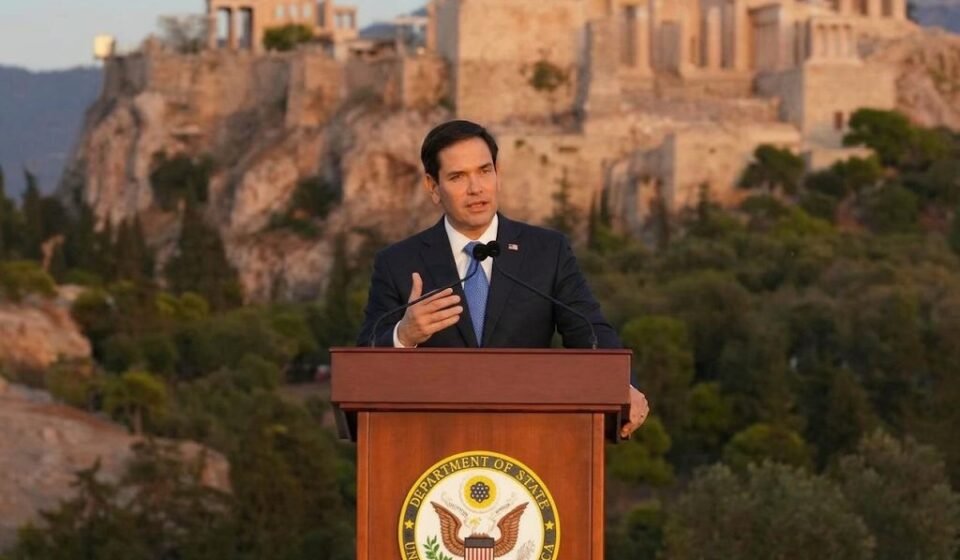
Rubio delivered the speech in the Greek capital Athens on 7 October. With the ancient Acropolis as the backdrop and the Parthenon behind him in the golden glow of sunset, he spoke about the past glory of Western civilisation and its present challenges, and painted a worrying picture of the future of the Western world.
According to Widmer’s analysis, Rubio’s speech gave more room to ideas of exploration, conquest, expansion and strongman leadership than to democratic traditions. The lament expressed in his words that Western civilisation is in decline echoes the discourse of several institutions in the conservative stream of the United States.
Ideal of conquest, or legacy of democracy
In his critique, Widmer pointed out that while the founders of the United States drew deep inspiration from the literature and philosophy of ancient Greece and Rome, their aim was not to establish dominance over other nations or peoples; they wanted to build a democracy of people enjoying equal rights.
The ideas of the Roman philosopher Cicero influenced Thomas Jefferson, one of the authors of the US Declaration of Independence. Equal rights for all citizens of the same republic were an important aspect of Cicero’s philosophy. Former US President Abraham Lincoln, meanwhile, sought inspiration in the work of the Greek mathematician Euclid. Ted Widmer noted that Euclid’s mathematical reasoning and concept of equality left their mark on Lincoln’s thinking.
In his view, these historical examples show that the lessons the American founders drew from ancient civilisations were not aimed solely at establishing an ideal of power and conquest; the ideas of liberty, reason and equality also mattered to them.
What really defines Western civilisation
In his analysis, Widmer also raised the question of how exactly Western civilisation should be defined. If the ancient heritage of Greece and Rome is taken as the basis of Western identity, then it is also questionable how logical it is to keep a country like Russia outside that boundary. Russian history and culture also have links with the traditions of ancient Greece and Rome.
A similar example is Germany’s Nazi leader Adolf Hitler. He too had a strong fascination with ancient Greek and Roman civilisation, which was starkly evident at the 1936 Berlin Olympics. In his book Mein Kampf, he glorified ancient Greek civilisation and the so-called ‘higher culture’ born of the experience of the Persian Wars.
Widmer’s argument is that neither revering an ancient civilisation nor making its heritage the basis of political identity automatically makes any political ideology democratic. What really matters is how these elements of history are being interpreted.
East also helped lay the foundations
Widmer has also highlighted the role of other regions in the development of Western civilisation. He believes the flourishing of knowledge and science in ancient Greece and Rome was not a separate or isolated phenomenon; civilisations and cultures of the East made significant contributions to it.
The earliest writing systems originated in the ancient Sumerian civilisation, located in what is now Iraq. Many ideas in mathematics and science also spread through the exchange of knowledge among different civilisations. Although the ancient Greeks and Persians fought each other, the contact between them opened the way for cultural and intellectual influence to spread.
Widmer believes that reading the history of Western civilisation solely as a story of European conquest and expansion obscures the contributions of other regions to the advancement of knowledge, science and culture.
Heroic tales of the speech versus the reality of the Iran war
In his speech, Rubio recounted the story of the courage of a small band of ancient Greek warriors who fought to save the Acropolis from Persian invaders. Widmer, however, believes there is a certain contradiction in bringing up such tales of heroism against the backdrop of the ongoing war over Iran.
In the article, he referred to the US military situation during the war. This included the aircraft carrier USS Abraham Lincoln returning to San Diego, the withdrawal of 12 B-1 bombers from a base in England, and the increase in Iranian attacks on shipping at sea. He also mentioned high oil prices.
In Widmer’s analysis, although an ideal of power and expansion is presented by citing examples of celebrated conquerors of history such as Alexander the Great, Julius Caesar, Charlemagne and Hernán Cortés, the reality of the ongoing war is laying bare the limitations of that ideal.
The ‘great man’ and the idea of imperial decline
Widmer identified the tendency to give excessive weight to the role of ‘great men’ in history as another notable aspect of Rubio’s speech. As he explains it, Rubio’s words conveyed the notion that the course of history is set by leaders who overcome obstacles to fulfil their ambitions and defeat weaker peoples.
Rubio’s speech placed emphasis on individualism, indomitable ambition, discovering new things, taking risks and the desire to achieve glory. In Widmer’s words, such rhetoric at times sounds like the plot of a video game, in which powerful characters must constantly face new challenges to prove their abilities.
Widmer, however, also acknowledged that such talk of the need to build a strong state, achieve national success and save an empire from decline is nothing new in history. The founders of the United States were also worried about how long democracy would last.
John Adams, one of the founders of the United States, once wrote, ‘There never was a democracy yet that did not commit suicide.’ The remark reflected the fear that the seeds of democracy’s downfall could be born within democracy itself.
Past presidents struck a different tone
In his well-known ‘Man in the Arena’ speech in 1910, former US President Theodore Roosevelt praised the person who keeps daring to try despite the risk of failing or making mistakes. The speech also highlighted the importance of effort, perseverance and learning from failure, alongside success.
In a similar vein, John F. Kennedy said in his 1961 inaugural address that the United States was ready to pay any price, bear any burden and meet any hardship to defend liberty.
According to Widmer’s analysis, although Rubio’s speech bears some resemblance to these remarks, the fundamental question remains: does the future of Western civilisation depend on reviving the ideals of military power, conquest and dominance, or on further strengthening the traditions of democracy, equality and international cooperation?
At the root of the debate over Rubio’s speech lie divergent views on questions such as the identity of Western civilisation, how history should be interpreted and what role Europe and the United States should play in today’s world. Source: The Guardian