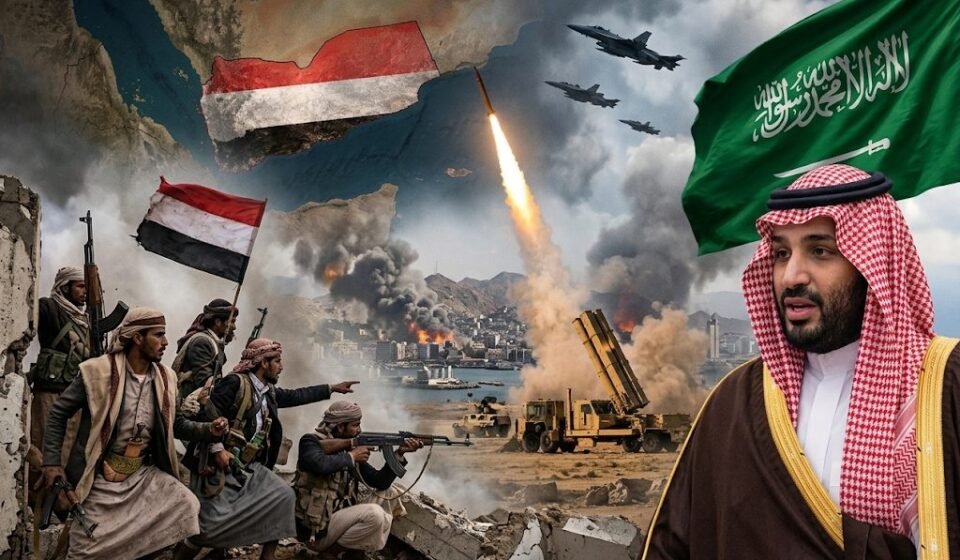
At least 13 killed in Houthi attack on Riyadh airport: ground war, US help or allies – every path carries risk for Saudi Arabia

Photo: Collected
Pressure is mounting on Riyadh to retaliate after a missile fired by Yemen’s Houthi rebels killed at least 13 people at King Khalid International Airport in the Saudi capital.
It is the deadliest attack on Saudi soil in more than a decade. Intense discussion is under way over which path the kingdom will now take to handle the situation. But every option before it carries major risks – whether entering a ground war, seeking direct military help from the United States, or confronting the rebels alongside international allies.
Saudi Arabia launched a large-scale military operation against the Houthis last week in support of Yemen’s government forces. But as of the time of writing, the rebels have not been dislodged from their positions; instead, they have stepped up their attacks on Saudi Arabia. Tensions reached a new level with Saturday’s missile strike on the Riyadh airport.
Drawing lessons from the strategy Iran pursued in its conflict with the United States, the Houthis have threatened more attacks on Saudi Arabia’s critical infrastructure. Their aim is not only to keep Saudi Arabia under military pressure but also to spread the impact to the global economy.
The Houthis’ grievances against Saudi Arabia go back a long way. Riyadh’s decade-long war against the group gave rise to Yemen’s humanitarian crisis, one of the worst in the world. However, many now see the recent attack as an extension of the US-Iran conflict.
The danger of a ground war
For the past 11 years, Saudi Arabia has tried to halt the Houthis’ advance through both military action and negotiations. That has done little to weaken the rebels. Instead, they have tightened their grip on Yemen’s key cities and are even trying to seize areas such as densely populated Taiz.
Ali Shihabi, a Saudi writer and analyst on Saudi politics, told US news outlet CNN: ‘This threat has to be resolved permanently.’
Shihabi believes much will depend on how effective a role Yemeni government forces can play on the battlefield. Saudi Arabia is supporting them extensively from the air.
So far, Saudi Arabia has mainly been providing air support to the anti-Houthi Yemeni coalition; it has not sent its own troops in large numbers into direct ground combat. But after the latest attack on Riyadh, the question has arisen whether the kingdom will maintain this restraint.
Sending troops into Yemen on a large scale could trap Saudi Arabia in a long and costly ground war in difficult terrain. It could also dent the image Saudi Crown Prince Mohammed bin Salman has built for the country as a stable, investment-friendly state and an international tourism destination.
Houthi missiles grow more powerful
Nearly two decades ago, the Houthis were a small religious revivalist movement. With Iran’s backing, they have over time become a powerful armed group. Their arsenal now includes ballistic missiles capable of striking targets as far away as Tel Aviv.
An official based in southern Yemen who has fought the Houthis for years told CNN that the rebels have improved their battlefield tactics. Their attacks are now more sophisticated and frequent than before, and their intelligence capabilities have also grown.
Majed al-Nazili, spokesperson for Yemen’s government forces, alleged that the Houthis have made their missiles more effective by working with experts from Iran’s Revolutionary Guards. He claimed the new missiles are faster and, using heat-seeking technology, can track heat sources to hit their targets. However, it is not confirmed whether such a missile was fired at the Riyadh airport on Saturday.
The Houthis’ use of artificial intelligence (AI) in weapons development has also raised concerns. According to AI company Anthropic, a group based in northern Yemen used its Claude AI technology to help develop guidance software for rockets and missiles. Such software is used to control and stabilise a weapon’s trajectory while it is in flight. The report did not identify the group, but as the area is Houthi-controlled, it suggests the group may have links to the Houthis.
Riyadh at its allies’ door
Saudi Arabia has sought support from various countries to confront the Houthis. Pledges of assistance have come from France, the United Kingdom and Pakistan. Other allies such as Turkey are also considering cooperation.
There have also been reports that Saudi Crown Prince Mohammed bin Salman has sought help from Syria. After nearly ten years of civil war, armed groups led by Syrian President Ahmed al-Sharaa managed to drive Iran-backed groups out of Syria.
Meanwhile, the United States, Riyadh’s most important ally, had not joined air strikes on the Houthis as of the time of writing. Instead, Washington has sent more than 100 military advisers, who will provide intelligence support under a newly formed joint command.
The United States reached a ceasefire with the Iran-backed Houthis last year. The ceasefire reopened the Bab al-Mandab Strait to US ships, a vital sea lane for global trade between Europe and Asia. Several sources told CNN at the time that the Saudi crown prince had urged US President Donald Trump to strike the Houthis during two conversations last month. But Trump did not agree.
Ali Shihabi believes Saudi Arabia would have benefited if the US air force had been directly involved. He argues that US aircraft can carry out operations quickly based on satellite intelligence, whereas the Saudi air force has to go through an additional step in the process.
US citizen among the dead, Trump hints
Despite buying advanced air defence systems from the United States, Saudi Arabia has not escaped the risk. The country’s energy facilities and other critical infrastructure, spread across vast deserts, could become easy targets for the Houthis’ relatively cheaply made one-way drones.
Saudi Arabia’s civil aviation authority said on Sunday that one of those killed in the Houthi attack on the Riyadh airport was a US citizen. This could put pressure on the Trump administration to become more directly involved in the conflict.
After the attack, Trump told reporters: ‘The Saudis are good fighters. But I think the attack was terrible.’
Asked whether the United States would join attacks against the Houthis, he replied: ‘We may join.’
The president’s remarks mean the possibility of US military intervention cannot be ruled out entirely. Yet the big question before Saudi Arabia remains: will it shoulder the risk of a long ground war, or rely on international support to contain the Houthis? Source: CNN