


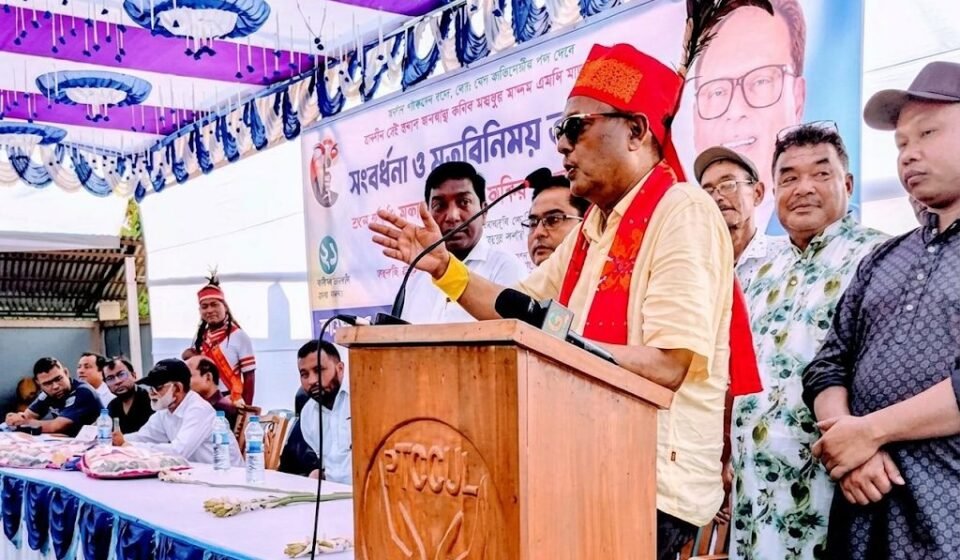
Technology minister asks Garo, Koch and Barman communities in Madhupur to put demands in writing

Photo: Collected
Posts, Telecommunications and Information Technology and Science and Technology Minister Alhaj Fakir Mahbub Anam has given an assurance that problems will be identified and realistic solutions taken up to establish the rights of the Garo, Koch and Barman communities of Madhupur in Tangail, create employment and improve their standard of living. He also said he wants to do something for the indigenous communities that they will remember him for all their lives.
He said this on Wednesday at a reception and exchange of views meeting held at the Pirgachha Thangyani Credit premises on the initiative of the Garo, Koch and Barman communities of the Madhupur (Abima) forest region.
In his speech as chief guest, the minister said it is essential to identify the problems and expectations of the indigenous communities specifically, and for that their demands and problems must be presented in writing with detailed information. After reviewing this information, he will place the matters before the prime minister and the ministers concerned so that a path to realistic solutions can be found.
Fakir Mahbub Anam said effective steps are needed to expand employment, skills development and higher education opportunities for indigenous young men and women. At the same time, he said the relevant matters would be considered with importance to preserve their language, culture and heritage and to improve their living standards.
Highlighting the development potential of the indigenous-dominated areas of Madhupur, the minister said matters such as setting up digital labs, improving road communications and expanding the mobile network would be discussed with those concerned. He also laid emphasis on expanding the fields of education and employment for the new generation by using the opportunities of information technology.
The minister also remarked that if the dignity of the people’s votes and trust is to be protected, work must be done sincerely to solve their problems. Calling on indigenous leaders to present their demands and expectations in an organised manner, he also assured them of the utmost effort to solve the problems.
Earlier, when he reached the venue, the organisers welcomed the minister with dance and song in their traditional manner.
The meeting, presided over by Advocate John Jetra, organising secretary of the central committee of the Bangladesh Nationalist Small Ethnic Communities Party, was attended by Madhupur upazila BNP president Zakir Hossain Sarker, Mrigen Hagidak, president of the central committee of the Bangladesh Nationalist Small and Ethnic Communities Party, Ajay A Mree, indigenous youth and student representative Jewel Reting, representatives of the local administration and leaders of the Garo, Koch and Barman communities.
Background
The dispute over land in the forest region of Madhupur is a long-standing one. According to a Prothom Alo report of 23 June 2019, before British rule this forest was under the Pannis of Tangail, later it became part of the zamindari of the Maharaja of Natore, and when it was handed over to the forest department in 1950, Bengali settlement began to increase.
The same report said that when a gazette of 15 February 2016 declared 9,145.07 acres of sal forest in Aronkhola mouza a reserved forest, many Garo-dominated villages fell inside it; as the state does not recognise customary land rights, the forest department treats the residents as illegal occupants and serves eviction notices from time to time.
Most recently, on 7 January, after concluding a hearing, Tangail forest court special magistrate Md Minhaj Uddin Faraji withdrew 88 forest cases and discharged a total of 387 accused, including 231 Garos and Kochs; a notice signed by Tangail divisional forest officer Dr Abu Naser Mohsin Hossain said the purpose was to protect the heritage and rights of those living in Madhupur National Park – The Daily Star Bangla reported this on 7 January.
The numbers
According to a Prothom Alo report of 23 June 2019, a survey conducted in 44 forest villages of Madhupur found that of the 47,726 residents of 11,048 families, 64.61 per cent were Bengali and 35.39 per cent Garo – that is, the Garos are now a minority in their own historical homeland.
The survey also showed that only 4 per cent of Garo families have CS or RoR records of their homesteads, against 13 per cent of Bengali families.