Senior US official meets junta chief in Nay Pyi Taw as Washington’s tone on Myanmar shifts

Photo: Collected
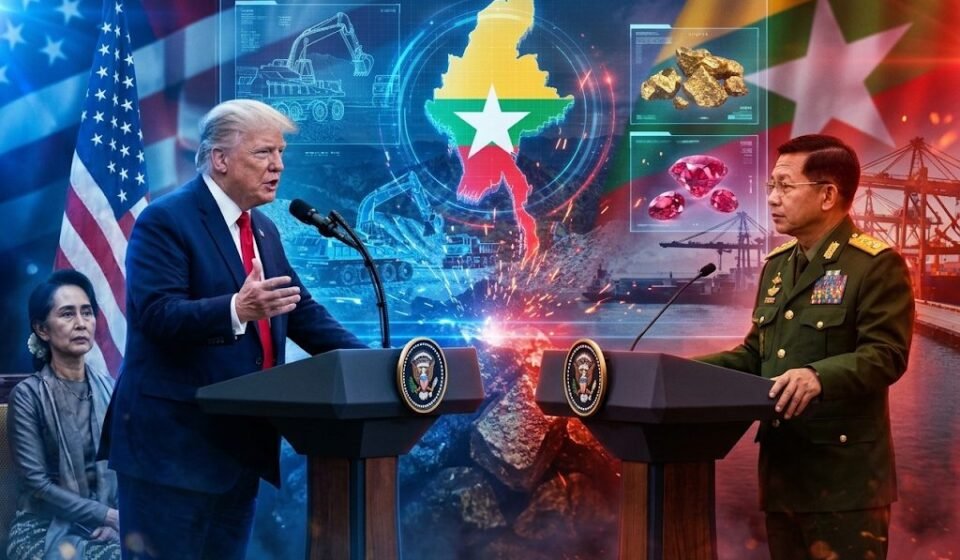
A meeting between junta chief Min Aung Hlaing and a senior official of the Trump administration, and the lifting of US sanctions on several businessmen, have raised a question – is the United States moving away from its long-standing policy of isolation in its relations with Myanmar’s military junta government?
After the democratically elected leader Aung San Suu Kyi was removed from power through a military coup in 2021, the United States had very limited formal contact with Myanmar’s military government. Washington had also imposed a number of sanctions on those assisting the country’s junta.
However, on 15 and 16 September, Michael Vance, the US State Department’s assistant secretary for intelligence and research, held a meeting with the junta chief in Myanmar’s capital, Nay Pyi Taw. The stated purpose of the meeting was to secure the release of US citizen Adam Castillo, who had been detained in June following a dispute with the local American Chamber of Commerce.
He is the most senior of the US officials to have met Min Aung Hlaing since the coup. It is therefore thought that other matters of mutual interest to the two sides also came up in the discussion.
An analysis by the British news outlet BBC said indications of a change in US policy on Myanmar had been emerging since July last year. Amid Trump’s tariff war, he announced a 40 per cent tariff on Myanmar at that time, in response to which Min Aung Hlaing praised Trump and expressed interest in continuing economic relations with the United States.
The junta government then signed a $3 million contract with the Washington lobbying firm DCI. It also hired the controversial lobbyist Roger Stone, known as a close associate of Trump, at a fee of $50,000 a month.
Aim of reducing dependence on Chinese rare minerals
The United States also has strategic interests behind increasing contact with Myanmar. Washington is looking for alternative sources to reduce its dependence on China for rare earth minerals, and the matter became clearer when China restricted the supply of these minerals last April as a counter-measure to US tariffs.
Myanmar has large reserves of rare earth minerals. At present Chinese companies extract these minerals from the country’s unstable border areas and take them to China for processing. But as many of these regions are under the control of ethnic armed groups, it may be difficult for the United States to extract the minerals directly.
Washington has also moved away from its earlier position on Myanmar’s disputed election. Although many Western countries raised questions about the acceptability of that election, held last December and January, the United States this time did not condemn it directly as before. It was through that election that Min Aung Hlaing created the path from coup-making military leader to nominally civilian president.
Doubts over the lifting of sanctions
Analysts, however, say the change is not as deep in reality as the headlines suggest. According to Richard Horsey, Myanmar adviser to the International Crisis Group, Min Aung Hlaing still remains under US sanctions; what is new is that senior Washington officials are now visiting Nay Pyi Taw directly.
With the closure of the activities of the US aid agency USAID in Myanmar, assistance to opposition groups, independent media and refugees has also fallen sharply. Alongside this, the decision to withdraw the temporary protected status of about 4,000 Myanmar nationals who have taken shelter in the United States has drawn criticism from human rights organisations.
According to Horsey, keeping contact with the junta government is not wrong in itself; what matters is what the United States is seeking in exchange for this contact and what it is conceding. He advised that Washington should press for an end to air strikes on civilians, access for humanitarian assistance and the continuation of contact with the opposition sides.
Finally, the big question is whether the Trump administration, preoccupied with the Iran war and domestic politics, will be able to sustain long-term attention on Myanmar. Because, to counter China’s influence, increasing contact with the junta government alone may not be enough. Source: BBC
Background
Myanmar’s army removed the elected civilian government led by Aung San Suu Kyi from power on 1 February 2021 – Aaj English TV, citing Reuters, reported this on 25 January 2026.
According to the same report, the army-backed Union Solidarity and Development Party (USDP) won 193 of the 209 seats in the lower house and 52 of the 78 in the upper house; voting was held in three phases on 28 December, 11 January and 25 January, and turnout in each phase was about 55 per cent. The United Nations, human rights organisations and the United Kingdom called the vote a farce, and Malaysia said ASEAN would not recognise the election.
According to an investigative report by Reuters, Adam Castillo is the former head of the American Chamber of Commerce in Myanmar; he was detained at Yangon airport on 11 June and after his release he credited President Trump for it – the English edition of Prothom Alo reported this on 8 October. The same report, citing FARA filings, said Roger Stone began working as a consultant for the DCI Group on behalf of Myanmar’s information ministry from last April.
The numbers
According to an Al Jazeera report of 30 April 2026, Aung San Suu Kyi, 80, was initially sentenced to 33 years in prison, which was later reduced to 27 years; after further remissions, including a decision to cut the sentences of all prisoners by one-sixth, she will now have to serve about 18 years, according to a member of her legal team.
The Department of Homeland Security announced the cancellation of the temporary protected status (TPS) of about 4,000 Myanmar nationals living in the United States; the facility had been extended for Myanmar nationals after the 2021 coup – Dhaka Tribune, citing AFP, reported this on 25 November 2025.
At a glance
TPS, or Temporary Protected Status, is a US arrangement that protects from deportation and grants work permits to people who would be at risk if they returned to their own country because of war, natural disaster or other extraordinary circumstances – Dhaka Tribune, citing AFP, reported this on 25 November 2025.