
Photo: Collected
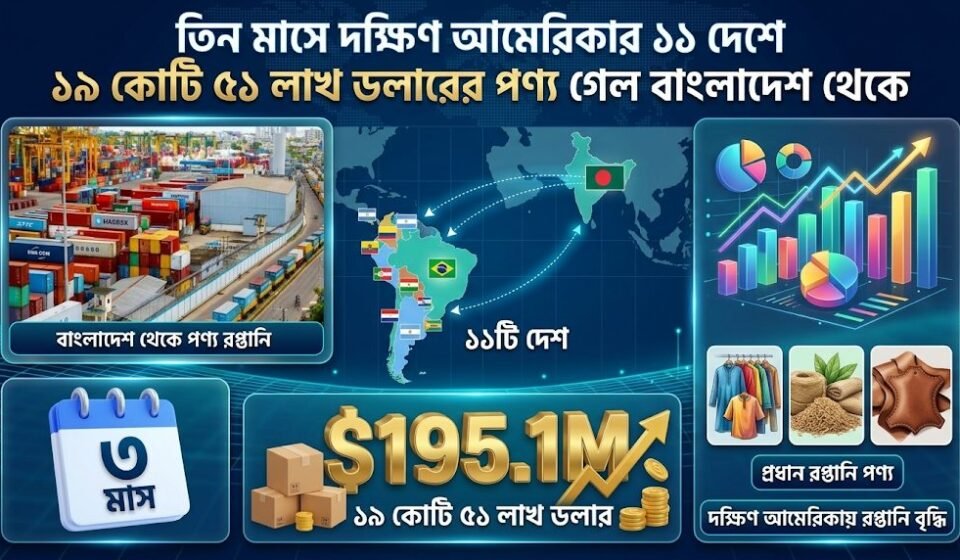
Bangladesh exported goods worth $195.17 million to 11 countries of South America in the first three months (July-September) of the current 2026-27 fiscal year. As part of the drive to expand exports beyond the traditional markets, efforts to ship goods to this region have been stepped up, and Brazil, Chile and Peru have emerged as the main destinations.
According to Export Promotion Bureau (EPB) data, exports to Brazil during the period stood at $70.82 million, to Chile at $51.87 million and to Peru at $24.24 million. Besides, goods worth $18.05 million went to Colombia, $11.63 million to Uruguay and $10.28 million to Argentina.
There is significant scope to expand exports to South America, outside the traditional markets of Europe and North America. Readymade garments are still the main source of Bangladesh’s export earnings in this region, but opportunities are also emerging to expand the market for jute goods, leather goods, home decor items, handicrafts and lifestyle products.
To that end, Bangladesh took part in the ‘Home Show Brazil 2026’ exhibition held in Sao Paulo, Brazil, from 11 to 13 August. With financial support from the EPB and under the management of the Bangladesh embassy in Brasilia, four companies from the country took part in the exhibition – Zihan Plastic Industries, Mother Tannery, Rainbow Jute and Classical Handmade Products. The companies showcased their products at five booths.
Jute goods, bags, leather items, baskets made of natural fibre, home decor materials, bamboo products, terracotta, earthenware items and nakshi kantha were displayed at the exhibition.
The EPB and the Bangladesh embassy also set up a promotional booth to inform foreign buyers about Bangladesh’s exportable products and promising sectors.
During the exhibition, opportunities were created for business contacts and exchanges of views among various companies, and prospective buyers visited the Bangladesh stall and expressed interest in the products on display. A seminar was also organised on the production and export of Bangladesh’s home decor and lifestyle products, through which an effort was made to present the potential of Bangladeshi products to Brazilian business bodies and international buyers.
EPB Vice Chairman and Chief Executive Officer Mohammad Hasan Arif said the EPB is working to diversify Bangladesh’s export products and to strengthen the country’s position in emerging international markets; for this, emphasis is being placed on taking part in international trade fairs in a more planned and professional manner.
He said excessive dependence on readymade garments and confinement to a few export markets could expose Bangladesh’s export earnings to the risks of global economic volatility, and it is for this reason that finding new products and new markets is becoming increasingly important.
Mohammad Hasan Arif further said that before taking part in international exhibitions, advance research is needed on the demand of the market concerned, consumer preferences, product prices, competition and business norms.
This will increase the benefits of participating in exhibitions. At the same time, emphasis must also be placed on strengthening the branding of the national pavilion, improving the preparedness of exporters and increasing direct contact with international buyers, through which it will be possible to turn exhibition participation into long-term business opportunities.
According to the EPB’s product-wise data, Bangladesh’s exports to the 11 countries of South America are still mainly dependent on readymade garments. In the first three months of the current fiscal year, earnings from the export of woven garments and garment accessories stood at about $84.53 million, while knitwear exports in the same period stood at about $71 million.
Taking the two categories of products together, export earnings stood at about $154.63 million, which is about 79.2 per cent of Bangladesh’s total export earnings from those 11 countries.
During this period, earnings from pharmaceutical exports stood at about $6.58 million and from footwear and related products at about $5.71 million. Other textile products, leather goods and travel goods are also on the export list; by expanding the market for these products, there is scope to diversify Bangladesh’s export basket in South America.
In export terms, Brazil and Chile together accounted for about 62.9 per cent of Bangladesh’s total export earnings, and exports to the two countries stood at $122.69 million. As a result, Brazil and Chile are getting special importance in market expansion plans, while there is also scope to expand exports by increasing business contacts in Peru and Colombia.
Background
Bangladesh’s exports to Brazil have been rising for several years. According to EPB data, goods worth $187 million were exported to Brazil in the 2024-25 fiscal year, 26 per cent higher than the $147 million of the 2023-24 fiscal year; the main products of that export were readymade garments such as jerseys, pullovers, cardigans, shirts, suits, jackets and trousers – The Business Standard reported this on 30 August 2025.
The numbers
According to EPB figures, Bangladesh’s overall merchandise exports in the first quarter (July-September) of the current fiscal year stood at $13.094 billion, 6.34 per cent higher than the $12.313 billion of the same period of the previous fiscal year – UNB reported this on 1 October. By this count, exports to the 11 countries of South America make up a very small part of the country’s total quarterly export earnings.
According to the same report, readymade garments worth $10.578 billion were exported in those three months, and the top single destination was the United States ($2.591 billion), followed by the United Kingdom ($1.37 billion) and Germany ($1.218 billion).
At a glance
The Export Promotion Bureau is a government agency under the Ministry of Commerce, tasked with developing the country’s export industry; the agency was established after the Export Promotion Bureau Ordinance was issued in 1977, and it is headquartered in Dhaka, with regional offices in Chattogram, Khulna and Rajshahi – this description appears in the English Wikipedia entry.