







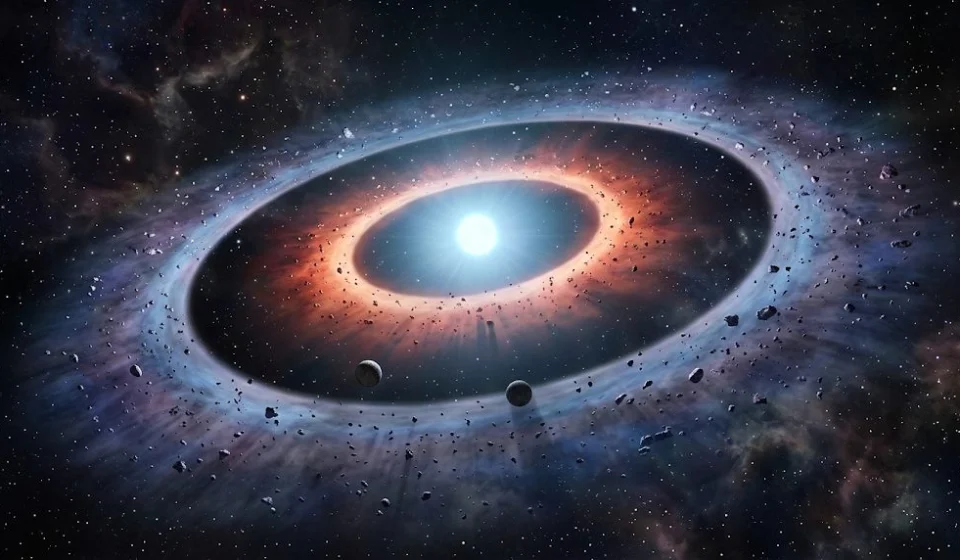
Two rings around a dead star 1,600 light years away offer a glimpse of the solar system’s future

Photo: Collected
Scientists have found a strange sight: two separate rings of dust and gas circling a dead star. This white dwarf, named J1328-1450 and located about 1,600 light years from Earth, is showing exactly what happens when a Sun-like star reaches the end of its life. At the same time, it offers a possible picture of the solar system’s distant future.
Like the Sun, this star once had its own planets. When the star died billions of years ago, its inner planets were shattered in violent explosions. Usually only a single ring of such debris is seen around a dead star. But scientists were surprised to see two separate rings here.
Researchers believe that two small rocky asteroids or fragments, about the size of Pluto, survived the shock of the star’s death and still remain inside the two rings. It is their gravitational pull that has split the dust into two rings. Interestingly, the composition of the two rings also differs — the outer ring contains less magnesium than the inner one.
The Sun’s fate
About 5 billion years from now, our Sun too will run out of fuel and turn into a huge red giant. Mercury and Venus will then be burnt completely to ash. Scientists do not agree on whether Earth will survive. However, distant planets such as Jupiter or Saturn are more likely to survive.
Later, when the Sun shrinks into a ‘white dwarf’ like this dead star, the surviving fragments of the solar system may come very close to it and be smashed to pieces in the same way. Such beautiful rings may then form from the remnants of our familiar solar system too. Besides unlocking a mystery of space, the scientists’ discovery is therefore also a small glimpse of our own future.
By the numbers
Publishing a Reuters report, Pakistan’s The Express Tribune said on 7 November that the white dwarf has about 47 per cent of the Sun’s mass but a diameter roughly equal to Earth’s. All 21 debris-surrounded white dwarfs identified before this had a single disc around them.
At a glance
According to the same report, the research was published in the journal Nature Astronomy, and the observations were made with the European Southern Observatory’s Very Large Telescope in Chile. According to EarthSky, the paper was published on 26 October 2026.
Sources
Background sources: The Express Tribune (Reuters), 7 November 2026; EarthSky, 29 October 2026