


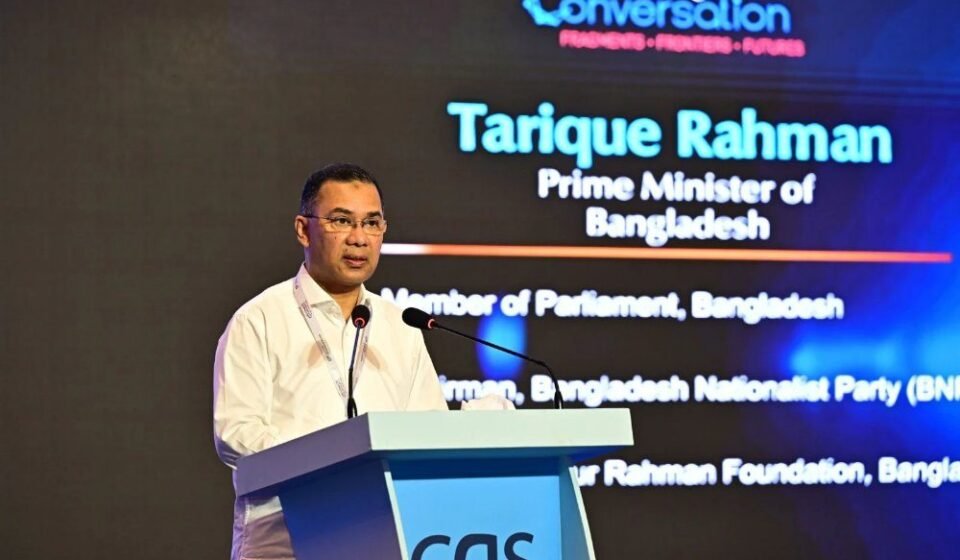

Photo: Collected
Prime Minister Tarique Rahman has said the newly elected government, which took office with a huge public mandate, has a five-year action plan in hand. He said safeguarding national interests, policy continuity, economic stability and institutional reform are the government’s priorities. Having passed the phase of promises, the government is now moving directly towards implementation.
The prime minister said that alongside turning Bangladesh into an attractive destination for investment, the country is being built as a strong manufacturing and investment hub. There is a goal of creating massive employment in all sectors including manufacturing, services and exports. Policy certainty is essential for investors, and the continuity of long-term policies will provide that certainty.
He said this at the three-day international conference ‘Bay of Bengal Conversation (BOBC) 2026’ at the Pan Pacific Sonargaon hotel in the capital on Saturday (3 October) morning. The conference is being held for the fifth time, organised by research organisation Centre for Governance Studies (CGS).
On social protection, he said the programmes have been designed in such a way that the most underprivileged people get priority. Through the ‘Family Card’, financial assistance will be delivered to the hands of the mother of every family, beginning with the poorest and most marginalised population. The ‘Farmer Card’ will connect farmers with government incentives, agricultural services and the market system, the ‘Health Card’ will ensure healthcare for all, and ultimately citizens will get integrated government services under one umbrella through the ‘Universal Card’.
Speaking of taking healthcare to every home, the prime minister said work is under way to recruit one lakh healthcare workers, around 80 percent of whom will be women. They will provide primary treatment, health-related advice and necessary referral services at the grassroots. Special importance is also being given to protecting the health of mothers and children.
On education, he said the education system will prepare students not just for certificates but for real life. Work is under way to ensure a joyful learning environment. Culture, sports, values and ethics will have an important role in the curriculum, and students will also have the opportunity to learn a third language. Technical and vocational education will be expanded alongside general education. The government will provide free uniforms, school bags, mid-day meals and stipends from class one, and the scope of free education for girls is being extended up to the graduate level.
Terming the young population a unique driving force of national progress, he said skills and suitable employment are needed to make use of this demographic dividend. Alongside enhancing language skills and creating employment, technological transformation and artificial intelligence are being embraced, and support is being given to innovation, entrepreneurship development and start-ups. In his words, let the youth compete on the world stage and turn brain drain into brain circulation.
Mentioning the agriculture sector as the main foundation of the economy, the prime minister said technology, irrigation, agricultural financing and market linkage for agricultural products are being made more accessible. Support is being given to fisheries, livestock and rural entrepreneurs, and the agro-processing and agricultural export industries must be advanced as a complement to food security. He believes that only a strong rural economy can build a strong Bangladesh.
Terming water security equally important, he said a plan has been taken to excavate 20,000 kilometres of canals and waterways in the next five years. The Padma Barrage project is being taken forward and the Teesta Master Plan is being formulated with the aim of water conservation and management. These steps will support the agriculture sector and increase climate resilience.
Speaking of specific targets for protecting the environment, the prime minister said 25 crore trees will be planted in the next five years and the use of solar power is being expanded. Bangladesh is playing a leading role in waste recycling and setting up environment-friendly green factories; 53 of the world’s top 100 LEED-certified factories are now in Bangladesh. By building clean and environment-friendly cities, it is possible to reduce waste, achieve climate resilience and make the economy more dynamic.
Commenting that strong state institutions are essential for development, he said institutional transparency and accountability are being strengthened. Human rights, democratic values and freedom of expression must be protected, and the rule of law must apply equally to every citizen. An institutional culture will be built where state institutions will truly be engaged in serving the people.
On global responsibility, the prime minister said Bangladesh is still sheltering around 12 lakh Rohingya refugees. The main goal is to ensure their speedy, voluntary, safe, dignified and sustainable repatriation to Myanmar, for which continued political support and financial assistance from the international community are needed. Resolving the root causes of the crisis is also essential; the crisis that originated in Myanmar must also end in Myanmar.
He said the Bay of Bengal has been shaping the destiny of Bangladesh for generation after generation. Because of its geographical and strategic location, the country’s seaports, waterways and coastal economy can be connected with the entire world. There is immense potential in shipping, fisheries resources, tourism, energy and regional supply chains. Deeper bilateral and multilateral engagement is needed to transform this shared geography into shared prosperity.
In the prime minister’s words, mutual cooperation in the trade, energy, education, technology, climate and maritime sectors can be expanded further. Additional opportunities can be created for the youth by opening up new markets, and a stronger relationship of cooperation can be built on the basis of equality, fairness and justice. He firmly believes that just as geography has brought everyone together, close people-to-people ties will take things much further.
He said Bangladesh believes in dialogue, partnership and mutual respect. Alongside protecting national interests and sovereignty, it will continue to work positively with all regional and global partners, because peace and harmony are the main foundation of shared prosperity and development.
At the end of his speech, the prime minister expressed the hope that the Bay of Bengal region would become an area where every state will flourish together, enjoy mutual and equal benefits, and where citizens will extend the hand of meaningful cooperation. He said Bangladesh is fully prepared to play its due role in this regard.