
Photo: Collected
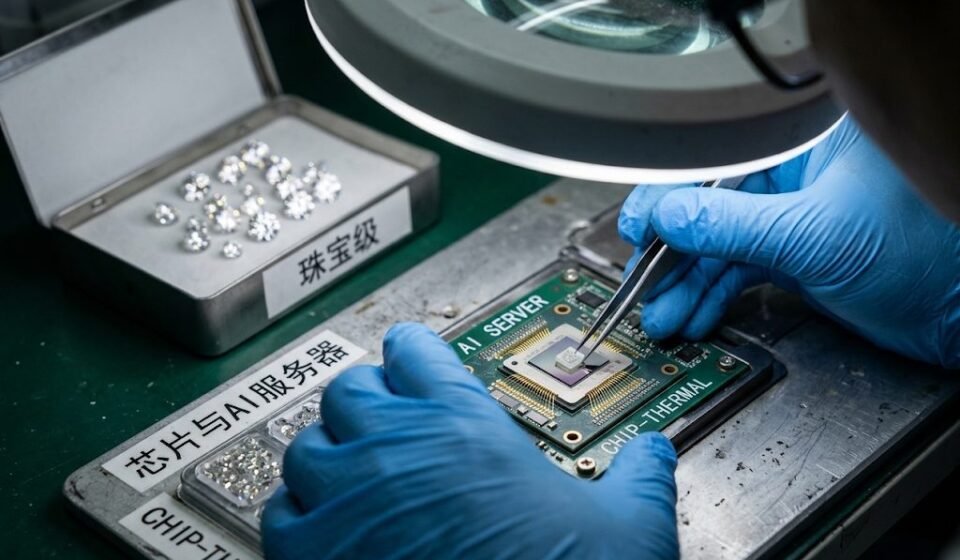
With prices falling and competition intensifying, China’s lab-grown diamond producers are looking for new avenues beyond the jewellery market. Their goal now is to make advanced materials for semiconductors, artificial intelligence (AI) servers and other high-tech uses. Producers believe the future of this huge industry is not confined to gemstones; big opportunities await in the technology sector too.
Feng Canjun’s factory produces 2 million carats of lab-grown diamonds a year. About 70 percent of that now goes into making jewellery. But the entrepreneur believes the industry’s growth in the days ahead will depend on supplying diamonds for various high-tech uses, including semiconductors and AI servers.
Feng plans for more than 50 percent of his factory’s diamonds to go into functional materials by 2030. Over the same period he wants to cut the share used in jewellery to below 30 percent.
About half of the world’s total supply of lab-grown diamonds comes from China. For years the country’s producers have been making diamonds for jewellery, cutting and drilling. But with competition rising and prices falling, they are now turning to technology-driven markets that offer more room for added value.
This shift could also add a new dimension to the China-US technology rivalry. If the use of lab-grown diamonds in thermal management for semiconductors and AI infrastructure grows, China’s dominance in production could become a strategic weak point for US supply chains. According to Manan Goenka, engagement manager at consultancy Ken Research, this transformation of the diamond industry is one of the most important aspects of a structural change that is directly affecting global technology supply chains.
Analysts and companies in the field believe a new chapter of growth could open for the lab-grown diamond industry if demand rises in areas such as chips, thermal management and quantum technology. Certain special physical properties of diamond can help boost the performance of advanced electronics and computing systems. In particular, lab-grown diamond could become a key material for quickly removing the heat generated by high-power devices.
The change is happening at a time when the spread of AI has created pressure to expand data centre capacity. A 2025 report by the International Energy Agency (IEA) says electricity use by data centres could more than double by 2030 to around 945 terawatt-hours, roughly equal to Japan’s total electricity consumption in a year. Growing use of AI is one of the main drivers of this extra demand for power.
Analysts reckon lab-grown diamond could create a big market for thermal management in the near future. But widespread commercial use of diamond as a core material for making semiconductors is still a long way off. For use in chipmaking, diamond has to be extremely pure, and production standards are far stricter. Those requirements are comparatively looser for diamonds used in cutting and drilling.
Interest from several of the world’s big technology companies, however, suggests that new demand for lab-grown diamond may emerge in chips and other electronic devices. The more AI computing spreads, the more heat devices generate. As a result, advanced cooling technology is becoming more important for maintaining the performance of chips and servers.
According to Chinese media reports, Huawei and Taiwan Semiconductor Manufacturing Company (TSMC) are exploring the use of lab-grown diamond to keep chips cool. Lenovo has said it has launched a consumer laptop in the Chinese market whose cooling system uses a material made from a mix of diamond and copper.
Last June, Intel chief executive Lip-Bu Tan said he had personally invested in Diamond Foundry, a company working on making diamond wafers suitable for chipmaking. The venture suggests the potential of lab-grown diamond is not limited to keeping devices cool; it could one day also find a place as a material for making chips.
Huawei, Lenovo and Intel did not respond to requests for comment on the matter. TSMC declined to comment.
Hoping that demand from the technology sector will rise, several Chinese producers are already lining up investment plans. According to a filing submitted in June, Henan Liliang plans to put 1 billion yuan of funds previously raised to expand diamond production into a new functional diamond project.
The transformation of China’s lab-grown diamond industry is therefore not just a hunt for new markets but also a bid to play a bigger role in high-tech supply chains. But to move away from the jewellery market and become a major player in the technology sector, producers will have to improve diamond purity and production quality, and their ability to supply at competitive prices. If they can clear these hurdles, lab-grown diamonds, best known for jewellery, could one day become a key material for the AI and chip industries.
Background
According to the China Superhard Materials (Industrial Diamond) Association, about 80 percent of China’s total lab-grown diamond output comes from Henan province, the Henan provincial government’s English portal reported on 4 June 2024.
By the same association’s 2024 estimate, about 95 percent of the world’s lab-grown diamonds are produced in China; this differs from the ‘about half’ figure in the original report, as data vary by source.
By the numbers
According to jewellery analytics firm Tenoris, open-market prices of lab-grown diamonds fell by about 20 percent in the 12 months to November 2023, Business Insider reported in February 2024.
According to Bain & Company, the cost of producing a lab-grown diamond fell from about $4,000 per carat to $300 over a decade, a Reuters report published in FashionNetwork on 21 December 2018 said.
Sources
Original report: Ajker Patrika
Background sources: Henan provincial government English portal, 4 June 2024; Business Insider (AOL), February 2024; FashionNetwork (Reuters), 21 December 2018