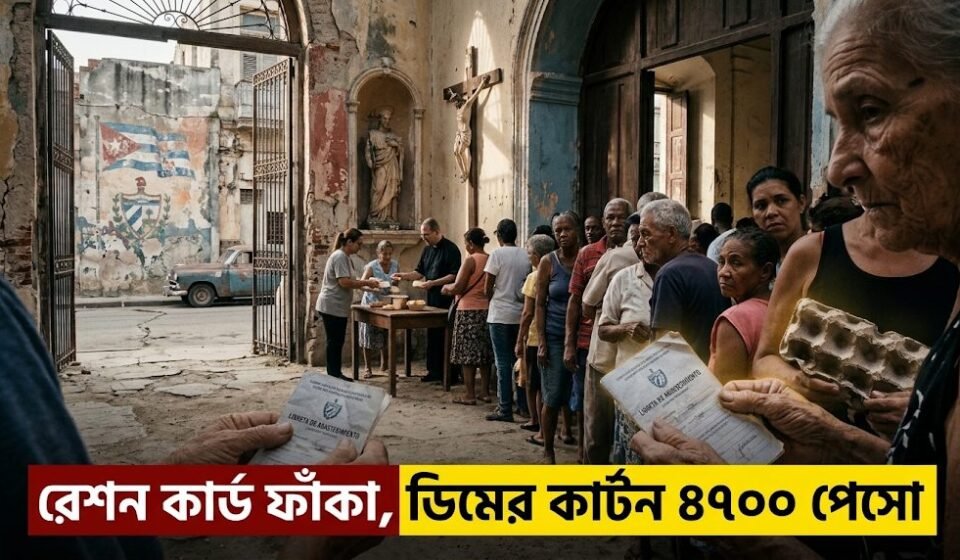
Empty ration cards and 4,700-peso egg cartons: in revolutionary Cuba, people now turn to the church

Photo: Collected
Food shortages, a collapsing health system, days on end without electricity, and people leaving the country in droves. In Cuba, once a revolutionary state, a dire economic crisis is being accompanied by the collapse of state services and administrative structures. The state ration system has all but ground to a halt, hospitals and clinics have no medicines, and in many areas churches and religious organisations are stepping in to meet people’s basic needs. A report The Atlantic produced after travelling around the island nation shows that this long-running crisis has deepened further in recent times.
After the 1959 revolution, a communist government led by Fidel Castro took power in Cuba. Education, healthcare and a large part of the economy passed into state hands. Decades on, questions are now being raised over whether that state system can function at all. The picture of life in various parts of the country points not only to the steady decline of state services but also to waning public support for the government.
The reporter saw the face of this change at an old church in eastern Havana. Its priest, Ivan Guerra Alvarez, said that after the revolution the government seized the church’s convent, residential quarters and school. The nuns were removed, and security guards were posted in one part. At one point the church’s work almost came to a standstill.
Now the tide is turning. The church has begun trying to recover the historic building held by the state. The priest believes religious institutions could play a big role in any future political change in Cuba. He maintains that, outside the government, the church is one of the country’s largest institutional forces.
But when and how political change will come is uncertain. US President Donald Trump’s administration has also stepped up pressure on Cuba. The report says moves to block fuel supplies early this year have further complicated the country’s economic crisis. Meanwhile, the room for opposition political forces inside the country to organise effectively is limited.
Cuba’s economic plight is seen most clearly in ordinary people’s incomes and food prices. The state ration system once guaranteed every citizen some basic food items. But when The Atlantic’s reporter visited the country last August, they found that no allocations had been entered on ration cards for several weeks.
Public sector workers earn an average monthly salary of about 6,500 pesos, less than $10. Doctors and teachers also fall within this income bracket. Yet in some places a single carton of eggs costs as much as 4,700 pesos. As a result, even after spending a large chunk of a month’s salary, a government employee struggles to buy the food the family needs.
Withdrawing cash from banks is a hassle too. At some banks a customer can take out only 1,000 pesos a day, less than one and a half dollars.
With no electricity, many fishermen in eastern Cuba have gone back to the old way of preserving fish — drying and salting it. The capital Havana also goes without power for long stretches, but conditions in the east are worse. Roads there are broken, vehicles are scarce, and in many areas horse-drawn carts are one of the main means of getting around.
A huge number of Cubans have moved abroad over the past few years. According to the report, up to a quarter of the country’s population may have left in recent times. Many families have been torn apart, and the shortage of skilled workers in institutions has grown even worse.
For years the health system was promoted as one of the communist government’s great achievements. Fidel Castro used to hold up the wide network of local clinics as proof of the socialist system’s success. The government also sent doctors abroad to boost its international profile and earn foreign currency, although the working conditions and freedoms of the doctors sent overseas have drawn criticism.
That health system is now struggling with a shortage of doctors and medicines. With many doctors having left the country, patients’ access to treatment has shrunk.
On Cayo Granma, an islet off the coast of Santiago de Cuba, the reporter met 55-year-old nurse Clara Luaces. She is responsible for the care of the island’s roughly 870 residents as well as many people in nearby coastal areas. With doctors leaving the country fast, it has become hard even to pin down how many patients she has and how far her duties stretch.
Her clinic is nothing more than a tiny room. There, a 12-year-old child with a fever had a saline drip in their arm. Beside them, another child with a skin infection sat with their mother.
Luaces said piped water had not reached the island for nearly three months. The lack of clean water has led to a rise in bacterial fevers and skin infections. Running short of medicines is a daily problem too. Treating patients with meagre resources leaves her facing an almost impossible situation.
Pointing to the shortage of doctors and health workers, she said she cannot even retire, because there is no one else to take over.
In Santiago de Cuba, the country’s second-largest city, the reporter was struck by the number of beggars. By the sea, the reporter met a 76-year-old woman and her daughter. Both were painfully thin. The woman said her son had died of cancer last year. He had been the family’s only breadwinner.
Since then mother and daughter have been begging on the streets and collecting plastic bottles to sell for a little money. They receive no government support. Visiting their home, the reporter found that they sleep on pieces of cardboard laid over a metal bedframe in a small room instead of a mattress. There is not even a light bulb in the room.
In such conditions, public anger at the government is also growing. The Committees for the Defence of the Revolution were once active in gathering information and keeping watch on behalf of the communist government. Now, when asked about these committees, many locals burst out laughing. Nor are they as afraid as before to criticise the government.
That anger came through in the words of a man on a beach in Baracoa. As soon as he was asked about communism, he cursed Fidel Castro in harsh language. People around him laughed at first, but then he broke down. In his words, Cuba seems frozen in time and people have no hope; being born Cuban is itself a sorrow to him.
Many of those who spoke to the reporter did not blame the United States for their plight. Some said the blow from the coronavirus pandemic had been bigger than the US obstruction of Venezuelan oil supplies. During the pandemic Cuba’s tourism industry was hit hard, and the value and availability of money sent home by relatives abroad also fell.
According to a retired engineer, Venezuelan oil never properly reached ordinary people anyway.
Religious institutions are playing a growing role in filling the gaps in state services. Catholicism once had a sweeping influence in Cuba. After the revolution the government made atheism the state ideology, and many religious figures were forced to leave the country. Some believers were sent to re-education camps.
Now, especially in the east, Evangelical and Pentecostal churches are spreading alongside the Catholic Church. One pastor said the number of Assemblies of God churches in the Baracoa area had grown from two to 40 over the past three decades.
Raul de Jesus Munoz Munder, a Pentecostal pastor in Baracoa, said his congregation has about 1,100 regular members, but far more people receive help. Every week he sits down with his assistant pastors to find out who is ill in which area, whose home has no food and who needs medicine. He then arranges for help to reach them.
When the Trump administration approved $100 million in aid for Cuba last May, it set the condition that the money be distributed through faith-based groups and humanitarian organisations. This has further increased the social role of religious institutions. But the religious revival in Cuba is not simply the result of foreign aid; the decline of state services is also a major reason.
At a Catholic home for the elderly in Havana, meanwhile, people who once worked in government jobs or the military are now seen living out helpless days. Many of their children are abroad. They are cut off from both the state and their families.
A 65-year-old former soldier had fought in Angola for two years. On his arm is a Che Guevara tattoo he got at 18. Once a supporter of the revolution, he is now angry at the state of the country. He even spoke of tough action against the people at the top of the government.
Another side of the crisis is the decay of social and cultural life. An 81-year-old musician in Santiago said that once there were bands of musicians at almost every street corner in the city. Even after 45 years in music, he no longer sees that scene.
Many of those who spoke to the reporter said Cuba was not like this before. They talked not only about food shortages, illness and power cuts, but also about anger, despair, and the joy and life draining out of their days.
The Atlantic’s report ends with a picture of the Santa Ifigenia cemetery in Santiago, where Fidel Castro’s ashes are kept. In contrast to the neglect and dilapidation across the country, the cemetery is clean, green and carefully tended. A changing of the guard is held there regularly in military style, and soldiers also march ceremonially in front of the mausoleum of Cuba’s national hero, Jose Marti.
Seeing that orderly display, one might think for a moment that the dream of the revolution is still intact. But outside the cemetery, the acrid smell of burning rubbish drifts on the air. That smell seems to symbolise today’s Cuba — on one side, memories of the revolution and state rituals; on the other, ordinary people’s hunger, illness, uncertainty and deepening despair.
Background
After the US operation against Venezuelan President Nicolas Maduro on 3 January, the Trump administration imposed an oil blockade on Cuba, after which oil from Mexico also stopped coming, Al Jazeera reported on 3 August.
According to a Boston Globe report of 20 February, Trump signed an executive order in January threatening tariffs on countries supplying oil to Cuba.
According to President Miguel Diaz-Canel, no oil from any foreign supplier had reached Cuba for three months, and the country produces only 40 percent of the fuel it needs, OPB reported on 22 March.
By the numbers
According to an OPB report of 22 March, Cuba’s national grid collapsed on 21 March, the third nationwide blackout that month.
According to a Local 10 News report of 3 August, the breakdown in early August was Cuba’s sixth nationwide grid failure this year; the entire grid collapsed again on 18 September, CP24 reported that day.
According to Cuba’s National Office of Statistics and Information (ONEI), the country’s population stood at 9.4 million at the end of 2025, down from 9.7 million a year earlier, an AFP report published in The Peninsula on 22 July said.
Sources
Original report: Ajker Patrika
Background sources: Al Jazeera, 3 August 2026; The Boston Globe, 20 February 2026; OPB, 22 March 2026; Local 10 News, 3 August 2026; CP24, 18 September 2026; The Peninsula (AFP), 22 July 2026