


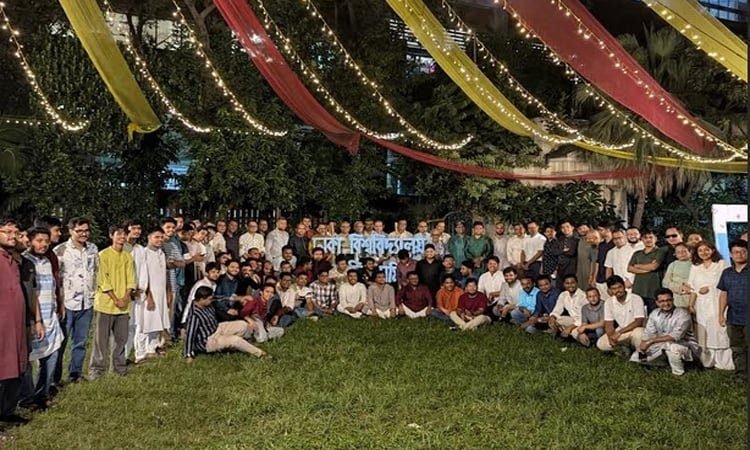
Dhaka University Journalists’ Association steps into 41st year after four decades

Photo: Collected
The Dhaka University Journalists’ Association (DUJA) has stepped into the 41st year of its founding. The organisation, which began its journey on 19 September 1985, has for four decades been presenting Dhaka University’s education, research, administrative activities, the various problems of students and different incidents on the campus in the news media with professionalism.
On the occasion of the founding anniversary, a discussion meeting and cultural evening were organised at the university’s TSC cafeteria yesterday evening. Teachers of the university, representatives of the administration, former and current members of the association and journalists of different levels took part in it. The speakers discussed objective journalism, the institutional structure of the media, the professional safety and responsibility of journalists and the importance of campus journalism.
The prime minister’s Press Secretary Saleh Shibly said that although the scope of journalism and the number of media organisations have grown, there is a need to think afresh about how far journalism has taken an institutional shape. Alongside the growth in the number of media outlets and journalists, whether the quality of journalism and the professional rights of journalists are being ensured is also an important question.
He said the phrase ‘power must be questioned’ is now widely used. However, alongside questioning state power, journalists also need to raise questions about the power structure of their own workplaces. The owner and the editor of a media organisation are also important powerful persons in a journalist’s workplace. Whether a journalist is getting the proper value and salary for his or her labour should also come up for discussion.
Saleh Shibly said that before new media organisations are launched, it needs to be ensured whether they have the capacity to pay journalists and staff regular salaries. If a newspaper, television channel or online media outlet is suddenly launched without the ability to pay salaries for at least a certain period and without an institutional structure, the journalists and staff working there fall into uncertainty.
He said a situation like ‘I brought out a newspaper with great fanfare, and two months later did not bring it out any more’ creates professional uncertainty for journalists. Incidents such as an organisation shutting down within a few days of one joining the media, or the owners being untraceable, need to stop.
On the responsibility of journalism, he said that in a democratic state not only journalists but the people too have the right to question the government. The state belongs to the people, and it is the people who give the responsibility of running the state to elected or assigned representatives. Journalism can present those questions before the people in a more organised and effective manner through an institutional process.
He laid emphasis on journalists making the environment of their own workplaces and the professional structure cleaner and more responsible. At the same time, he called for maintaining mutual respect, tolerance of dissenting views and professional cordiality.
Nurul Karim Bhuiyan, former president of the association and deputy commissioner of Gazipur, said he was delighted to be able to take part in the founding anniversary event. Mentioning his long-standing relationship with the association, he greeted its current and former members. He said he had the opportunity to get together after a long time with colleagues and seniors from his time in the association. Such events further strengthen mutual contact and relations among journalists.
The university’s Pro-Vice-Chancellor Professor Dr Almojaddedi Alfesani said presenting objective news is not an easy task. However, Dhaka University’s campus journalists have been carrying out this responsibility with skill for a long time. Their reports bring out the university’s positive activities as well as various inconsistencies and problems.
He said journalists’ reports often help the university administration understand the real situation and take the right decisions. So it is essential to have mutual cooperation and a responsible relationship between the administration and journalists.
Stressing the need to enhance the skills of the new generation of journalists, he proposed organising training for campus journalists. He also remarked that such training can play an important role in journalistic ethics, fact-checking, objective news presentation and enhancing professional skills.
The speakers said campus journalism has an important role in building a bridge among the university’s students, teachers and administration. By presenting academic activities, research, administrative decisions, the problems and achievements of students and the overall environment of the campus in the news media, journalists present a picture of the university before the wider society.
They further said that in campus journalism it is essential to verify the accuracy of information, take the statements of all parties concerned and present news rising above personal or organisational interests. Alongside this, the matter of ensuring journalists’ professional dignity, safety and fair remuneration also needs to be considered with importance.
A cultural programme was held after the discussion meeting, in which invited guests, including current and former members of the association, took part. On the occasion of stepping into the 41st year after crossing four decades, DUJA members expressed their determination to maintain the organisation’s tradition, professional standards and the continuity of responsible journalism.