

Government wants to cut 50-55-day business approvals to 14 days, commerce minister seeks World Bank support

Photo: Collected
Trade licences, environment and fire safety clearances or import registration certificates (IRC): getting these government services needed to start and run a business now takes 50 to 55 days, sometimes even longer. The government has embarked on a major reform to overcome this delay. The aim is to bring the time down to 14 days.
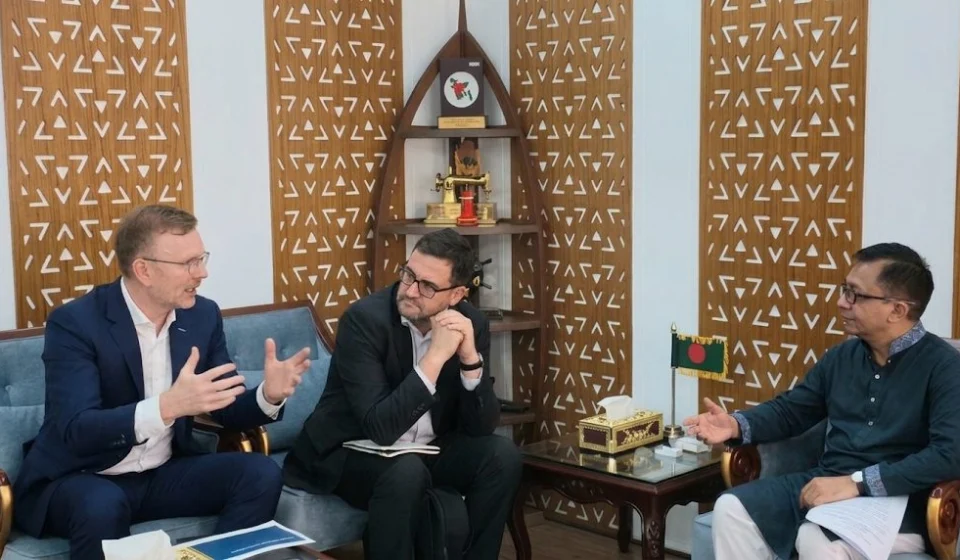
An eight-member delegation led by Jean Pesme, the World Bank’s Division Director for Bangladesh and Bhutan, held a meeting at the Commerce Ministry at the Secretariat on Tuesday morning. Commerce Minister Khandaker Abdul Muktadir outlined the plan there.
The minister said the process of providing the services is being digitised to make business operations easier. There is a plan to bring the time for getting services down to 14 days through the National Single Window and the one-stop service portal of ‘Invest Bangladesh’. Bangladesh has sought the World Bank’s policy and technical support for this work.
The government hopes that if the initiative is implemented, both time and costs for businesses will fall and the investment climate will also improve.
With LDC graduation ahead, the government has also taken the initiative to adopt an integrated action plan for the next three years. Emphasis is being placed on moving away from an export structure reliant on readymade garments and advancing the leather, footwear, shipbuilding and recycling, light engineering and gold jewellery industries.
The commerce minister said a large share of the country’s export earnings has depended on the readymade garment sector for many years. The capacity of new sectors is being increased to reduce this dependence.
To expand the international market for leather, there are plans to ensure environmental standards and compliance at the Savar Tannery Industrial Estate. To this end, an initiative is being taken to set up a new central effluent treatment plant (CETP). Efforts are also under way to obtain Leather Working Group (LWG) certification to increase acceptance in foreign markets.
The minister also spoke of plans to bring the country’s gold industry into an institutional framework and develop it into an industry capable of exporting gold jewellery within the next few years.
Trade agreement talks are under way with several countries to boost export capacity. Talks are progressing on economic partnership agreements (EPAs) with Japan and South Korea and free trade agreements (FTAs) with the United Arab Emirates, Malaysia, Singapore and the European Union.
In-principle approval has also been obtained for Bangladesh to join the regional trade bloc, the Regional Comprehensive Economic Partnership (RCEP).
The Commerce Ministry also plans to eliminate duplication and lack of coordination in development projects, increase the skills of project directors and turn the Bangladesh Foreign Trade Institute into a specialised institution.
Jean Pesme assured support for trade facilitation, implementation of the National Single Window, skills development in the leather and light engineering sectors and FTA-related research. He said the World Bank Group and the International Finance Corporation (IFC) are interested in working together to increase the capacity of Bangladesh’s private sector and manufacturing industries.
Sebastian Eckardt, regional practice director of the World Bank’s Prosperity department, said the three to four years before LDC graduation are very important for Bangladesh. If trade policy can be reformed, tariff and non-tariff barriers removed and the country integrated into global value chains during this period, foreign investment and employment will rise significantly.
He also said the World Bank is interested in providing training and technical assistance to increase the negotiating capacity of Bangladeshi officials in FTA talks.
Lead Economist Souleymane Coulibaly said reform of para-tariffs and the supplementary duty structure can play a big role in boosting export competitiveness. If trade reforms and logistics infrastructure development can be carried out drawing on Vietnam’s experience, it will create a big opportunity to increase Bangladesh’s export earnings and employment.
Besides senior World Bank officials, Commerce Ministry additional secretaries Dr Ahmad Ullah and Khadija Naznin, among other officials concerned, attended the meeting.
Background
Under a 2021 decision of the UN General Assembly, the scheduled date for Bangladesh’s graduation from least developed country (LDC) status was 24 November 2026, The Daily Observer reported on 4 September.
According to a report by The Business Standard, Bangladesh made a formal request in February 2026 to extend the preparation period by three years; on 1 June, the UN Committee for Development Policy (CDP) recommended extending the preparation period until 24 November 2029.
At a glance
To graduate from the UN-declared list of least developed countries, a country must meet three criteria, namely gross national income per capita, the human assets index and the economic and environmental vulnerability index, in two consecutive triennial reviews; Bangladesh has met them, The Financial Express reported.
Sources
Background sources: The Daily Observer, 4 September 2026; The Business Standard, 2026; The Financial Express, 2025