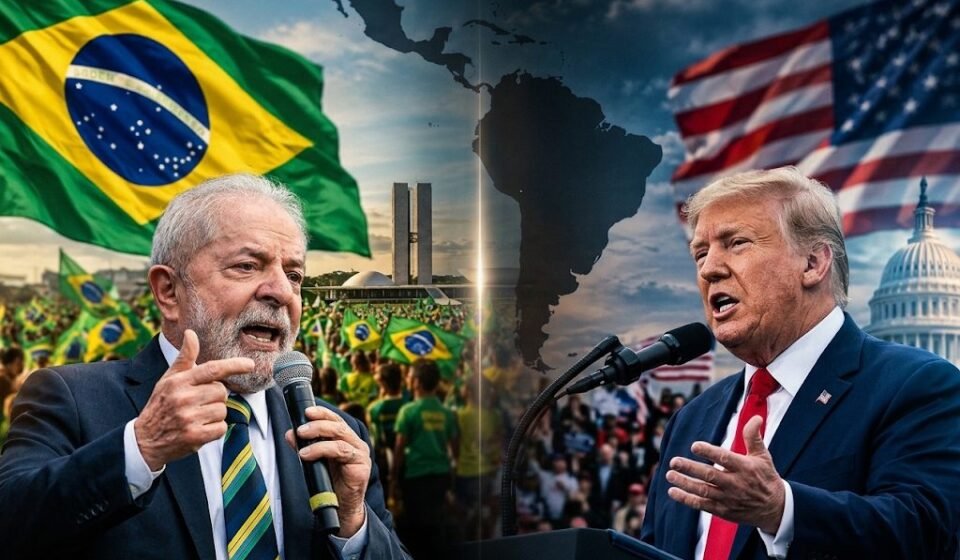
‘Brazil is nobody’s backyard’: Lula’s comeback trips up Trump’s Latin America plans

Photo: Collected
US President Donald Trump’s ambition to expand his influence in Latin America has run into a fresh obstacle in Brazil’s election. Leftist President Luiz Inácio Lula da Silva has won at the ballot box once again.
Lula did not budge an inch on the question of national sovereignty despite pressure from Washington and allegations of interference. That unyielding stance has worked to his political advantage.
At a time when right-wing leaders close to Trump are coming to power in several countries in the region, Lula’s victory in Brazil has complicated the United States’ strategy of regional dominance.
In his victory speech, Lula said, ‘Brazil will not accept being anyone’s backyard.’
There is little doubt the remark was aimed at Washington. Foreign policy is rarely the main factor deciding an election, and Brazil was no exception. But Lula’s stand against US interference in the country’s internal affairs helped stir patriotic sentiment among voters.
A former trade union leader, Lula has built much of his politics on standing up to the powerful. His firmness in the face of US pressure fits that image too.
Surprisingly, Trump appears to have developed a certain respect for Lula because of that firmness. Reacting to the election result, Trump said, ‘I like Lula, we have a good relationship.’
He added, ‘I didn’t take sides.’ Yet in the same breath he called the election ‘terrible’ and ‘rigged’.
Trump’s mixed messages show just how complicated the relationship between the two leaders is. Trump did not publicly back Lula’s rival Flávio Bolsonaro, but he had close political ties with Flávio’s father, former Brazilian president Jair Bolsonaro. Flávio himself has refused to accept the result.
Lula’s pushback against tariffs
When I spoke to Lula at his residence almost a year ago, relations between the two countries had hit rock bottom. Lula said at the time that he had no relationship with Trump, had never spoken to him and had no plans to call him himself.
Before that, Trump had slapped steep tariffs on Brazil, widely believed to have been driven mainly by political motives. Trump had called the coup attempt case against Jair Bolsonaro ‘political persecution’, and the punitive tariffs on Brazil were imposed over that very case.
While several US allies chose to avoid a confrontation with Trump, Lula went the other way. He spoke out forcefully for Brazil’s sovereignty, criticised US interference in the judicial process and even took to the campaign trail wearing a blue cap reading ‘Brazil belongs to Brazilians’.
That boosted his popular support. He also accused the Bolsonaro family, who had lobbied for the tariffs, of being unpatriotic. That left Brazil’s right, which has always claimed the high ground on patriotism, politically uncomfortable.
Some influential groups in the country’s agriculture sector also accepted Lula’s argument. Many of them are Bolsonaro supporters but depend on the United States for their business.
At one point the United States backed down and cut the tariffs, though they were later raised again. By then, however, the ice between the two countries had begun to thaw.
The two leaders spoke at the United Nations and later sat down for a meeting in the Oval Office at the White House. Trump called the meeting ‘very good’, while Lula said he was ‘very satisfied’ when it ended.
This suggests Trump may have a certain respect for leaders who take a firm stand.
Plans for dominance in Latin America
So why is Trump unhappy with Lula’s win?
Right-wing forces have grown stronger in Latin American politics in recent times. Several leaders close to the Trump administration have come to power in countries such as Ecuador, Chile, Colombia, Argentina and Peru. Trump wants to use these allies to cement US dominance in the Western Hemisphere. His administration has dubbed the strategy the ‘Donroe Doctrine’.
Christopher Sabatini, a senior research fellow on Latin America at think tank Chatham House, believes that after Flávio Bolsonaro took the lead in the first round, Trump thought Brazil would be his ‘tenth and biggest prize’.
Brazil is Latin America’s largest economy. Flávio Bolsonaro was expected to join Trump’s ‘Shield of the Americas’ alliance and sign up to its anti-drug trafficking initiative.
Brazil also has the world’s second-largest reserves of rare earth minerals after China. The United States had its eye on securing priority access to these critical minerals too.
Lula’s victory has upset those calculations. With another four-year term ahead of him, Washington will have to rethink the future of its relationship with Brazil.
Rows over the electoral system and military intervention
Relations may have improved somewhat, but there is still no shortage of friction between the two countries.
Earlier this year, Brazil accused the United States of trying to sow doubt about the credibility of its electoral system. As a result, Brazil refused visas to two US State Department officials who had planned to visit. In response, the United States revoked the visa of Brazil’s ambassador, and Washington dismissed Brazil’s allegation as ‘baseless’.
If Trump keeps calling Brazil’s election result ‘rigged’, fresh diplomatic tension could emerge between the two countries.
Lula has also been opposing US military activity in Latin America. He has criticised every such move, from the capture of Venezuelan President Nicolás Maduro to bombing boats suspected of drug trafficking.
Lula voiced anger after the United States, following lobbying by Flávio Bolsonaro, designated two of Brazil’s main criminal gangs as terrorist organisations. He fears such a move could become a threat to Brazil’s sovereignty.
The issue is particularly sensitive for the Latin American left. The US Central Intelligence Agency (CIA) has a history of involvement with several brutal military dictatorships in the region during the 20th century. Washington backed these regimes at various times in the name of halting communism.
Tension over technology and the digital economy
Technology has become a new area of dispute in US-Brazil relations.
Lula’s campaign had alleged that social media company Meta was tilted towards Flávio Bolsonaro. Meta denied the allegation but acknowledged that, because of some content moderation problems and technical glitches, a few posts had been removed by mistake or their reach reduced.
In response, Lula’s supporters used WhatsApp groups with nearly one crore members to spread his message while getting round the algorithms.
The Trump administration is also unhappy with Pix, Brazil’s instant payment system. The system, which plays a major role in the country’s economy, lets people send money quickly and easily. But in Washington’s view, the spread of Pix is increasing competitive pressure on the business of US payment companies such as Visa and Mastercard.
The divide between the two sides was also visible on the campaign trail. US flags flew at rallies of Bolsonaro supporters. At one rally a balloon was seen bearing the words ‘Trump, nuke Brazil’. Lula and his supporters, for their part, accuse Flávio Bolsonaro of putting US interests ahead of Brazil’s.
Trade ties matter too
Still, there is room to overstate the tension between the two countries. The United States is Brazil’s second-largest trading partner after China. Whatever their political differences, the importance of the two countries’ economic relationship cannot be denied.
For now, Trump and Lula have a working relationship. How long it lasts will depend on how far the United States wants to meddle in Brazil’s internal affairs and how firmly Lula stands his ground in response.
Lula’s return in Brazil is therefore not just a domestic political event. His victory has brought to the fore the tension between the US strategy of expanding its influence in Latin America and the desire of countries in the region to protect their sovereignty. Source: BBC
Background
US President Donald Trump announced a 50 percent tariff on all goods from Brazil in a letter on 9 July 2025, to take effect from 1 August that year, OPB (NPR) reported on 10 July 2025.
According to the same report, while the letters to other countries cited trade deficits, Trump’s letter to Brazil described the case against former president Jair Bolsonaro as a ‘witch hunt’.
By the numbers
According to the final count by Brazil’s electoral court (TSE), Lula won 51.79 percent of valid votes in the 25 October run-off against 48.21 percent for Flávio Bolsonaro, a margin of about 44 lakh 30 thousand votes, The Rio Times reported on 27 October.
According to the same source, Flávio Bolsonaro led the first round on 4 October with 47.03 percent of the vote, while Lula got 45.16 percent.
Sources
Original report: Bangladesh Pratidin
Background sources: The Rio Times, 27 October 2026; OPB (NPR), 10 July 2025