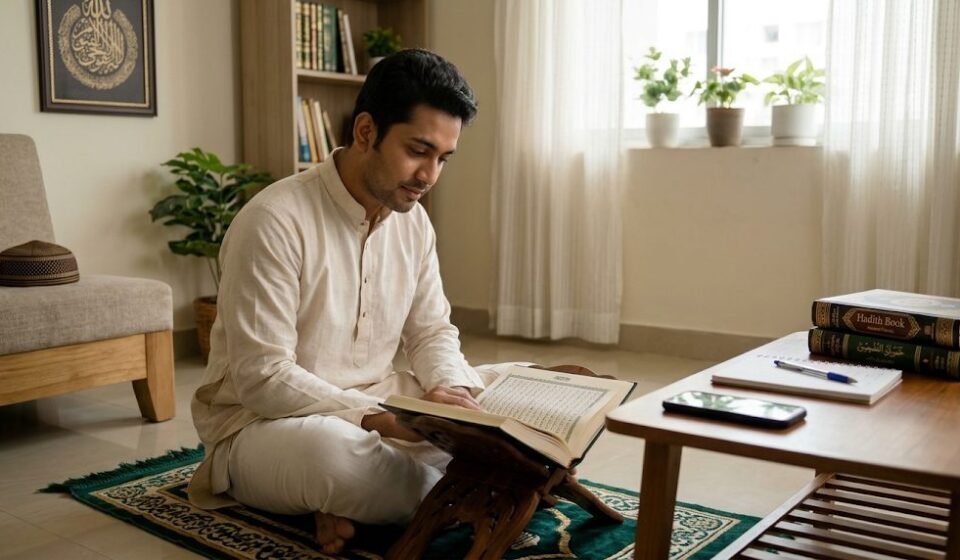
Let the Quran and Sunnah, not the algorithm, lead your life: a lesson in restraint on social media

Photo: Collected
Hundreds of millions of people around the world are now connected through social media platforms such as Facebook, YouTube, Instagram, X (Twitter) and TikTok. This era is called the age of information and technology. The astonishing progress of technology has certainly made life easier, but it has also brought some new challenges. For many, the day begins with their eyes on a mobile screen and ends while scrolling through the news feed. In this way, without people even realising it, technology has become a powerful force that runs their lives.
In prayer, the imam leads from the front and the muqtadi follows him. In modern society, the lifestyles, thinking, likes and dislikes, and even the values of many people are largely being run at the direction of social media algorithms, in much the same way. For a believer, this is something to reflect on deeply. Because Islam seeks to shape people not as slaves to circumstance, but as self-controlled, aware and responsible human beings. That is why Allah the Exalted says, ‘By time! Indeed, mankind is in loss.’ (Surah Al-Asr, verses 1-2)
Today countless people spend hour after hour on social media, yet at the end of the day realise they have gained no benefit worth mentioning. The teaching of Islam is that one day an account of every moment must be given to Allah. The Prophet (PBUH) said, ‘On the Day of Judgement, the feet of a servant will not move until he is asked how he spent his life.’ (Tirmidhi, Hadith: 2417)
Therefore, every minute spent on social media is also part of our record of deeds.
How freedom of thought is being lost
One of the major effects of social media is that it influences people’s thinking. Seeing what is trending, what is popular and who is saying what, many abandon their own conscience and judgement and become followers of public opinion. Almighty Allah says, ‘Do not pursue that of which you have no knowledge.’ (Surah Al-Isra, verse 36)
The verse teaches that the mark of a believer is not blind following, but making decisions after careful scrutiny. In the age of social media, this teaching is even more relevant.
Islam teaches us to keep our desires in check. A believer never blindly follows his own wishes, emotions or surroundings. Allah the Exalted says, ‘But as for he who feared standing before his Lord and restrained his soul from base desires, Paradise will be his refuge.’ (Surah An-Naziat, verses 40-41)
In this age, one of the biggest tests of the nafs is aimless scrolling, wasted time and digital addiction. A conscious Muslim must build self-control in these areas. The Prophet (PBUH) said, ‘Part of the beauty of a person’s Islam is that he leaves alone what does not concern him.’ (Tirmidhi, Hadith: 2317)
There are countless things on social media that bring good neither for this world nor for the hereafter. A believer should therefore give priority to beneficial knowledge, Islamic teaching, business skills, educational material and content that serves social welfare.
Making social media the muqtadi does not mean rejecting technology; rather, it means keeping technology subordinate to one’s own goals and values. In other words, we will not be slaves to social media; we will use it within set times, cut down on needless scrolling, follow beneficial and educational content, stay away from backbiting, slander, obscenity and fitna, and put technology to work in the service of the faith, the pursuit of knowledge and self-improvement. When technology no longer drives us, but we drive technology, only then will social media be the muqtadi, and we will be able to be the imams of our own lives.
A believer’s digital code
1. Use social media only at set times of the day.
2. Cut down on unnecessary mobile phone use after Fajr and Isha.
3. Set aside some time every day for reciting the Quran and gaining Islamic knowledge.
4. Verify any news before sharing it.
5. Avoid backbiting, arguments and obscene content.
6. Prioritise relationships with family, relatives and society in real life.
7. Review your own screen time every day.
Social media is a powerful medium. It can increase knowledge, but it can also take away time and freedom of thought. A believer’s duty, therefore, is to keep technology under his control and not fall under the control of technology himself. Islam teaches us self-control, awareness and the value of time.
So come, let us not make social media the imam of our lives, but seat it in the place of the muqtadi. Let the leadership of our thoughts, time, deeds and the conduct of our lives rest with the Quran, the Sunnah and conscience. Only then can we enjoy the benefits of technology and move along the path to success in both places, this world and the hereafter. It must be remembered that in the hands of a believer, technology is a useful tool; but a believer can never be a toy in the hands of technology.
Background
BTRC figures give a sense of how many people in the country this question touches. According to the regulator’s data, the number of internet subscribers in the country rose from 12 crore 89 lakh 90 thousand to 13 crore 76 lakh 60 thousand between January and August 2026, Jugantor reported on 17 October.
Over the same period, the internet usage rate rose from 73.28 per cent to 77.89 per cent, while mobile internet subscribers stood at 12 crore 22 lakh 60 thousand in August.
Sources
Background sources: Jugantor, 17 October 2026