


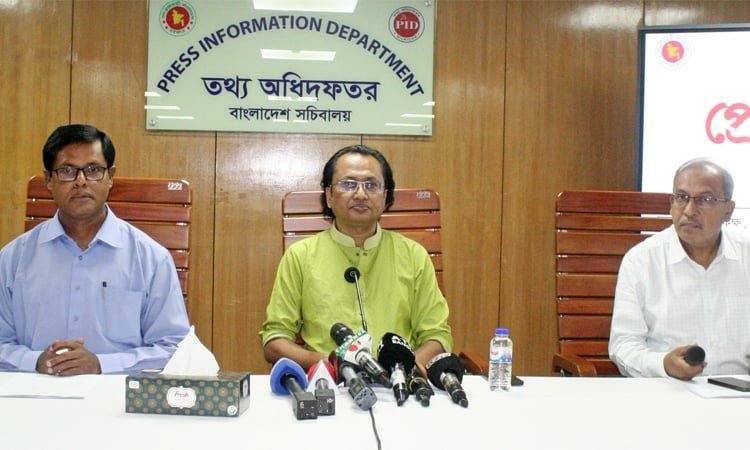

Photo: Collected
The government has decided to adjust subsidy in the energy sector in order to maintain the balance of the country’s limited resources, deal with the rise in fuel oil prices on the international market, save foreign currency, tackle the risk of fuel oil being smuggled to neighbouring countries and ensure balanced distribution of the budget to the health sector and various social protection programmes such as the Family Card, the prime minister’s Information and Broadcasting Adviser Dr Zahed Ur Rahman has said.
He said these things in reply to journalists’ questions at the weekly press briefing in the conference room of the Press Information Department this Tuesday afternoon.
The information adviser said, ‘Reducing subsidy in the energy sector is a very complex matter. But the state cannot pour all its resources into just one sector to keep it fully at ease. Maintaining economic balance in a country of low capacity is extremely challenging. So alongside balanced distribution of limited resources, the government also has to take into consideration the rise in oil prices on the international market and saving the foreign exchange reserves.’
On the comparison of fuel oil prices with neighbouring countries, he said, ‘If fuel oil prices are higher in neighbouring countries, a major risk of oil smuggling across the border is created. The price comparison is drawn to prevent that smuggling and to explain the international context. However, the government realises the matter of people’s purchasing power. For this reason, balance is being brought by increasing the budget in the health sector to set up specialised hospitals at divisional level and through balanced distribution of the budget to various social protection programmes including the Family Card.’
Explaining the government’s policy position on handling the inflationary pressure created by the rise in fuel prices, he said, ‘If inflation rises, ensuring that ordinary people’s daily essential needs are met is the government’s main goal. For this, the scope of Open Market Sale (OMS) and TCB’s food assistance programmes is being expanded. Alongside that, there is a plan to further increase in the next fiscal year the number of Family Cards given to 41 lakh families, which will help people on fixed incomes.’
Asked whether the decision was because of the loan conditions of the International Monetary Fund (IMF), the adviser said clearly, ‘This is not being done because of any IMF condition. The government is taking these economic decisions according to its own priorities, considering the social welfare of the people, saving foreign currency and the country’s financial capacity.’
On investment and employment in the country, Dr Zahed Ur Rahman said, ‘Domestic investment will increase once the temporary energy crisis is over. The Family Card and government assistance will create demand in the market, which will play a big role in creating employment for the youth and ordinary people.’
In reply to another question on the law and order situation and the role of the police, the information adviser said, ‘During the previous government, a culture of repression of ordinary people was created by using the police force. We want to come out of that and see the police as a force truly oriented to serving the people. Although there is some lack of morale among the police at field level, normal policing will return quickly if ordinary people stand by them.’
Syed Abdal Ahmad, principal information officer of the Press Information Department, and Dr Md Alam Mostafa, joint secretary of the Ministry of Information and Broadcasting, were present at the briefing.