


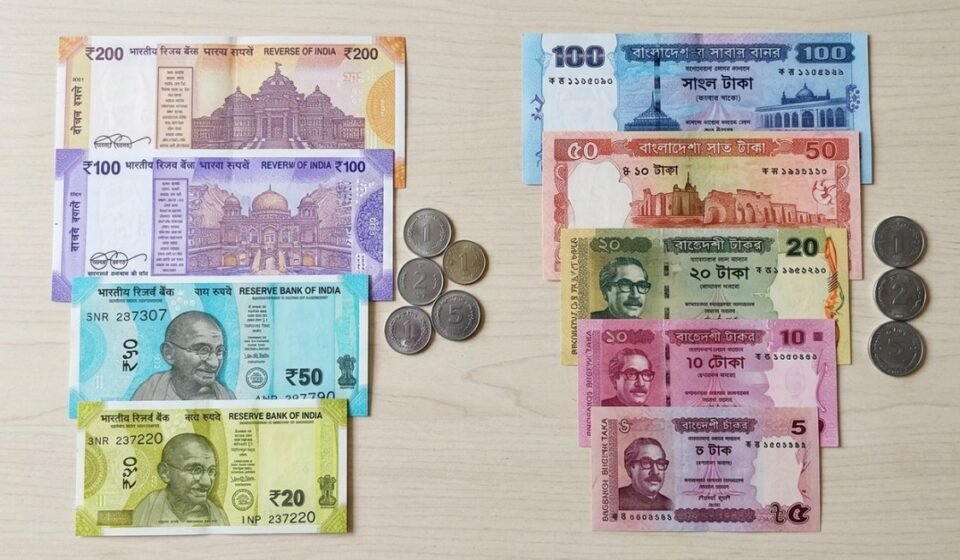

Photo: Collected
The Bangladeshi taka has strengthened at a significant rate against the Indian rupee over the last two years. During this time, the value of the taka against the rupee has risen by 11.6 per cent, of which it rose by 7.6 per cent in the last one year alone.
According to exchange rate data, the value of one taka stood at about 0.78 Indian rupee on 22 September this year. A year ago, on 22 September 2025, it was about 0.72 rupee; and on the same day in 2024 it was about 0.70 rupee. That means the value of the taka against the rupee has risen by 5.5 paisa in the span of a year, and the purchasing power of the taka against the Indian currency has risen by 7.6 per cent.
On the other hand, the price of one Indian rupee stood at about Tk 1.28 on 22 September this year, which was about Tk 1.38 a year ago. That means it now takes 9.72 paisa less than the previous year to buy one rupee; by this calculation, the value of the taka has risen by 7.1 per cent. On 22 September 2024, the price of one rupee was Tk 1.43. Compared to that, the value of the taka against the rupee has risen by 11.6 per cent in two years.
Where one taka fetched 0.72 rupee on 22 September 2025, it is fetching 0.78 rupee on 22 September 2026 – that is, the value of the taka has risen by 7.6 per cent in a year.
Central bank data show that the cross rate of the taka against the Indian rupee was Tk 1.2789 to Tk 1.2796 on 21 September. That means one taka fetched 0.781 to 0.782 Indian rupee.
Bangladesh Bank Executive Director and Spokesperson Arif Hossain Khan said the strong position of the taka against the rupee could have a positive impact on Bangladesh-India economic and trade relations. In particular, the cost in local currency of importing goods from India could come down.
He said this change in the exchange rate in the two countries’ trade will also affect the overall local-currency expenditure on imports from India. If the taka remains comparatively strong against the rupee, importers will need less taka to settle import bills payable in rupees.
Arif Hossain Khan further said Bangladesh Bank is regularly monitoring the movement of the foreign exchange market and the exchange rate. The necessary surveillance is continuing to maintain stability in the market and ensure an orderly market.