


Photo: Collected
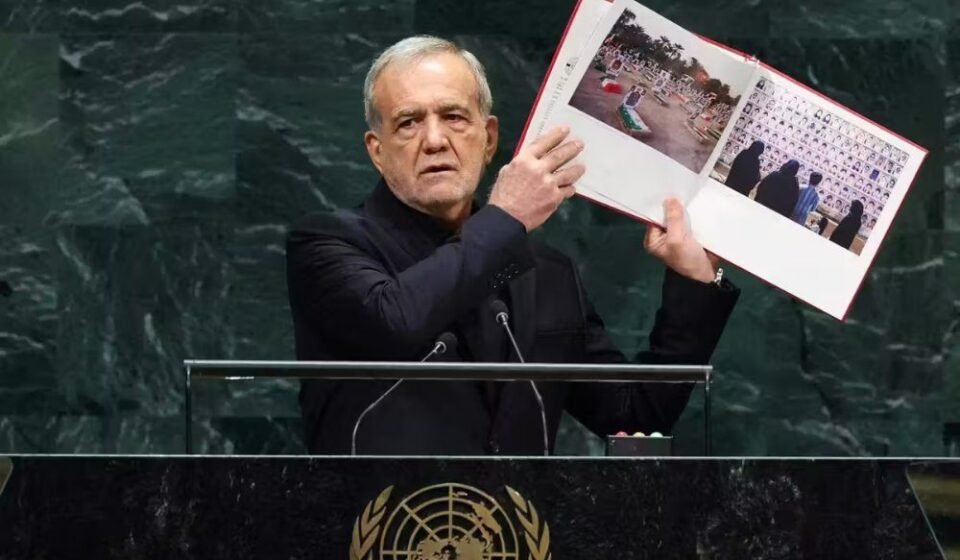
Iranian President Masoud Pezeshkian has set out a hardline stance in his speech at the United Nations. Wednesday’s speech at the UN was his first since the United States and Israel launched an all-out war against his country. He made it clear that Tehran will never ‘bow down.’
Pezeshkian accused Washington of ‘terrorism’ over the killing of Iran’s former supreme leader Ayatollah Ali Khamenei at the start of the conflict. He said Iran has never started any war.
News agency AFP reported this from the United Nations.
Earlier, in his speech at the UN General Assembly on Tuesday, US President Donald Trump had said he was thinking of ‘obliterating’ Iran. However, in the same speech he also praised the newly resumed talks between Tehran and Washington.
Pezeshkian, however, made no mention at all in his tough speech of the ongoing talks to end the stalled war.
He said, ‘Trump must understand that in the face of sanctions, added pressure and growing threats, the resistance of the Iranian people will only increase. We will never bow our heads, nor will we kneel.’
Since the start of the war, Iran has kept traffic through the Strait of Hormuz effectively shut, as a result of which fuel prices have risen in the global market. Pezeshkian said Tehran will not allow the Strait of Hormuz to be used as a tool of pressure against Iran.
In his words, ‘Someone will sail freely through this waterway to serve their own interests, and then use the same waterway to carry out aggression against us; this we cannot allow to happen.’
There was uncertainty over Pezeshkian’s participation in this important diplomatic event of the United Nations in the heart of Manhattan, because it was not clear whether the United States would give him a visa.
In the end Washington gave him a visa, but several members of his entourage did not get visas.
With fuel prices having risen sharply, Trump’s Republican Party is at risk of losing control of Congress in November’s midterm elections. However, the US president has tried to play down the impact of the war at home.
Artificial intelligence and Ukraine
The future of artificial intelligence also came up for discussion at the annual gathering of world leaders at the United Nations on Wednesday.
Amid weeks of headlines around the world about the risks of artificial intelligence that could go out of control and calls to slow the pace of its development, technology sector leaders briefed the UN Security Council on the matter. They called for greater caution.
OpenAI chief executive officer Sam Altman said, ‘Extreme caution is needed at this moment.’
Anthropic chief executive Dario Amodei said that in bringing new artificial intelligence systems to market, the pace will be slowed where needed to ensure safety.
In Tuesday’s speech, Trump rejected international initiatives to regulate artificial intelligence. He termed such proposals a ‘globalist conspiracy’.
The issue of Russia’s war in Ukraine also came up at the United Nations on Wednesday.
Ukrainian President Volodymyr Zelensky alleged that Russian President Vladimir Putin is using fighters from 47 countries to keep Moscow’s war going. The war began with Russia’s invasion in 2022 and has been going on as a bloody conflict for four years.
Zelensky warned that his forces could target Russia’s heating and energy facilities in the coming winter. Such a step could come in response to the way Moscow has used the region’s severe winter against Ukraine.
At the United Nations he said, ‘Ukrainians understand that this winter may be very hard for us. But in response we will have no other path before us than to make the situation hard for Russia as well.’
‘No woman has ever been in the lead’
In his speech at the General Assembly, Spanish Prime Minister Pedro Sanchez called for a Latin American woman to be chosen for the top post of the United Nations.
Sanchez said, ‘How is it possible that no woman has ever come to lead an organisation that claims to speak for the whole of humankind?’ He further said it is also long overdue for the world’s third largest continent in terms of population to get this responsibility.
UN Secretary-General Antonio Guterres, a former prime minister of Portugal, will step down on 31 December. Four women and three men are in the race to succeed him, among whom there are also several candidates from Latin America.