


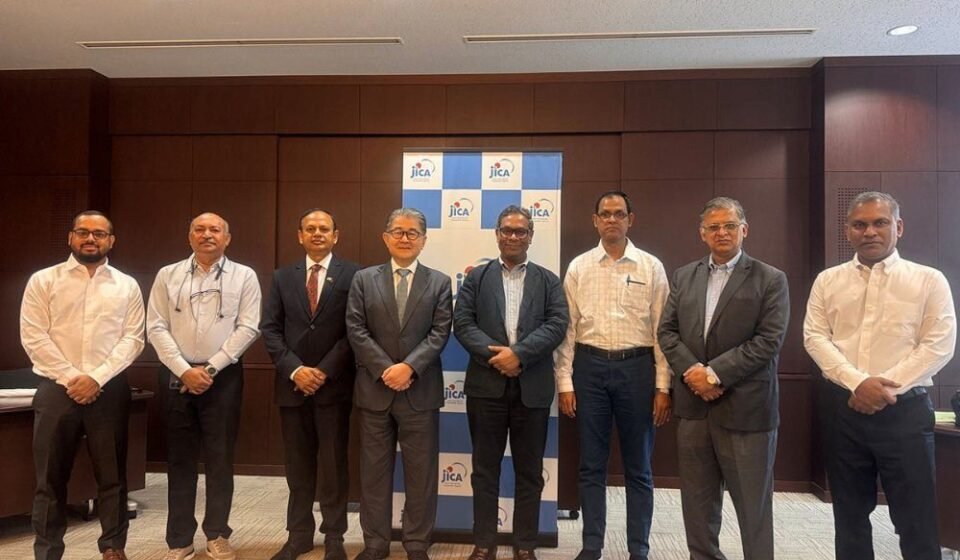

Photo: Collected
The high-level delegation led by State Minister for Health and Family Welfare MA Muhith has returned home after concluding a visit to Japan. They returned home on Sunday. During the seven-day visit from 26 September to 3 October, the members of the delegation held meetings with relevant individuals and institutions of Japan on the development of Bangladesh’s health sector.
Accompanying the state minister on the visit were Health Services Division Additional Secretary Shah Imam Ali Reza, Directorate General of Health Services (DGHS) Director General Prof Dr Provat Chandra Biswas, National Institute of Cardiovascular Diseases (NICVD) Director Prof Dr Abdul Wadud Chowdhury, Narsingdi Sadar Hospital Civil Surgeon Md Bulbul Kabir and the state minister’s Private Secretary Md Sarwar Salam.
The visit was organised as part of the feasibility study of the integrated non-communicable disease (NCD) prevention and management project. During the visit, the members of the delegation exchanged knowledge and experience with Japanese institutions and experts on the prevention and management of non-communicable diseases, healthcare delivery, health financing and medical technology. The main objective was to make Bangladesh’s health sector more effective and stronger by drawing on the experience of Japan’s successful health system.
At the headquarters of the Japan International Cooperation Agency (JICA), the delegation was briefed on Japan’s healthcare delivery and health financing systems. They then visited several institutions in the healthcare, education and medical technology sectors – among them were Terumo Medical Pranex, Fujifilm, the Faculty of Medicine of Teikyo University, Tokushukai Hospital, Riverfield Robotic Surgery and a private clinic. After the visits, views were exchanged on treatment methods, clinical services, medical education, diagnostic technology and advanced medical solutions.
During the visit, a courtesy call at Japan’s Ministry of Foreign Affairs, discussions with relevant stakeholders, and discussions with Nippon Koei and KRC were also held. At this time, the Japan External Trade Organization (JETRO) and the Bangladesh Embassy in Japan jointly organised the ‘Bangladesh Health Business Seminar’, where stakeholders of the two countries spoke about the potential for cooperation in the health sector.
Highlighting the experience of visiting primary, secondary and tertiary level hospitals in Japan, State Minister MA Muhith mentioned the clear role of each tier and the process by which patients receive services from one level to another through referral. Praising the professional attitude, discipline and empathy of Japan’s health workers, he said, ‘This proves that technology can be bought, but a culture of quality service has to be built. And this is the lesson we have brought back to the country, which I believe will inspire our country’s health workers.’
It is hoped that an integrated system for the prevention and treatment of non-communicable diseases will be built in the country by using the knowledge and experience gained from this visit.