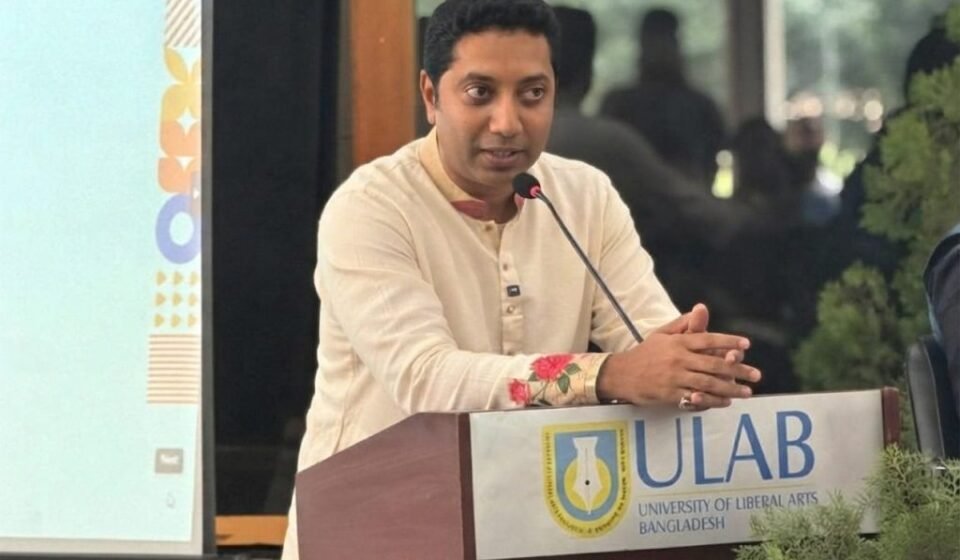

Photo: Collected
State Minister for Primary and Mass Education Bobby Hajjaj has said that merely obtaining an institutional degree will not do; students must also acquire communication skills in English, technological knowledge and the ability to solve problems in real workplaces. To achieve the goal of doubling Bangladesh’s economy by 2034, he stressed building the youth into human resources who will be skilled, employable and suited to the international labour market. In his view, if these skills can be combined, the country’s vast young population will become one of the main driving forces of economic progress.
The state minister spoke as chief guest at the ‘2nd ULAB-TESOLBD International ESP (English for Specific Purposes) Conference 2026’ at the University of Liberal Arts Bangladesh (ULAB) in Dhaka on Friday. TESOLBD and ULAB jointly organised the conference.
Addressing students, Bobby Hajjaj said people study at university to gain knowledge and build their careers. But if the necessary skills are not developed, the desired success cannot be achieved on the strength of a degree alone. A student has to prepare in such a way that the knowledge gained can be applied in real life and the challenges of the workplace can be met.
Raising the issue of the shortfall in English proficiency, the state minister said major challenges still remain in learning and teaching English in the country’s education system. Sharing his experience of visiting schools in different regions of the country and exchanging views with teachers and students, he said teachers need to improve their own language skills as well in order to teach students English. Similarly, even after studying in English at university level, many students still have shortcomings in speaking fluently, expressing themselves in writing and professional communication. To change this situation, emphasis must be placed on the practical use of language and on improving communication skills instead of rote-based education.
He further said proficiency in English is important not only for communication; it is also highly necessary for acquiring modern knowledge in various fields including science, technology, engineering, business, economics and management. A large part of international research, technical guidance and professional information is published in English. As a result, a lack of language skills often becomes a barrier even for meritorious students in acquiring knowledge and proving their abilities in the workplace. However, he also highlighted the need to make knowledge and technical terminology easily available in one’s own language alongside English.
The state minister also spoke about employment and entrepreneurship opportunities for the youth. He said that if the country’s vast young population can be built up with proper skills, they will become a great asset for the national economy. It is essential to create dignified employment, stable income and opportunities for entrepreneurship for them. If realistic alternatives can be placed before the youth through education and skills development, they will get the chance to stay away from the tendency to crime and engage in productive work. To this end, he stressed developing job-oriented education, problem-solving ability, innovative thinking and an entrepreneurial mindset in educational institutions.
ULAB Vice Chancellor Professor Dr Shamsad Mortuza presided over the event. The special guests were Professor Dr Masuma Habib, member of the University Grants Commission of Bangladesh (UGC), Nigel Killick, chief executive officer (CEO) of ReallyEnglish, and writer and journalist Anisul Hoque. Members of the TESOL Society of Bangladesh and teachers and students of various universities were also present.