
Photo: Collected
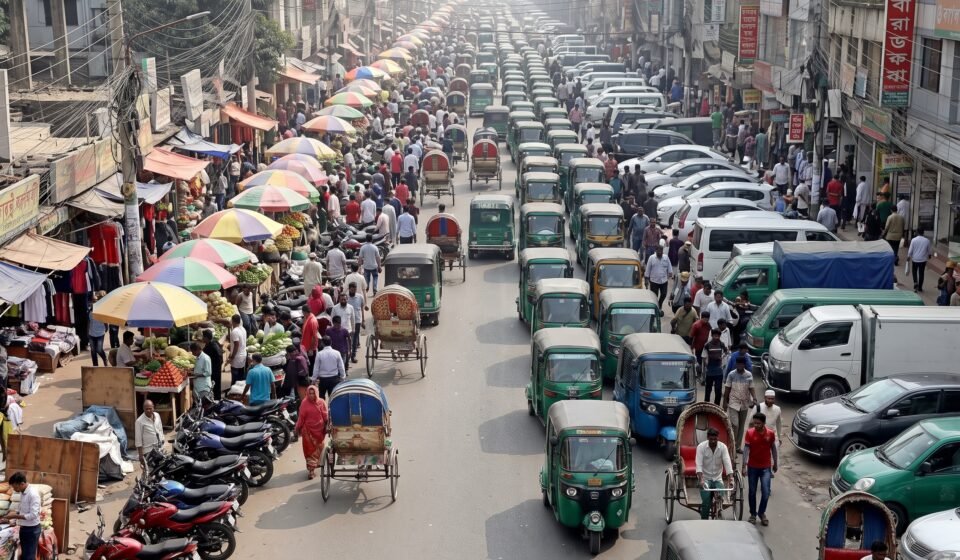
The road running along Madani Avenue in Bhatara was built 100 feet wide for smooth movement. Today, in places, barely 10 feet of it is left for vehicles to use. Local residents allege that roughly 90 feet of the road has been taken over by encroachers. A shortage of road space is already a daily ordeal for city dwellers in the capital, but the state of this particular road is far more worrying.
Three causes stand out behind the takeover — hawkers’ shops, the unrestrained movement of battery-run auto-rickshaws, and vehicles parked wherever there is room. Together they have rendered a large part of this wide road practically unusable. The result is mounting traffic congestion, a growing risk of accidents, and daily suffering for pedestrians and passengers alike.
A visit to the spot showed that hawkers’ stalls are no longer confined to the footpath; they have spread onto the main carriageway itself. In some places, temporary shops and business outlets have been set up in three to four rows. As a result, despite the road’s 100-foot width, there is not enough space for vehicles to move normally. With a large section occupied, traffic is squeezed into a narrow strip, and during peak hours this has become one of the main causes of congestion.
Pedestrians are the worst affected, since the footpath has been encroached upon along with the road. With no designated space to walk, many are forced to move alongside moving vehicles, or even along the main road itself. This has increased the risk for women, children and the elderly. In the evening and at night, when movement of people picks up, walking safely on the road becomes even harder.
The uncontrolled movement of battery-run auto-rickshaws and other small vehicles has emerged as another major cause of congestion. Many of their drivers are seen changing lanes abruptly, driving against the flow of traffic, stopping anywhere they please, and picking up and dropping passengers while standing in the middle of the main road. This obstructs the normal speed of other vehicles, while also raising the likelihood of sudden collisions and accidents.
Illegal parking has compounded the problem. Private cars, auto-rickshaws and various other vehicles are left standing on both sides of the road, at its entry points and near several intersections. Encroachment by hawkers combined with this disorderly parking has narrowed the road’s effective width still further. Covering even a short distance now means a long wait for vehicles.
Office-goers, students, local residents and people travelling to various institutions bear this hardship every single day. Reaching destinations on time has become difficult, and the safe movement of pedestrians is being disrupted as well. Beyond ordinary commuting, the condition of the road has raised concerns about overall public safety.
Residents fear that if the road remains constricted in this way, emergency service vehicles too will face serious obstruction. If ambulances, fire service units or police vehicles cannot reach a scene quickly, the damage in an emergency could be far greater. They believe this congestion could, in particular, become a major obstacle when a critically ill patient needs to be taken to hospital quickly.
Local residents have demanded that the 100-foot road on Madani Avenue be freed of encroachment immediately, that the footpath be made usable for pedestrians, that illegal parking be stopped, and that the movement of battery-run auto-rickshaws be brought under control. In their view, occasional eviction drives will not solve the problem; what is needed is regular monitoring, effective enforcement of the law, and the establishment of discipline in road management. If the authorities concerned take the initiative, they believe, it will be possible both to restore normal movement on the road and to ensure the safety of pedestrians.