
Photo: Collected
Algeria, the North African country, has signed a memorandum of understanding (MoU) with Bangladesh to increase cooperation in the energy sector. To strengthen energy security, Bangladesh has taken the initiative to import liquefied natural gas (LNG), liquefied petroleum gas (LPG) and other petroleum products from the country on a government-to-government (G2G) basis.
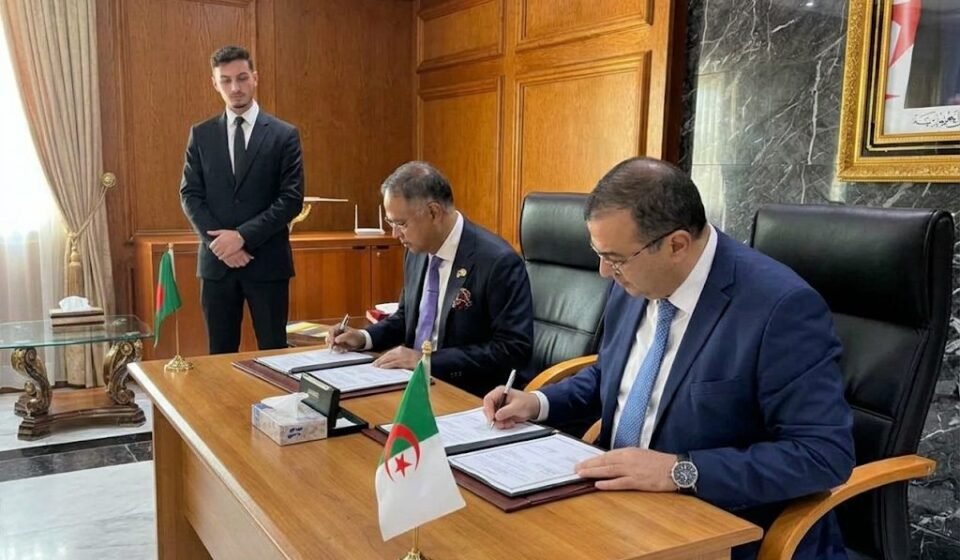
Bangladesh’s Power, Energy and Mineral Resources Minister Iqbal Hasan Mahmood and Algeria’s Hydrocarbons Minister Mohamed Arkab signed the memorandum of understanding on behalf of their respective countries in the Algerian capital Algiers on Tuesday.
This information was given in a press release from the Africa wing of the foreign ministry on Wednesday.
Alongside the signing of the memorandum of understanding, various aspects of energy cooperation between the two countries were discussed, including the import of LNG, LPG and other petroleum products on a G2G basis, the development of infrastructure for these fuels in the country, and cooperation in oil, gas and coal exploration. Bangladesh’s energy minister also requested that training programmes be arranged for the exchange of Algeria’s experience and technical knowledge in the energy sector in order to increase the skills of Bangladesh’s engineers and technical staff.
After the signing, Iqbal Hasan Mahmood said this initiative has opened the door to new possibilities for Bangladesh’s energy security, and that through it an opportunity will be created to import LNG, LPG and other petroleum products from an alternative source in Africa under the G2G arrangement.
Meanwhile, on 20 October, Algeria’s Minister of Mines and Mineral Industry Mourad Hanifi and Minister of Energy and Renewable Energy Mourad Adjal separately met Bangladesh’s energy minister. Various matters of mutual interest to the two countries were discussed at these meetings.
Background
Preparations for this cooperation with Algeria had been under way for several months. On 10 September, the two ministers of the two countries discussed the framework for supplying LNG to Bangladesh at a video conference; Sonatrach president and chief executive Noureddine Daoudi, Bangladesh’s ambassador to Algeria and the chief executives of Petrobangla, BPC and RPGCL were present at that meeting, and the two ministers agreed to form a joint working group – The Business Standard reported this on 10 September.
Then, on 5 October, Algeria’s ambassador Dr Abdelouahab Saidani met Home Minister Salahuddin Ahmed; at that meeting the plan to import fertiliser as well as LNG from Algeria under the G2G framework was mentioned, and the ambassador noted that Algeria was the first country in the Arab world to recognise Bangladesh after 1971 – UNB reported this on 5 October.
The numbers
Bangladesh’s main reliance for long-term supply is now on Qatar and Oman. The first long-term agreement with Qatar was signed on 25 September 2017, for 1.8 million to 2.5 million tonnes of LNG a year for 15 years; supply began on 9 September 2018. A second 15-year agreement was later signed with QatarEnergy Trading for up to 1.8 million tonnes a year – The Daily Star reported this on 1 June 2023.
Petrobangla also signed another agreement with Oman’s OQ Trading for 250,000 to 1.5 million tonnes a year, running until 2035; with this, long-term import capacity was to reach 7.3 million tonnes by 2026 – The Business Standard gave this information on 19 June 2023.
According to a report by The Financial Express of 4 January 2026, the plan for this year was to bring in 86 cargoes from long-term suppliers, against 56 in 2025; the target from the spot market is 17 cargoes, against 49 the previous year. Citing RPGCL data, the same report said about 34.34 million tonnes of LNG had been imported in 554 cargoes from 2018 to November 2025.