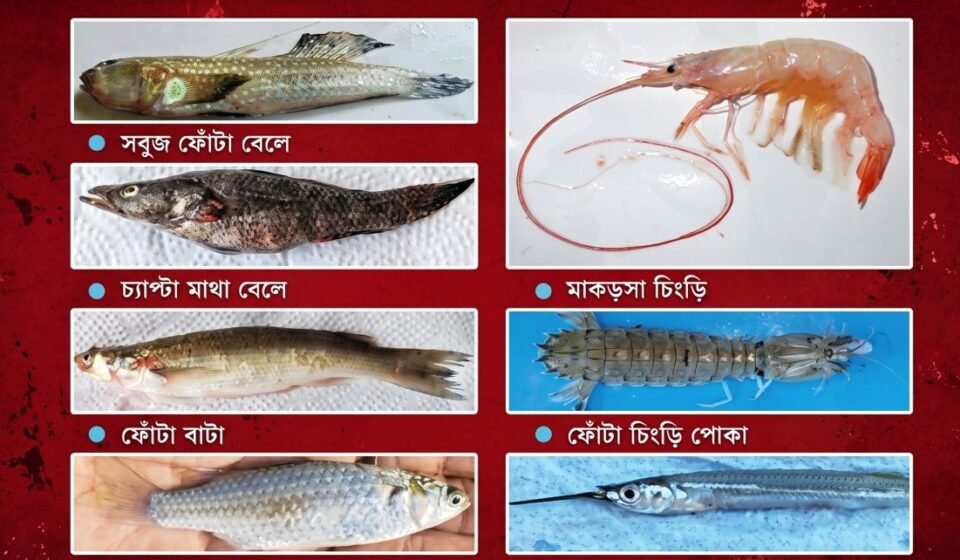
DNA of 5 fish and 2 shrimp species newly found in Sundarbans rivers and canals heads to international gene bank

Photo: Collected
The DNA sequences of five fish species and two shrimp species newly found in the waters of the Sundarbans are set to be included in the database of an international gene bank. This is being seen as a major achievement for the country’s environmental and fisheries science concerning the world’s largest mangrove forest; it will open up unique innovation and new horizons in Bangladesh’s biodiversity research.
A workshop is due to be held in Dhaka in November, where the research team will hand over its findings to the Forest Department in the presence of the Minister for Environment, Forest and Climate Change. Then comes the long-awaited moment of their inclusion in the gene bank.
This success came from a comprehensive 16-month study titled ‘Assessment of the aquatic resources of the Sundarbans’. The study was carried out jointly by the Center for Natural Resource Studies (CNRS) and Arannayk Foundation under the Bangladesh government’s ‘Sundarbans Protection Project’. The draft findings of the study were formally released and set out in detail at an event in Khulna recently.
Over the 16 months from March 2024 to June 2025, the researchers surveyed 65 rivers and canals in four ranges of the Sundarbans. Data were collected by travelling by boat over 424 kilometres inside the forest and also from fish landing centres in Shyamnagar, Koyra, Mongla and Sharankhola.
Team leader Dr M Enamul Hoq, a former director of the Bangladesh Fisheries Research Institute, said that at the end of the study they had prepared to upload the data on the five fish species and two shrimp species to the international gene bank in America. But as the matter falls under the Forest Department, the findings will be handed over to the Forest Department in the presence of the forest and environment minister at the project’s final workshop in Dhaka in November. The DNA sequences of these seven species will later be added to the international gene bank database officially through the Forest Department.
He further said that the DNA sequences of 141 fish species of the Sundarbans have previously been added to the international gene bank. That research was carried out by a team from Sher-e-Bangla Agricultural University with Korean support and in coordination with the Forest Department. He expressed hope that if a suitable environment and conservation can be ensured, these aquatic resources of the Sundarbans can be increased many times over.
The research team has created DNA barcodes for 30 fish species and 11 species of shelled animals of the Sundarbans. As part of this, DNA analysis of 83 fish samples documented five fish and two shrimp species entirely new to Bangladesh’s coastal waters, whose DNA sequences were not previously in the database of any international gene bank in the world.
Once this information enters the international gene bank, the distinct identity of the Sundarbans’ aquatic animals will be established before the world, and scientists worldwide will be able to carry out more precise research on these species.
The newly found fish are the boro aish parshe, phota bata, Burmese ek thuita, kuli bele or flat-headed bele, and sobuj phonta bele. Along with them, two entirely new shrimp species were found — the spider shrimp and the spotted shrimp bug.
The study assessed the state of aquatic resources, breeding seasons and the impact of climate change across the four ranges of the Sundarbans — Sharankhola, Satkhira, Khulna and Chandpai.
The findings show that species diversity is highest in Sharankhola range — 164. But because of illegal practices such as overfishing and poisoning of rivers and canals, the natural stocks of several species are under threat.
This new study has confirmed the presence of a total of 251 fish species and 51 species of shelled animals in the Sundarbans. Combined with the results of earlier studies, a total of 382 species of white fish and 88 species of shelled animals (shrimp, crabs, snails, oysters, octopus and squid) have so far been found in the Sundarbans.
The research report says the species were identified using the mitochondrial method (a modern, integrated scientific method for precisely identifying an organism’s species) within a morpho-molecular approach. This method uses morphological (external structure) and molecular (DNA or genetic) methods together to classify an organism taxonomically with precision. In this way, a total of 83 fish and 28 crustacean samples were identified and barcode sequences created for a total of 41 species — 30 fish species and 11 crustacean (shelled aquatic animal) species. The nucleotides (the basic structural units or monomers of the nucleic acids DNA and RNA) of these sequences matched the international gene bank references by 98.19% to 100%.
According to the researchers, through this the genome database of the Sundarbans region’s aquatic animals is set to be formally linked to the international sphere, which will play a very important role in species protection, preventing illegal fishing and conserving the ecosystem in future.
The study also found that commercially important large fish such as bhetki, poa and pangas are declining at an alarming rate because of unregulated and excessive harvesting, catching of fry and use of harmful poison. The report makes several important recommendations to sustain this aquatic wealth of the Sundarbans.
The recommendations include setting catch limits for certain species and reviewing bans; a complete ban on the use of poison and harmful nets; declaring ecologically suitable new canals (such as the Khodiakhali, Atharobeki, Armal and Kagaboga canals) ‘protected canals’ to ensure breeding; and quickly arranging alternative livelihoods for forest-dependent communities.
Imran Ahmed, director of the Sundarbans Protection Project and conservator of forests for the Khulna region, told BSS that this new achievement on the international stage has further increased the importance of the Sundarbans. Short- and long-term plans are being taken to protect the Sundarbans’ aquatic resources in line with the study’s recommendations.
It is learnt that researchers have long been working on identifying fish species in the Sundarbans and conserving their genetic diversity.
Around 2020 and 2021, researchers from several institutions, including Sher-e-Bangla Agricultural University, carried out a major study on the aquatic animals of the Sundarbans. They used DNA barcoding to identify fish species precisely; barcoding was done for the Sundarbans’ fish, crabs and molluscs.
As part of that study, data on a total of 185 mitochondrial sequences and 59 RNA sequences from about 120 genera and 65 aquatic animals (mostly fish) of the Sundarbans’ saline and brackish waters were submitted to the international gene bank.
Source — original report: Ajker Patrika |