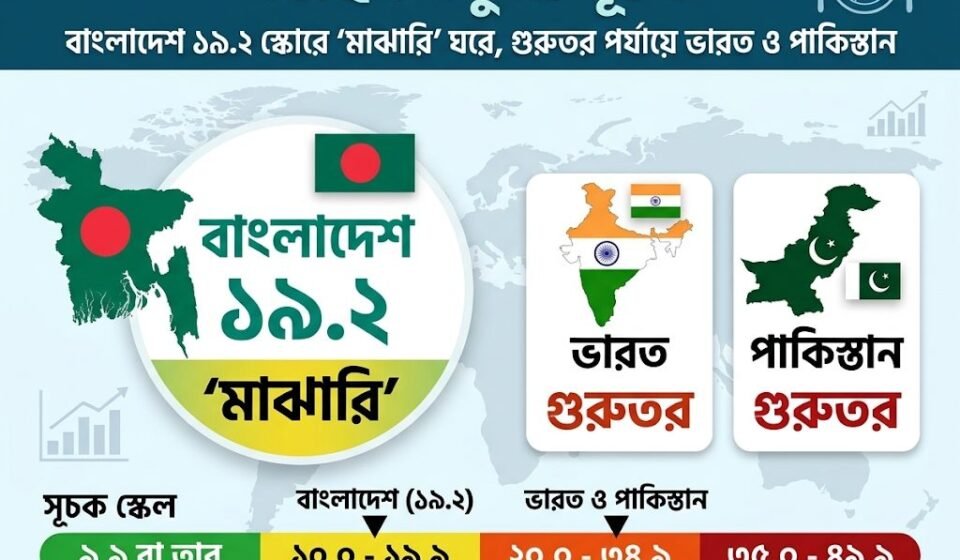
Global Hunger Index: Bangladesh ‘moderate’ with 19.2 score, India and Pakistan at serious level

Photo: Collected
Job opportunities for women, community-based healthcare reaching every household, better sanitation and girls’ education — experts say these are what have driven Bangladesh’s steady progress against hunger and malnutrition in South Asia. Pakistan is heading the opposite way; there, rising food prices, child malnutrition, limited employment for women, low investment in health and education, and climate-related disasters have combined to deepen the hunger crisis.
This picture emerges from the 2026 Global Hunger Index (GHI), published last week. The report says India, Bangladesh and Nepal have improved steadily on the index since 2000, but Pakistan’s progress has stalled and the country’s situation is worsening again.
The report was published jointly by three organisations: Welthungerhilfe, the Bonn-based German anti-hunger organisation; Helvetas, the Zurich-based Swiss aid organisation; and the Institute for International Law of Peace and Armed Conflict at Germany’s Ruhr University.
Bangladesh scored 19.2 on the index, which falls in the moderate range. India’s score is 24.1, which is considered serious. In South Asia, only Sri Lanka and Nepal are better placed than Bangladesh.
Pakistan’s score this year is 25.5. In 2018 the country scored 24.0, meaning the situation has worsened. Pakistan ranks 106th among the 122 countries on the index. Around a dozen countries scored higher than it, including Afghanistan, Sierra Leone and Syria.
Experts see the rise in women’s employment and the expansion of health and social services as the main reasons Bangladesh is ahead of Pakistan. London-based financial analyst Javed Hassan told the Japanese outlet Nikkei Asia that Bangladesh’s readymade garment export sector has created job opportunities for women. Community health workers have taken healthcare to people’s doorsteps. Improved sanitation and wider access to education for girls have also contributed to this progress.
Islamabad-based independent economist Niaz Murtaza expressed the same view. In his assessment, steady improvement in women’s employment has put Bangladesh ahead in tackling hunger. Experts believe India’s situation is not very different from Pakistan’s; the two countries’ scores are close, while Bangladesh has managed to show considerable progress.
Hunger measured on four indicators
The Global Hunger Index is built on four main indicators: undernourishment, or not getting enough food; child mortality; children being short for their age; and children having low weight for their height. Undernourishment and child mortality are each given 33.3 per cent of the total weight. The other two — low height for age and low weight for height — get 16.7 per cent each.
Scores range from 0 to 100. A score below 10 means a low level of hunger; 10 to 19.9 is moderate, 20 to 34.9 serious, and 35 to 49.9 alarming. A score of 50 or above is considered extremely alarming.
By this measure, Pakistan’s score of 25.5 reflects a serious level of hunger in the country. This slide from 24.0 in 2018 has deepened concern over the country’s food and nutrition situation.
By the numbers
According to a UNB report of 15 October, Bangladesh ranks 84th in GHI 2026 with a score of 19.2.
According to figures on the Global Hunger Index website, South Asia’s regional score in 2026 is 23.5 and the global score 18.1.
Data from the same source show that the stunting rate among children under five in Bangladesh was 54.9 per cent in 2000 and now stands at 24.0 per cent.
Background sources: UNB, 15 October 2026; Global Hunger Index (Bangladesh page), 2026