



Photo: Collected
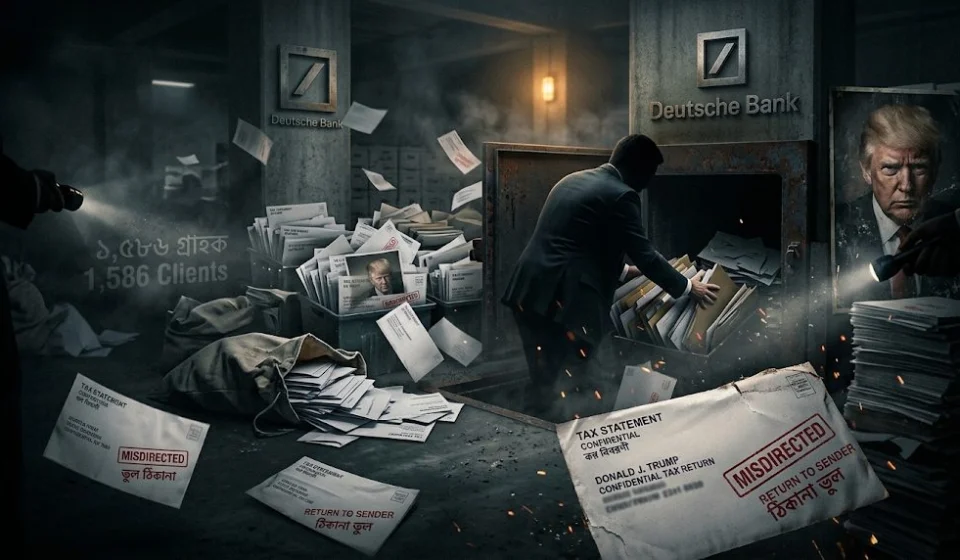
30 March 2017. A relationship manager at Germany’s Deutsche Bank mistakenly sent the year-end tax statements of 1,586 of the bank’s private bank accounts to a client’s accountant. Among the documents was the tax statement of US President Donald Trump, then in his first term. British media outlet the Financial Times (FT) reported this.
Realising the mistake, the accountant later alerted the bank and deleted the file that had been sent. But the bank kept this accidental leak secret from the White House. Officials also adopted a strategy of not informing the affected clients. The bank’s current chief executive officer (CEO), Christian Sewing, was also aware of the matter.
Sewing was then head of Deutsche Bank’s private banking division. At the time, it was he who called the incident a ‘terrible mistake’. Officials under him began working on a strategy to keep the matter hidden from clients.
An international consortium of journalists from more than 200 media outlets around the world, including the FT, German outlet Der Spiegel, French outlet Le Monde and Paper Trail Media, has analysed millions of leaked Deutsche Bank documents. The details of this previously unknown incident emerged from them.
Trump has always opposed releasing his income tax returns. Although most US presidents in the past six decades have released their tax returns, he has refused to do so. Earlier this year, he sued his own government for at least $10 billion over the leak of his tax returns by an Internal Revenue Service (IRS) contractor during his first term. Securing a settlement in his own favour in that case as the sitting president sparked fresh controversy.
Trump’s relationship with Deutsche Bank began in 1998. Despite a long history of failing to repay loans over the next two decades, the bank became his most important lender. Deutsche Bank kept up the business relationship even after Trump sued the bank over a defaulted loan in 2008. Although it stopped new business with Trump in 2021, he still owed the German lender more than $300 million at the time.
The data leak happened at a time when Trump was under intense criticism and scrutiny for his decision not to release his tax returns. The bank, too, was then trying under current CEO Sewing to put behind it a past of one ethical, legal and financial scandal after another. Amid this, officials sat down to discuss how to justify the decision not to inform the affected clients.
In an email sent to Sewing the day after the incident, then managing director Frank Kuhnke said that, to avoid the obligation under various US state data breach laws to notify clients, they would try ‘to challenge or to keep the situation under our own control’. In another email, he described the incident as ‘a disaster, but its impact on the outside world can probably be contained’.
However, Deutsche Bank did inform the Federal Reserve Bank of New York (New York Fed), a key US regulator. The bank also raised the question of what impact it might have on politically important clients and whether clients should be informed.
The bank’s argument for not informing clients was that the risk of misuse of the information was low, because the accountant concerned had not downloaded the documents but had instead informed the bank and deleted the file. The documents had been sent via the document exchange service DocuSign.
On 4 April, Kuhnke told Sewing that he had arranged for the incident to be classified as a ‘Digital Unit Release’ rather than a ‘personal data leak’ or ‘private/personal data breach’. No other mention of this term was found in any other document prepared on the leak.
Earlier, in an email to a colleague, Kuhnke had written, ‘There has been no breach of data security, and we all need to stand together to make sure of that.’ He also wrote, ‘Any further disclosure of information about this to the outside world must be stopped, especially to the account holders.’
In a message to Kuhnke on 6 April, Sewing said he had informed the bank’s top executives. Their decision was that the incident was not a ‘Regulatory Breach’ but a ‘Near-miss’. He also said the bank’s business division would carry out a ‘Light-touch Investigation’ into it.
The next day, 7 April, a meeting was held between Deutsche Bank and the regulators. After the meeting, Kuhnke told Sewing that everything had gone ‘according to plan’. However, the Federal Reserve Bank (Fed) requested an internal investigation into the incident. In reply, Sewing wrote, ‘Very good! Congratulations.’ He remarked that it would not be a problem even if the incident ultimately led to a formal investigation, but acknowledged, ‘What happened is a terrible mistake.’
A Deutsche Bank spokesperson said, ‘We do not comment on our relationships with potential, former or current clients. Generally speaking, in the US it is legally prohibited to comment on banks’ discussions with supervisory authorities and on Suspicious Activity Reports. There is also no scope to comment on whether such reports exist.’
Frank Kuhnke did not respond to a request for comment. The New York Fed also declined to comment. And the accountant to whom the documents were mistakenly sent said he did not remember the incident.
Background
According to an NPR report on 18 May, Trump and the Trump Organization filed a $10 billion lawsuit against the IRS and the Treasury Department in January this year over the tax return leak; a federal judge dismissed the case at Trump’s request that day, paving the way for a settlement.
According to a report by news agency AP on 19 May, as part of that settlement the US government agreed to permanently drop tax claims against Trump.
According to a Reuters report published by Arab News on 18 April, at the root of the case was former IRS contractor Charles Littlejohn, who leaked Trump’s tax returns to the media; he was charged in 2023.
Sources
Background sources: KAXE (NPR), 18 May 2026; PBS NewsHour (AP), 19 May 2026; Arab News (Reuters), 18 April 2026