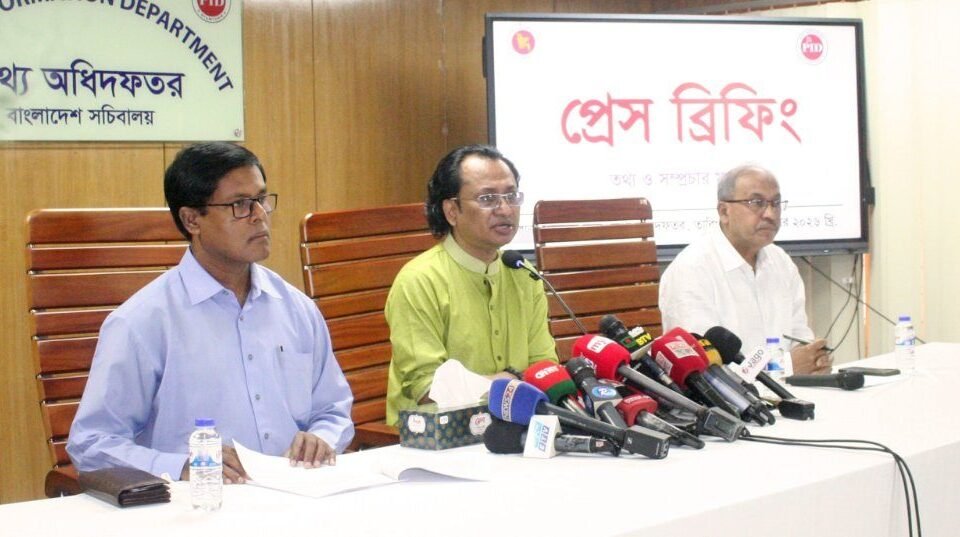

Photo: Collected
Because of the abnormal price rise on the international market and the war situation in the Middle East, the government is currently incurring a loss of about Tk 89 on every litre of diesel. As a result, the government’s loss in the diesel sector alone stands at about Tk 109 crore every day. That means the government’s loss on diesel alone will be about Tk 40,000 crore a year.
Dr Zahed Ur Rahman, information and broadcasting adviser to the prime minister, presented this information in a written statement at the weekly briefing in the conference room of the Press Information Department (PID) at the Secretariat this Tuesday afternoon.
The press briefing was organised to inform about the progress of work of various ministries of the government and contemporary issues.
In the written statement the adviser said that although fuel oil prices rose in the global context, oil prices in the country had been kept unchanged from March to August this year by accepting a loss of about Tk 22,875 crore. But the government had to refix or adjust oil prices in order to reduce this continuous loss, save foreign currency and avoid the major risk of fuel oil being smuggled to neighbouring countries.
According to the new rates, the price of diesel has been raised from Tk 115 to Tk 135 per litre, octane from Tk 145 to Tk 165, petrol from Tk 140 to Tk 160 and kerosene from Tk 135 to Tk 155.
Presenting a comparison of fuel oil prices in neighbouring and Asian countries, the information adviser said the price of diesel per litre is currently Tk 134.76 in Kolkata of India, Tk 164.83 in Myanmar, Tk 161.24 in Nepal, Tk 179.42 in Sri Lanka, Tk 151.22 in Thailand and Tk 185.48 in Pakistan.
As the price was the lowest in Bangladesh, an acute risk had arisen of oil bought with expatriates’ hard-earned foreign currency being smuggled across the border. With an adjustment of Tk 20 per litre in line with neighbouring countries, it will be possible to reduce Bangladesh Petroleum Corporation’s (BPC) losses by about Tk 10,000 crore a year.
Highlighting the initiatives to achieve self-sufficiency in the energy sector, Dr Zahed Ur Rahman said a plan has been taken to drill 150 wells in the country by 2030 to reduce import dependence. As part of this, supply of a further 12.5 million cubic feet of gas per day to the national grid began with the inauguration of Titas well No 28 in Brahmanbaria on 19 September. This will further increase gas supply to the industrial and power sectors. It is hoped that by 2035 it will be possible to add about 235 million cubic feet of gas per day to the national grid from the areas under BGFCL.
Social protection and Family Card
The adviser said the government is strengthening several alternative social safety net programmes to ease the pressure created on ordinary people by the fuel oil price hike.
He said that from the coming October, about 41 lakh families across the country will be given a ‘Family Card’, through which the allowance will reach the beneficiary’s bKash, Nagad or bank account directly under the G2P method. A target has been set to bring 1.61 crore families under this universal protection net by 2029-30.
Besides, under the Food Friendly Programme, distribution of 30kg of rice each at Tk 15 per kg to 55 lakh families of the country and of vitamin-enriched ‘Pushti Chal’ in 300 upazilas is continuing.
Giving information on the activities of the Ministry of Food, the adviser said 2,942 food samples were tested through labs across the country in August and legal action was taken as excessive levels of harmful substances were found in 811 of them.
Hajj airfare reduced
Highlighting the progress of the Ministry of Religious Affairs, the adviser said that on the directive of Prime Minister Tarique Rahman, the airfare for the 2027 hajj has been fixed at Tk 1,30,000, a reduction of Tk 24,830 compared with last year. In 2023 this fare was more than Tk 1,97,000.
Besides, through an allocation of Tk 1,100 crore in the 2026-27 fiscal year, 2,56,074 religious leaders and service workers (imams, muezzins, khadems, priests, sebaits and Buddhist monks) of 86,709 institutions of the country are being brought under honorarium coverage.
Syed Abdal Ahmad, principal information officer of the Press Information Department, and Dr Md Alam Mostafa, joint secretary of the Ministry of Information and Broadcasting, were present at the briefing.