


Photo: Collected
Uninterrupted electricity supply in the health sector cannot be viewed like any other ordinary service, State Minister for Health Dr M A Muhit has said. In his view, it is indispensable and directly linked to health security.
He said work is under way to make the health ministry the ‘first champion’ in the rollout of this national initiative by implementing solar power from the grassroots level up to large hospitals.
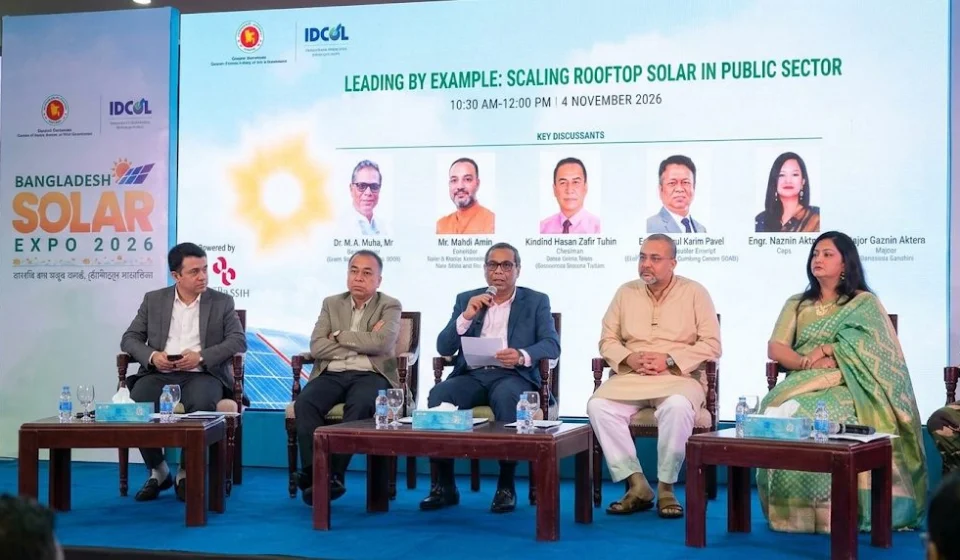
The state minister for health made the remarks today (Wednesday) at a panel discussion titled ‘Setting an example in expanding rooftop solar power in the public sector’ at the ‘Bangladesh Solar Expo’ at the China-Bangladesh Friendship Conference Centre in the capital.
The discussion was organised by the government’s Power Division and Infrastructure Development Company Limited (IDCOL).
Others who spoke on the panel included the Prime Minister’s Adviser (with the rank of state minister) Mahdi Amin, Barind Multipurpose Development Authority (BMDA) Chairman Agriculturist Md Hasan Zakir Tuhin, Power Division Secretary Mirana Mahrukh, IDCOL Head of Renewable Energy Enamul Karim Pavel and Solaric Director Engineer Naznin Akter.
State Minister for Health Dr Muhit said the government has around 15,000 healthcare centres across the country down to the grassroots level. Beyond these, there is a vast infrastructure of district sadar hospitals, medical colleges and specialised institutions. A large part of hospital work takes place during the daytime peak hours, which perfectly matches the hours of solar power generation. He said, ‘We are determined to reduce dependence on diesel and switch to eco-friendly solar power to protect operation theatres, emergency services, intensive care and the vaccine cold chain.’
According to him, structural audits and energy demand audits of all health infrastructure will be completed within the next six months to one year.
Calling on private entrepreneurs to invest in hospitals, Dr Muhit said hospitals cannot be shut even for a single day, so there is a full guarantee of electricity bill payment here. However, investors must ensure regular maintenance, use certified equipment to prevent fires and have security plans to prevent theft or damage of panels in remote areas.
The Prime Minister’s Adviser Mahdi Amin outlined plans for expanding green energy in educational institutions. He said, ‘The country has more than one lakh educational institutions, including schools, colleges, madrasas and universities. Within the next six months, a final list will be prepared after verifying which institutions have rooftops suitable for solar power and where surplus land is available.’
Mahdi Amin said work on implementing solar projects is already under way at more than 30 of the over 50 public universities.
In his view, backward linkage industries must be developed to become self-reliant in solar power. He said the education system is also being linked to that transformation to harness the demographic dividend and train young people as skilled workers in the sector.
Barind Multipurpose Development Authority (BMDA) Chairman Agriculturist Md Hasan Zakir Tuhin said around 17,000 irrigation pumps in the Barind region will be brought under a solar network within the next year. When the pumps are idle outside the dry season, 450 to 800 megawatts of electricity can be supplied from these panels to the national grid. This will save around Tk 150 crore in electricity bills a year.
Speaking about the potential of public infrastructure, IDCOL Head of Renewable Energy Enamul Karim Pavel said around 2,000 megawatts of solar power could be generated from the rooftops of government buildings alone. The government has already simplified the sector’s policies by issuing an ordinance. Under the OPEX model, 100 percent payment security and long-term financing on easy terms are also being arranged for private investors.
Speaking on behalf of private entrepreneurs, Solaric Director Engineer Naznin Akter said a stable and investment-friendly policy must be ensured, without frequent changes, to protect long-term investment. She also stressed avoiding the risk of load-shedding during peak solar generation hours in the daytime and easing bank guarantee conditions to attract international funds.
The event was moderated by Bangladesh Rural Electrification Board (REB) Chairman Major General Md Mahbubul Haque. People from various professions, including representatives of local and foreign organisations, solar sector entrepreneurs and businesspeople, top officials of the public and private sectors, investors and renewable energy experts, were present.
By the numbers
According to research by the Centre for Policy Dialogue (CPD), the country’s total installed renewable energy capacity is 1,745 megawatts, 83 percent of which is solar power; renewables account for only 5.39 percent of total installed power capacity — UNB reported this on 17 May.
The same research mentions the government’s target of generating 10,000 megawatts of electricity from solar sources by 2030.
Sources
Background sources: UNB, 17 May 2026