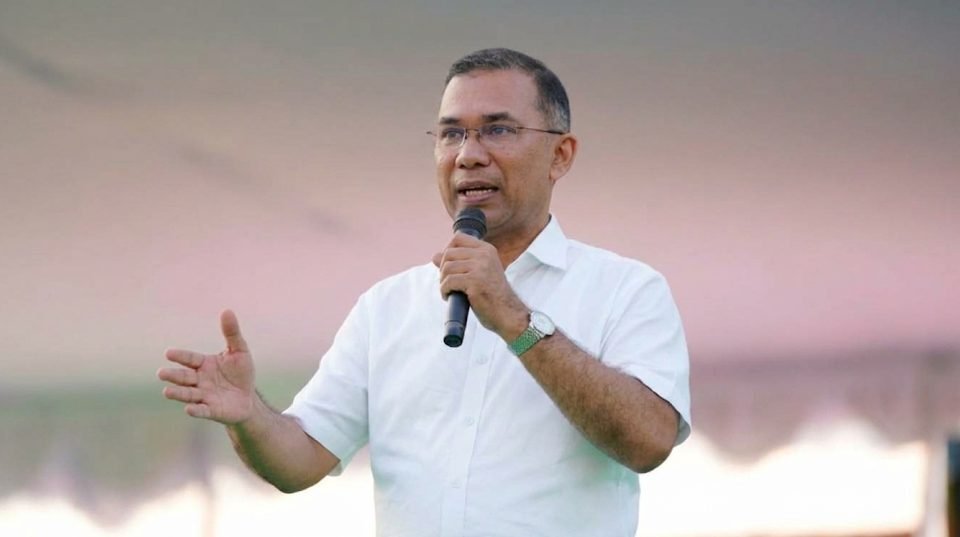

Photo: Collected
At a public rally held on Tuesday afternoon at the Madrasa Maath in Rajshahi, Prime Minister and BNP Chairman Tarique Rahman said cards would be placed in the hands of 40 lakh farmers across the country within this year. Referring to the incentives taken for sugarcane growers, he said, ‘We have arranged incentives so that from the coming season farmers face less hardship in sugarcane cultivation. Why were incentives given? Because the BNP believes that if this country’s agriculture survives, if the farmer survives — this country will survive.’
Recalling the pledges made at the time of the election, the Prime Minister said the BNP had promised that it would stand beside farmers if it could form the government; it had also been said that within seven days of forming the government, agricultural loans of up to Tk 10,000 would be waived along with interest. Accordingly, within seven days the agricultural loans of 13 lakh farmers, up to Tk 10,000, were waived along with interest.
Explaining what the card would be like, Tarique Rahman said, ‘We want to give our farmer brothers a card, which will be called the farmers’ card or agriculture card. Work on it has already begun. The work will be finished within the next few days. Then, step by step, we will try to get the cards to our farmer brothers. We will deliver cards to 40 lakh farmers this very year.’
Highlighting the benefits, the Prime Minister said an attempt would be made to provide fertiliser and seed for at least one crop, through the card, to farmers who grow two or three crops a year, so that their hardship is reduced. The card can be used to take out insurance and to obtain bank loans easily, and will even provide information on whether it will rain the next day; this will make it easier to decide on sowing seed or applying fertiliser.
20,000km of canals to be dug in five years
Noting that a canal-digging programme is under way across the country to ensure irrigation facilities for farmers, the Prime Minister said 20,000km of canals would be dug in five years; of this, 800km has been dug in eight months. This will give farmers irrigation facilities and also recharge groundwater. He said this northern region is the country’s granary. Just as there is a scarcity of water here, there is elsewhere too. The canal-digging programme had begun in the time of Shaheed Zia. This Barind project came into effect in the time of Shaheed Zia.
Tarique Rahman also spoke about the water crisis in the Padma and the Teesta. Saying that the Padma river is drying up, he said a decision had therefore been taken to build barrages on the Teesta and the Padma. Those who have created the water problem will be spoken to; the government will make the effort, however far it has to go, to secure Bangladesh’s share of water. At the same time, the work of building the barrages will be completed as quickly as possible.
Upazila hospitals to have 150 beds
The Prime Minister also announced the decision to raise the number of beds at upazila health complexes from 50 to 150 to ensure healthcare for rural people. He said the BNP is the people’s government; the decision to increase beds at every upazila health complex had therefore been taken with the people in mind. There are now 50-bed hospitals. Shaheed President Ziaur Rahman had made them 30 beds. He left 30 beds, and in 1991 Deshnetri Khaleda Zia added another 20 beds. Since the BNP has formed the government this time, we will upgrade every hospital from 50 beds to 150 beds.
The Prime Minister said, ‘We want to take healthcare to people’s doorsteps. We will keep beds for children. We will keep separate beds for mothers and sisters. We will arrange dialysis for kidney patients, so that they do not have to come this far.’ He also said that in the budget presented last June the cost of dialysis for kidney patients had been reduced and taxes on treatment equipment for heart patients had been cut. Equipment that previously cost heart patients Tk 1,20,000 has now come down to Tk 60,000 to Tk 65,000.
Move to reopen 46 closed factories by December
The Prime Minister said various businesspeople and entrepreneurs had been encouraged to reopen closed mills and factories. Six closed mills and factories have already been handed over to entrepreneurs so that they can start them up. Steps have been taken to reopen about 46 factories lying closed across the country by this December, with the aim of ending unemployment among workers.
Stressing the need to maintain an environment for business, trade and investment, Tarique Rahman said the BNP government is trying to improve security in the country and wants to reduce the curse of unemployment; local and foreign entrepreneurs are being encouraged to invest.
He alleged, however, that some political parties are trying to obstruct the government’s development work by creating disorder on the streets. The Prime Minister said, ‘If beds are not increased at upazila hospitals now, if mills and factories do not reopen, if canals are not dug, then who will suffer? My question is, if they want to take up a programme that harms the people, then have they become friends of the people? Is the canal-digging programme not the people’s programme?’
Free education for women up to honours level
On women’s education and women’s economic self-reliance, the Prime Minister said Deshnetri Khaleda Zia had arranged free education up to intermediate level; this time the BNP government has decided on free education up to honours level. Alongside this, arrangements will also be made to give stipends to students who study well.
Speaking of the plan to provide a family card to make women economically self-reliant, he said financial support would be given to families every month through this card. This will allow them to arrange good food for their children, meet urgent needs and make small investments. Tarique Rahman said, ‘We want to make a family self-reliant under the mother’s leadership. In this way a village, a union, an upazila, a district, a division and finally Bangladesh will become self-reliant.’
In his speech the Prime Minister also mentioned the BNP’s tree-planting programme. He remarked that everyone must stay united so that no one can obstruct the process of changing the fortunes of the country’s people.
In the Prime Minister’s words, ‘No one will come from abroad and build our country for us. We will have to build it ourselves through hard work. We will have to build this country of ours through the hard work of the 40 crore hands of 20 crore people.’
Noting that the people’s support is the strength of the BNP government, the Prime Minister called on everyone to stay united to keep this process of changing fortunes going.
The rally was presided over by BNP acting secretary general Ruhul Kabir Rizvi. Conducted by Rajshahi City Corporation administrator Mahfuzur Rahman Riton, it was addressed by party standing committee member Gayeshwar Chandra Roy, Land Minister Mizanur Rahman Minu, Commerce Minister Khandaker Abdul Muktadir, Cultural Affairs Minister Nitai Roy Chowdhury, MP Abu Sayeed Chand, Professor Nazrul Islam Mondal, Shafiqul Haque Milon, Dhaka district BNP general secretary Nipun Roy Chowdhury and the party chairman’s adviser Major General (retd) Sharif Uddin, among others.
Also present were State Minister for Local Government Mir Shahe Alam; Rehan Asif Asad, adviser to the Ministry of Posts, Telecommunications and Information Technology and the Ministry of Science and Technology; BNP industry affairs secretary Abul Kalam MP; reserved women’s seat MP Mahmuda Habiba; and Krishak Dal president agriculturist Hasan Jafir Tuhin, among others.
Background
The farmers’ card plan is not new. According to information from the Department of Agricultural Extension, a target had been set to get the card into the hands of 1 crore 65 lakh farmers over four years, and the initial cost had been put at Tk 681 crore — Prothom Alo reported this on 22 March 2026. In that report, State Minister for Agriculture Sultan Salauddin Tuku had said the card would make it easier to receive incentives, allowances and subsidies; the programme had been planned to launch on Pahela Baishakh.
The decision to waive agricultural loans was taken last February. According to Cabinet Secretary Nasimul Ghani, the cabinet meeting held on 26 February 2026 decided to waive loans of up to Tk 10,000, along with interest, for farmers in the crop, fisheries and livestock sectors — Amar Barta reported this on 26 February 2026.
The numbers
According to Bangladesh Bank’s accounts, as of 25 February 2026 the banks’ dues from farmers in this category stood at about Tk 1,550 crore including interest, and about 12 lakh farmers were expected to benefit directly from the decision — Amar Barta reported this on 26 February 2026. The Prime Minister said today that in the end the loans of 13 lakh farmers were waived.
The 40 lakh cards announced for this year are part of the overall target; the Department of Agricultural Extension’s four-year plan had put the total figure at 1 crore 65 lakh — Prothom Alo reported this on 22 March 2026.
At a glance
The farmers’ card is an integrated card for a farmer’s identity and access to services. According to Prothom Alo’s report of 22 March 2026, cardholders were initially to be given 10 kinds of benefit — agricultural inputs at fair prices, government subsidies, government incentives, irrigation at fair prices, agricultural loans on easy terms, crop insurance, sale of produce at fair prices, agricultural training, weather information, and advice on controlling diseases and pests. Fish farmers and livestock farmers are also to come under the card.
Sources
Background sources: Prothom Alo, 22 March 2026; Amar Barta, 26 February 2026, Ajker Patrika