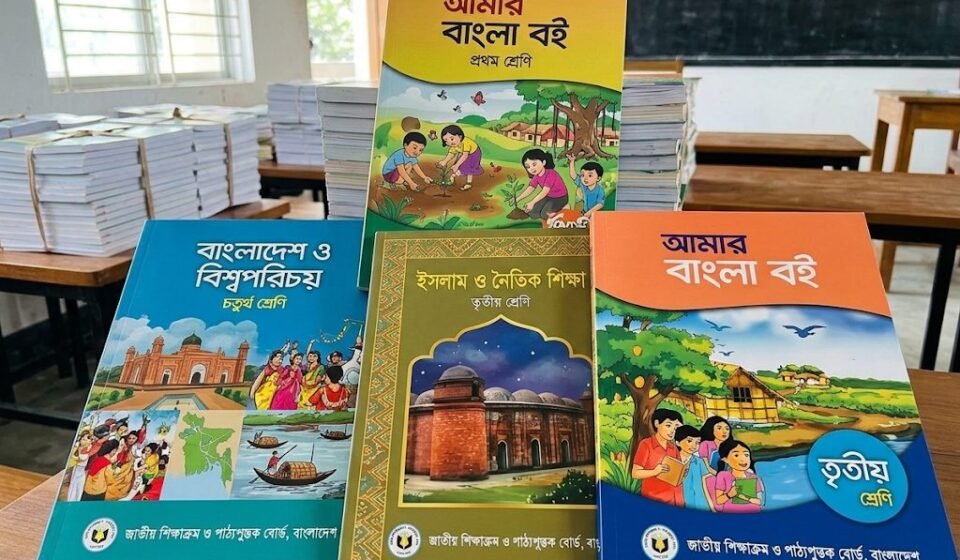
All textbooks to reach upazilas by 30 November, nearly 93 per cent of primary books printed

Photo: Collected
The government wants to hand revised new textbooks to nearly four crore students across the country before the 2027 academic year begins. The National Curriculum and Textbook Board (NCTB) is continuing its supervision to deliver 100 per cent quality, attractive books for all classes from pre-primary to secondary to the upazila level by 30 November.
The organisation’s latest assessment report says printing and binding of books at the pre-primary and primary levels has neared 100 per cent. Printing progress for Ebtedayee and secondary combined has crossed 57 per cent. However, although printing of Class VIII and Class IX-X books has begun at some presses, it has not yet started at most of them.
According to the NCTB, presses that received work for both primary and secondary books have finished the primary books and started printing secondary books in full swing. Most of these are Ebtedayee, Class VI, VII and VIII books. Formes for Class VIII, IX and X books are also being printed at some presses.
The NCTB said 113 printing firms across the country received textbook printing work in a total of 623 lots this time. A total of 30 crore 771 lakh 98 thousand 101 books will be printed for the pre-primary, primary and secondary (Ebtedayee, Dakhil, vocational and technical) levels. These include books for students from small ethnic communities and visually impaired students. Printing began a month earlier this time than last year.
Level-wise picture of textbook printing
According to the NCTB report of 28 October, printing at the pre-primary and primary levels is almost 100 per cent, which is satisfactory under the contracts. Of the total 57 lakh 30 thousand 640 pre-primary books, 56 lakh 28 thousand 153 (98.21 per cent) have been printed. Pre-delivery inspection (PDI) has been carried out on 50 lakh 70 thousand 240 (88.48 per cent) books at this level.
At the primary (Class I-V) level, of a total of 7 crore 60 lakh 97 thousand 96 books, printing of 6 crore 66 lakh 29 thousand 173 (87.67 per cent) has been completed, and PDI has been done on 5 crore 91 lakh 17 thousand 889 (77.79 per cent) books. That means an average of 92.94 per cent of books have been printed for pre-primary and primary combined.
Tenders for Ebtedayee books were invited together with the secondary level. As of 28 October, of a total of 4 crore 16 lakh 39 thousand 574 books at the Ebtedayee (Class I-V) level, 2 crore 67 lakh 10 thousand 784 (64.15 per cent) have been printed. PDI, by contrast, has been done on 2 crore 12 lakh 81 thousand 422 (51.11 per cent) books.
At the secondary (Class VI-X) level, of a total of 17 crore 95 lakh 43 thousand 18 books, 9 crore 18 lakh 17 thousand 56 (51.18 per cent) have been printed, and PDI has been done on 6 crore 64 lakh 64 thousand 35 (37.05 per cent) books. An average of 57.66 per cent of books have been printed for Ebtedayee and secondary combined; the NCTB is now supervising book quality and printing with top priority.
In this regard, NCTB Chairman Professor Mohammad Fakhrul Maula told BSS, ‘More than 90 per cent of printing of pre-primary and primary books has been completed. More than half of the work on Ebtedayee and Class VI and VII secondary books has also been completed. However, as the pace of work on Class VIII and IX-X is somewhat slow, monitoring has been further strengthened. Work has slowed somewhat as tenders were re-invited for several lots at this level.’
He added, ‘Thirty-two presses have been served show-cause notices for slow progress. If necessary, the work of lagging presses will be cancelled and assigned to other presses to coordinate the work. To maintain book quality and targets, several teams are monitoring round the clock in the field from 9am to 5pm and from evening until late at night.’
He expressed hope that, in line with the government’s decision, quality books will reach students within the set time.
The NCTB said work is under way to deliver all pre-primary and primary books and 50 per cent of secondary-level books to various upazilas of the country. The government’s goal is to ensure the supply of 100 per cent quality books to every upazila by 30 November.
Substandard formes and books rejected, monitoring to maintain quality
The education administration has taken a tough stance this time to ensure transparency in the printing process and maintain book quality. A total of 53 monitoring teams of the NCTB and the education ministry are working in the field to check the quality of books printed at presses in Dhaka and elsewhere in the country. Substandard formes and books from various presses have already been rejected for failing to meet standards.
According to the NCTB monitoring report, substandard and defective formes, books and covers have been destroyed at various printing presses in line with the standards. A total of 9 lakh formes and 12 thousand substandard printed books from 36 presses have been rejected.
In this regard, the NCTB chairman told BSS, ‘The government is taking a tough stance on book quality this time. We have rejected nine and a half lakh substandard formes and around 12 thousand books for failing to maintain quality. We are committed to delivering 100 per cent quality, flawless books to the upazilas by 30 November.’
The monitoring report also said several firms have made little progress in printing secondary-level (Class VIII and IX-X) books. Although under the contracts 50 per cent of Class VIII and IX-X books were supposed to reach the upazila level by 3 November, there had been no progress as of 27 October. NCTB officials said lagging presses have been urged to speed up their work within the set time.
NCTB Member (Textbook) Professor Mohammad Abu Naser Tuku told BSS, ‘Work is proceeding according to the roadmap to deliver books to students on time. Work on primary-level books will be 98 to 99 per cent complete within this month. And more than 95 per cent of secondary books will be delivered by 30 November. As pre-primary and primary work is almost at the final stage, there will be no complications in supplying books in the field.’
He added that although there was scope for irregularities at presses and in the field in the past, this time the district and upazila education officers concerned and heads of institutions have been given direct responsibility for checking quality when receiving books. If any deviation in quality is found after the books are received, the receiving officer will also face punishment.
On the overall matter, Education and Primary and Mass Education Minister Dr A N M Ehsanul Hoque Milon told BSS, ‘Supply of any books printed on substandard paper to the upazila level will not be tolerated. The government has set reasonable prices after checking market rates, so that no one gets the chance to produce substandard books on the pretext of low prices. This time no one will be spared if they fail to supply quality books within the set time.’
Background
According to a Prothom Alo report of 17 December 2025, nearly 67 per cent of secondary textbooks had not been supplied even about two weeks before the start of the 2026 academic year; the cancellation of tenders for Class VI to VIII books followed by fresh tenders, delays in approval and contracts, and a paper shortage were cited as the reasons.
By the numbers
According to the same report, more than 8 crore 59 lakh free textbooks were printed for primary and more than 21 crore 43 lakh for secondary for the 2026 academic year. As of 14 December 2025, about 33.06 per cent of secondary books had been supplied.
Sources
Background sources: Prothom Alo, 17 December 2025