
Photo: Collected
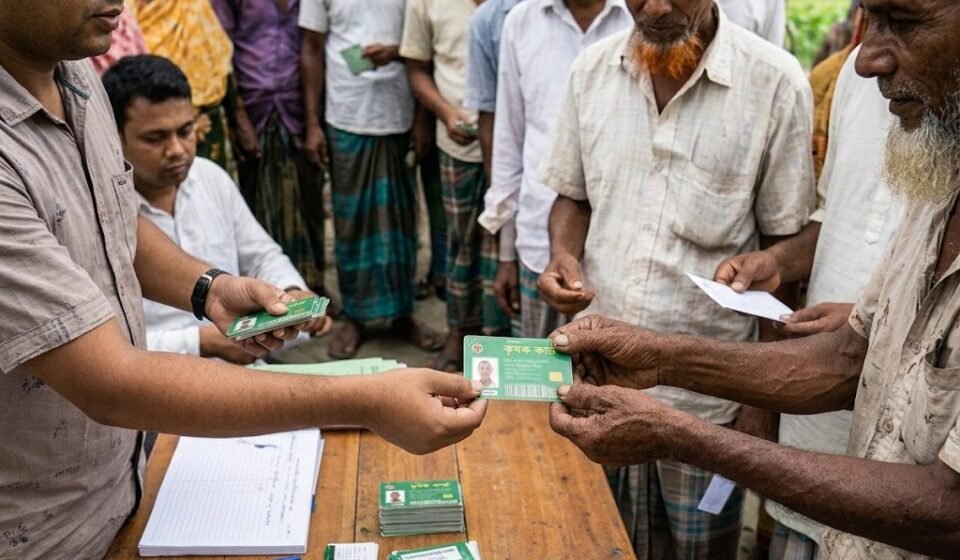
The BNP government led by Prime Minister Tarique Rahman wants to bring about 2 crore 40 lakh farmers under the farmer card scheme within the next four years. This large-scale programme, covering farmer registration and farm input support as well as phased distribution of cards across the country, is now being implemented.
Work is under way to bring 43 lakh farmers under the card scheme in the current 2026-27 fiscal year alone. According to the plan, the programme will proceed on the basis of a total of 14,180 agricultural blocks in 503 upazilas of the country’s 64 districts.
Collecting farmers’ data, opening bank accounts, distributing cards through pre-piloting and providing farm input support have already begun. The aim of the programme is to build an integrated database of farmers and to deliver financial and input support to them. In the first phase, landless, marginal and small farmers are receiving special attention.
There are plans to gradually bring all districts, upazilas and agricultural blocks of the country under it. Relevant data show that so far data collection has progressed in 1,681 agricultural blocks in 503 upazilas of 64 districts. Data on 19 lakh 25 thousand farmers have been collected from these blocks. Nine lakh bank accounts have been opened for the farmer card.
Data collection and account opening are being considered key parts of the programme’s initial implementation. Card distribution will then be expanded step by step.
To test the implementation method, pre-piloting was carried out from March to June this year. At that time, 20,832 farmers in 11 agricultural blocks in 11 upazilas of 10 districts across eight divisions received cards. The pre-piloting was formally inaugurated in Tangail Sadar upazila on the first day of the Bangla New Year, 14 April 2026; work then went on in the selected areas.
In this phase, 20,480 landless, marginal and small farmers received financial incentives. At a rate of Tk 2,500 per person per year, a total of Tk 5 crore 12 lakh was distributed.
Drawing on that experience, an initiative was taken to extend the programme to a wider area. On 1 October 2026, activities were inaugurated virtually in 77 upazilas of 56 districts at the same time. As one agricultural block was chosen from each upazila, a total of 77 blocks were added in this phase.
In this phase, there is an initiative to cover 1 lakh 10 thousand 165 farmers, of whom 7,643 are farmers from six upazilas of Feni district. Along with expanding the cards, there are plans to provide input support in selected areas, where landless, marginal and small farmers are getting priority. According to programme data, 1 lakh 47 farmers are on the input support list in this phase: 7,153 from six upazilas of Feni and 92,894 from the other 55 districts.
The programme is not being launched in all agricultural blocks at once; it will be expanded in phases. Initially, 7,643 cards will be given to farmers in six agricultural blocks in six upazilas of Feni district. Under this plan, all 64 districts, 503 upazilas and 14,180 agricultural blocks are eventually supposed to come under the programme.
Adding about 2 crore 40 lakh farmers in four years will require collecting and managing data on a huge number of farmers. That is why it is essential to keep a regular watch on progress in data collection, registration, bank account opening and card distribution. Up-to-date figures on registration, card distribution, account opening and input support will also play a major role in understanding how far the current fiscal year’s target of 43 lakh has progressed.
Efforts are under way to take the programme nationwide by using the experience of the initial phase and expanding card distribution in line with the banks’ capacity.
A major share of field-level implementation is being carried out by the Program on Agricultural and Rural Transformation for Nutrition, Entrepreneurship and Resilience in Bangladesh (PARTNER) project. The project’s Deputy Programme Director (DPD), Md Rakibuzzaman Khan, told state news agency BSS that primary data collection is under way to obtain accurate information on farmers, understand their needs and support the modernisation of agriculture.
He said there are some challenges because farmers’ needs change from season to season. However, once a reliable database is in place, it will be easier to take initiatives for training, modern farm technology, raising productivity and creating agricultural entrepreneurs as needed.
According to Rakibuzzaman Khan, data on 22 thousand farmers have already been collected. If data and work are coordinated with the farmer card programme, farmers can be brought under various agricultural services, and government initiatives in the field will also become more effective.
In the words of Md Yasin, additional secretary of the farmer card cell at the agriculture ministry, the main aim of the programme is to store accurate information on farmers and to make the process of delivering government support to them simple and effective. To that end, data collection, verification, bank account opening and phased card distribution are all being carried out in a coordinated way.
Agriculture Secretary Md Selim Khan said the farmer card is an important initiative to bring the country’s farmers into an integrated database. It will make it possible to identify genuine farmers, deliver inputs and financial support to them as needed, and make agricultural services more orderly.
The secretary said the agriculture- and farmer-friendly prime minister has introduced the ‘farmer card’ for the welfare of farmers. Following the prime minister’s directives and instructions, 2 crore 40 lakh farmers will be given the card within the next four years.
According to Selim Khan, cardholding farmers will receive a total of 10 services. These include low-interest farm loans, irrigation, fertiliser, seed, incentives, crop insurance, weather information and advice on pesticides.
The farmer card reflects giving farmers the respect they deserve and shows that the government and the state stand by them.
Background
According to a Prothom Alo report of 6 February 2026, BNP Chairman Tarique Rahman announced the party’s election manifesto that day at the Sonargaon Hotel in the capital; the second pledge was the ‘farmer card’. It said the card would give farmers subsidies, loans on easy terms, crop insurance and marketing facilities under state management.
After an inter-ministerial meeting chaired by the prime minister at the Secretariat on 23 February 2026, Information Minister Zahir Uddin Swapan said farmer cards would be distributed quickly as a pilot project modelled on the family card, The Daily Star Bangla reported that day.
According to the prime minister’s additional press secretary Atiqur Rahman Rumon, a decision had been made to inaugurate the programme on Pahela Baishakh, and there was initially a plan for a subsidy of about Tk 2,500 for marginal, landless and small farmers, The Daily Star Bangla reported in a UNB report published on 15 March 2026.
By the numbers
According to a Prothom Alo report of 11 October 2023, a plan was announced at the time to give ‘farmer smart cards’ to 2 crore 27 lakh 53 thousand 321 farming families under the PARTNER project.
At a glance
According to that 2023 Prothom Alo report, the total cost of the PARTNER project is Tk 6,910 crore; of this, the World Bank is providing Tk 5,300 crore, IFAD Tk 500 crore and the government about Tk 1,151 crore. The project runs from July 2023 to June 2028, covering 495 upazilas in 64 districts.
Sources
Background sources: Prothom Alo, 6 February 2026; The Daily Star Bangla, 23 February 2026; The Daily Star Bangla, 15 March 2026; Prothom Alo, 11 October 2023