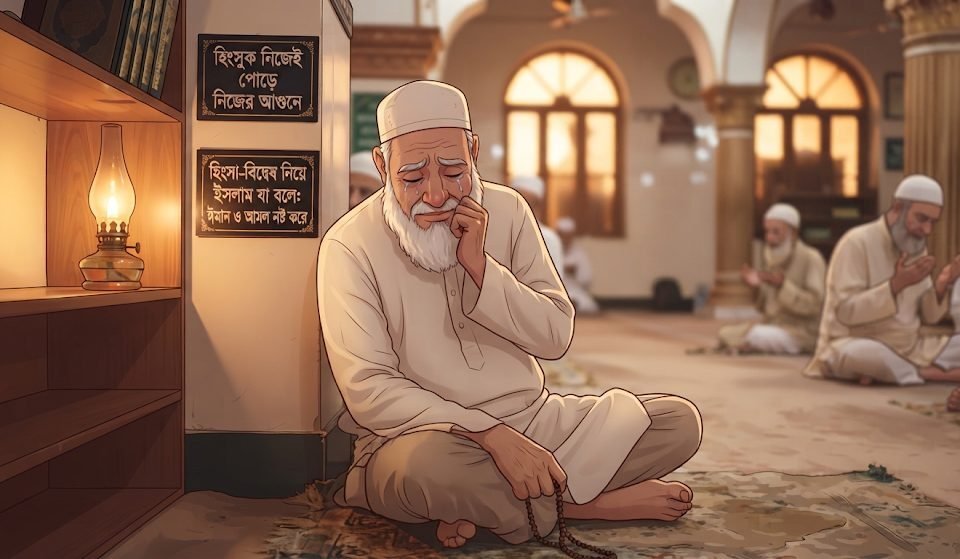

Photo: Collected
There is no such thing as ease in the life of an envious and malicious person, under any circumstances. He finds no sincere friend, and despair works in his mind all the time. His heart is like a blazing pit of fire, from which sparks of plotting and conspiracy, deceit and falsehood fly out constantly. He always thinks himself the victor, yet he is the most defeated of all. He thinks himself a hero, yet he is also the greatest coward.
What is envy
To wish for the destruction of a blessing that Almighty Allah has given to another, and to feel pain at not having received it oneself, is what is called envy. Malice follows on the heels of envy; a person then keeps wishing ill on that individual all the time. For example, about the conduct of the hypocrites towards the believers, Allah says, ‘If any good touches you, it displeases them. And if any harm befalls you, they rejoice at it.’ (Surah Al Imran, verse 120)
In some people envy is ingrained, almost like a trait of character. They consider themselves entitled everywhere, and yet see themselves as the wronged ones. But they pay no heed to the blessings Allah has given them; nor is there any gratitude for those blessings.
To be safe from the harm of such people, one must recite Surah Falaq and Surah Nas every day and seek refuge with Allah. The Holy Quran says: ‘And (I seek refuge) from the evil of the envier when he envies.’ (Surah Falaq, verse 5)
Burnt to ashes in the fire of envy
Before killing another, envy and malice kill the person himself. Almighty Allah says, ‘… Say: Die in your rage! Surely Allah is fully aware of what is hidden in the hearts.’ (Surah Al Imran, verse 119)
Almighty Allah has made people higher and lower than one another in talent, strength, wealth and status in order to test them. So it is the duty of a Muslim to wish others well and not to keep the stain of envy towards anyone in the heart. If it does ever arise, let it vanish like a bubble and slide away like water off a taro leaf.
The Prophet (PBUH) said, ‘Do not cut yourselves off from one another, do not keep after one another, do not harbour envy and malice towards one another; rather, become servants of Allah and become brothers to one another.’ (Tirmidhi, hadith 1935)
A cow does not die just because a vulture absorbed in its own thoughts wishes it; in the same way, the envy of the envious cannot snatch away anyone’s blessing. When someone ignores the envy and keeps moving forward, the fire of envy only grows. And it is the envious person himself who keeps burning to ashes in that fire; his deeds too are laid waste. The Prophet (PBUH) said, ‘Keep away from envy. For envy devours good deeds just as fire devours firewood (or grass).’ (Abu Dawud, hadith 4905)
A blow to self-interest and excessive greed make people envious
People become envious when their self-interest is hurt, and sometimes out of excessive greed. A few examples:
(a) At the beginning of creation, Satan burned with envy on seeing the high honour of Adam (AS). When told to prostrate in respect to Adam (AS), he refused and, offering a false argument, said, ‘I am made of fire and Adam is made of clay. Therefore, fire can never prostrate to clay.’ Displaying envy and arrogance in this way, he refused to obey Allah’s command; as a result he was banished from Paradise for ever.
(b) In the same way, Qabil, the son of Adam (AS), failing to get the woman he desired, killed his brother Habil out of envy.
(c) The Jews believed that the last prophet would come from their lineage. When that did not happen, they became enraged and were envious of the Prophet. Almighty Allah says, ‘Many among the People of the Book wish to turn you back to disbelief after you have believed, even after the truth has become clear to them, purely out of malice.’ (Surah Baqarah, verse 109)
(d) Even after acknowledging the last prophet Muhammad (PBUH) to be truthful, Abu Jahl did not accept him, for fear of losing leadership. The Prophet (PBUH) was born not in the Banu Makhzum clan (Abu Jahl’s clan) but in the Banu Hashim clan; for this reason he burned to death in the fire of envy.
(e) Prophet Yusuf (AS) was a victim of his brothers’ envy. On hearing the account of the dream Yusuf (AS) had seen in his childhood, his father became deeply attached to him and, out of an unknown fear, kept him before his eyes at all times. At this, his half-brothers burned with envy towards him and decided to kill the child Yusuf. Surah Yusuf was revealed in the Holy Quran on this subject.
Ways to be safe from the envious
First, to seek Allah’s refuge and to recite often the supplications narrated in the Quran and hadith. Along with the practice of reciting Surah Falaq and Surah Nas, this supplication from the Quran may also be recited: ‘Our Lord! Forgive us and those brothers of ours who believed before us. And do not place in our hearts any malice against the believers. Our Lord! Surely You are kind and merciful.’ (Surah Hashr, verse 10)
Second, to resist if one has the power. For example, the Messenger (PBUH) took steps against the Jewish tribes of Madinah and in the end expelled them from Madinah.
Third, to make the truth known, to avoid the envious person or group and to leave the matter of their punishment to Allah. For example, about the envious Jews, Almighty Allah says, ‘Forgive them and overlook, until Allah gives His (final) command. Surely Allah has power over all things.’ (Surah Baqarah, verse 109)
May Allah grant everyone good sense. Ameen.