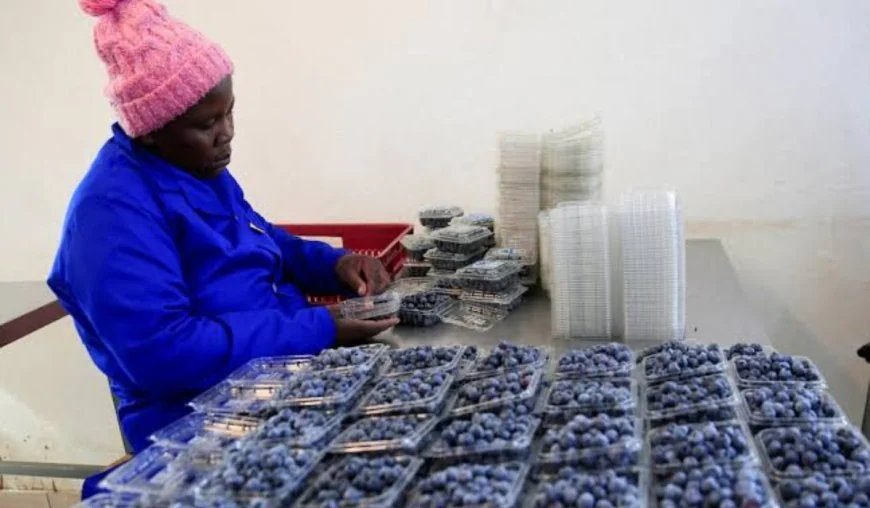

Photo: Collected
In the morning sun, several women were working with quick hands between rows upon rows of bushes. They were picking blueberries for Zimbabwe’s export market. As a result of a new trade deal with China, this market is now open to them.
Managers of the Forrester Estates farm, located about 100 kilometres north of the capital Harare, want to more than double the land under blueberry cultivation to 50 hectares next year. The plan is meant to take advantage of the growing demand in China. News agency AFP reported this from Mvurwi, Zimbabwe.
Farm manager Albert Chakala told AFP, ‘Financing is the problem.’ Zimbabwe exported blueberries to China for the first time last July, after a plant health agreement signed a year ago and China’s withdrawal in May of tariffs on imports from 53 African countries.
Chakala said, ‘The production we are having is not enough to meet the market’s demand.’ He said every hectare of new blueberry orchard requires an investment of $50,000 to $55,000 at the very outset, mainly for irrigation, saplings and building other infrastructure.
The Horticultural Development Council (HDC), which represents growers and exporters, has said the lack of access to affordable financing is one of the biggest obstacles to many Zimbabwean farmers increasing production.
There is an acute tension between the prospects of the new global market and Zimbabwe’s ongoing financial reality. Because of the foreign currency crisis in the country, farmers often cannot arrange the money needed to increase production enough to meet demand.
Chakala said, ‘We are expanding slowly. We are doing it on the basis of the money we are getting back from selling the produce.’
Zimbabwe’s blueberries are already going to the markets of Europe, the United Kingdom and the Middle East. But China, one of the world’s largest blueberry consumers, has now emerged as a big new market. The market for this fruit, widely promoted for its health benefits, has created the prospect of major change for farmers able to expand the scale of cultivation.
‘Big concern’ over financing
According to HDC data, Zimbabwe is Africa’s third-largest blueberry-producing country after Morocco and South Africa. It is also one of the world’s fastest-growing blueberry producer countries.
HDC Chief Executive Officer Linda Nielsen said in a statement in June that the sector expects to export about 12,000 tonnes of blueberries from about 850 hectares of land this year. Last year, production was 9,500 tonnes from 650 hectares of land.
Nielsen said that, to increase production by taking advantage of China’s huge demand, the sector is in talks with the government on more competitive export financing and specific tax benefits for investment in irrigation, solar power and cold storage systems. She said, ‘The lack of adequate financing is a matter of big concern for growers.’
Clarence Mwale, chairman of Zimbabwe’s Export Produce Growers Association, said most of the country’s commercial blueberry producers are white farmers whose families have been engaged in farming for many years.
He told AFP, ‘With the opening of new markets like China, an opportunity has also been created for local farmers to grow crops like blueberries.’ But he believes low-cost, long-term capital must be arranged for this.
Mwale said, ‘If we can bring in foreign direct investment, foreign funds, foreign loans and long-term financing, then it will be possible to talk about creating better opportunities for new farmers.’ Referring to the high interest rates on bank loans, he said, ‘Money is indeed available locally at present, but it is very expensive.’
Zimbabwe is Africa’s top country in tobacco production. For decades, tobacco has been the country’s main agricultural export. According to the tobacco board’s data, 3,55,000 tonnes of tobacco were produced in the country in 2025. As with Zimbabwe’s vast lithium and chromium ore, China is the biggest buyer of its tobacco too.
Blueberry production is still far lower than that of tobacco. But Mwale believes the prospect of China’s huge market could attract a new generation of farmers to this sector. He said, ‘My aim is to encourage more young people into blueberry farming and move them away from tobacco farming. I think this is an opportunity we can use to move towards a healthier crop instead of tobacco.’